Dubai off-plan payments: when escrow, SPA and Oqood records align (2026)
 Lida Moghaddam
Disclaimer: This article is for general informational purposes only. It is based on cited public data and published under Lida Moghaddam's RERA-licensed masthead. It is not financial, legal, or investment advice. Dubai's property market moves quickly, so figures, yields, and rules may change or become outdated by the time you read this. Verify current information with the relevant authority or a qualified professional before acting. Read the full disclaimer.
Table of contents
Dubai Land Department's current initial-sale service says the signed sale and purchase agreement must enter the provisional register within 90 days of signing (DLD, as of 27 September 2026). That clock does not begin with a reservation payment, and the resulting Oqood e-certificate records the off-plan sale rather than certifying each instalment.
The four records answer four different questions
The useful distinction is not “payment made” versus “payment missing.” It is which document can establish each fact.
DLD describes the initial-sale service as the route for a developer to register off-plan units, or land whose value is not fully paid, in the provisional register. The required documents include the signed SPA, and the issued document is a provisional registration e-certificate (DLD, as of 27 September 2026). The service page does not describe the e-certificate as a statement of instalments.

This article is a document workflow beneath the wider Dubai property investment route guide. The pillar compares entry routes. This companion stays with the evidence created between reservation and provisional registration.
Follow the payment trail in order
The strongest overseas-buyer file is one in which the names and references agree before the amounts are interpreted.
Read the reservation form
Copy the unit reference, proposed price, payment amount, beneficiary, expiry wording and any clause dealing with credit into a later SPA. Treat only the exact signed version as evidence of those reservation terms. The reservation-form companion explains why the form and receipt need separate rows.
Match the project and escrow fields
Search DLD's Project Status Enquiry by the exact project name or project number. The current screen exposes the project number, registered and completion fields, developer name and number, bank name and escrow field (DLD Project Status Enquiry, as of 27 September 2026). Compare those fields with the payment instruction rather than relying on a shortened marketing name.
Read the signed SPA schedule
Identify the sale price, the treatment of any booking amount, the first instalment trigger, its due date or milestone, and the payment destination. A receipt shows a payment event. The SPA states whether that event satisfies the named obligation.
Retain the DLD output
The developer submits the initial-sale application through Oqood. DLD says the purchaser receives the provisional registration e-certificate by email. Reconcile its buyer and unit details with the signed SPA (DLD, as of 27 September 2026).
The separate project escrow verification route goes deeper on matching the project, registered developer, bank and escrow fields. That official match is one layer. The SPA remains the source for the buyer's particular instalment schedule.
The 90-day clock starts at the signed SPA
DLD publishes a contract-to-registration term, not a universal reservation-to-registration deadline.
The current initial-sale service says the developer and purchaser must sign the SPA and that the contract must be registered in the provisional register within 90 days from the signing date (DLD, as of 27 September 2026). On the same page, DLD lists the service time as one business day. These are not the same period: the service time describes DLD's listed processing time, while the 90-day term concerns when the signed contract reaches the provisional register.
The current DLD page does not publish a single clock beginning on the reservation-form date. A reservation may precede the SPA, but the duration of that interval has to come from the actual form, correspondence and signing history. That is why “reservation paid” cannot be converted into a universal Oqood due date.
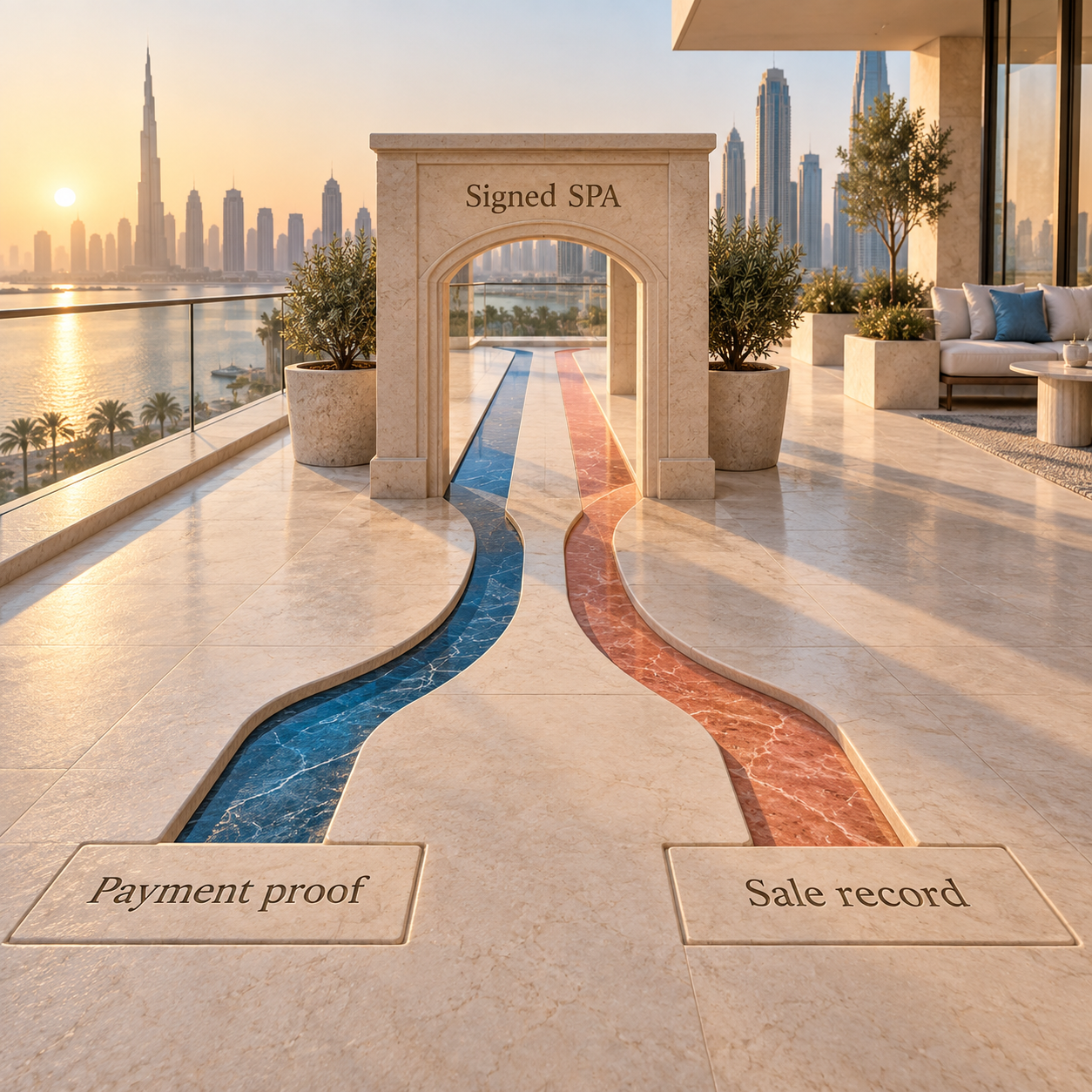
One invented illustration shows where the records separate
This illustration is wholly invented. The dates, amounts and percentage are not taken from a project, developer, buyer file or market practice.
Assume an invented AED 2,000,000 price, an invented AED 50,000 reservation payment on 5 October 2026, and an invented SPA signed on 20 October 2026. Assume the invented SPA sets its first instalment at 10% and expressly credits the reservation amount against it.
The arithmetic cannot create the legal link between the first two payments. The invented AED 150,000 top-up works only because this invented SPA expressly credits the AED 50,000 booking amount. If the actual documents use different wording, the calculation changes with them.
Nor does the 18 January 2027 line mean an instalment becomes “registered” on that date. The DLD service establishes the provisional registration of the sale. Payment status still comes from the contract, receipts and account records.
Escrow establishes a project-account framework, not every outcome
Escrow answers where project money is held and regulated. It does not answer every commercial or contractual question around a purchase.
Dubai's Law No. 8 of 2007 defines the escrow account as the project bank account into which payments by off-plan purchasers or project financiers are deposited. It also says each project has a separate escrow account, that the account is dedicated to that development, and that depositors may access their own accounting records (Dubai legislation, checked 27 September 2026).
DLD's current FAQ uses the same project-account framing and says the law applies to developers selling off-plan units and receiving payments from buyers or financiers (DLD FAQ, as of 27 September 2026).
A bank confirmation or developer receipt still needs to be read narrowly. It can show the beneficiary, amount, date and reference printed on that record. Matching it to the official project bank and escrow fields strengthens the identity trail. It does not establish that the purchase price fits the buyer, that construction is complete, that a return will be achieved, or that DLD has registered the sale.
The narrow off-plan versus ready distinction is the registry output
For this workflow, off-plan and ready property lead to different DLD outputs because they sit at different property stages.
DLD's initial-sale route covers an off-plan unit whose value has not been fully paid and issues a provisional registration e-certificate. DLD's completed-property sale service covers land, property or a completed unit and lists an electronic title deed among its outputs (DLD initial-sale service; DLD property-sale service, both checked 27 September 2026).
That does not make one route universally stronger. It explains the document difference an overseas buyer has to plan around. The best fit for staged off-plan cash is a file where the reservation terms, project escrow identity, SPA schedule, receipts and DLD provisional record all reconcile. A ready-property buyer follows the completed-sale registration route and receives the title output named by that service.
Keep one evidence question for each record
The clean file is a set of separate answers, not a pile of documents carrying the same label.
For an overseas buyer, this record-by-record method is the strongest match when the file may need to be checked by a licensed agent, lawyer, bank or auditor without relying on a sales conversation. It explains the evidence. It does not decide the investment on the buyer's behalf.
What does off-plan property mean in Dubai?
For this workflow, it means a unit sold before completion under the development and registration framework. Law No. 8 of 2007 applies to developers selling units off-plan and receiving payments from purchasers or project financiers (Dubai legislation, checked 27 September 2026).
Is it worth buying off-plan in Dubai?
The records do not answer that universally. Off-plan is the closer fit for a buyer whose cash timing can follow the actual SPA schedule and who can maintain the reservation, payment, escrow and provisional-registration evidence through completion. Price fit and return assumptions need their own sourced analysis.
Can a non-resident buy off-plan property in Dubai?
DLD's current initial-sale service lists a valid passport for non-residents among the required individual documents. The same page says the signed SPA is required and the developer submits the provisional-sale registration through Oqood (DLD, as of 27 September 2026).
Lida MoghaddamArchitect-turned-real-estate-specialist based in Dubai. She helps buyers, sellers, and investors read property with a designer's eye — structure, location, and long-term value.