Ready-property cash-flow calendar: reservation to first rent
 Lida Moghaddam
Disclaimer: This article is for general informational purposes only. It is based on cited public data and published under Lida Moghaddam's RERA-licensed masthead. It is not financial, legal, or investment advice. Dubai's property market moves quickly, so figures, yields, and rules may change or become outdated by the time you read this. Verify current information with the relevant authority or a qualified professional before acting. Read the full disclaimer.
Table of contents
On a hypothetical AED 1.5 million completed home, the Dubai Land Department's Property Sale Registration page, verified 19 September 2026, assigns AED 30,000 of the transfer fee to the buyer and AED 30,000 to the seller, before the contract reallocates anything. The cash calendar begins earlier with a conditional Form F security cheque and ends later than the title deed, when the first rent payment has cleared rather than merely become due.
The cash calendar changes when the evidence changes
The cleanest calendar ties every movement of money to a signed contract, official receipt, registered record or cleared bank entry. A verbal reservation, a cheque in a file and a rent instalment written into a lease are not the same cash event.
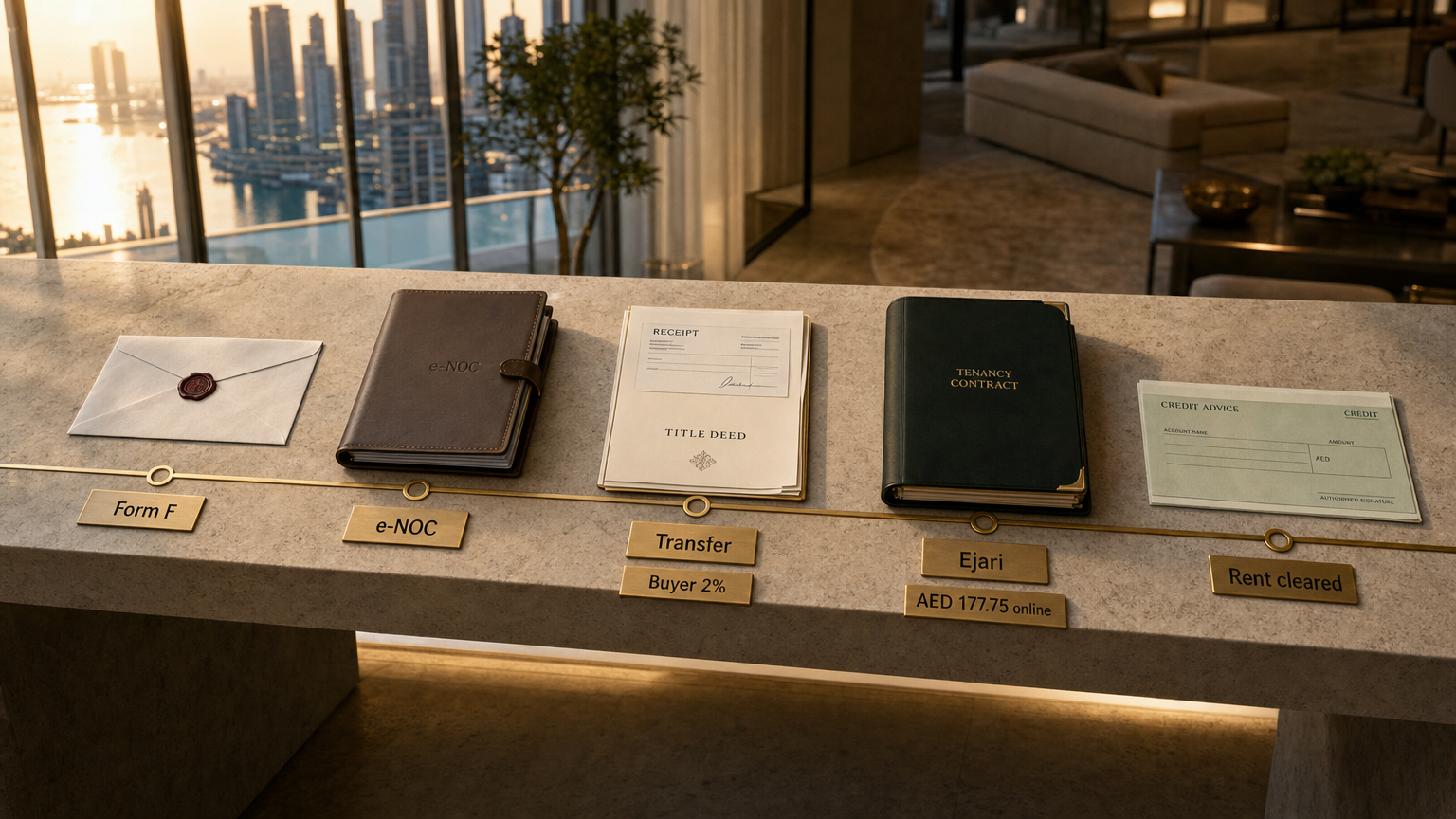
The table is a control sheet, not a universal payment schedule. Form F and the completion statement govern the transaction-specific price, deposit, conditions and allocation. DLD's service pages govern the official records and published government charges as of the verification date.
Follow the file from reservation to cleared rent
The sequence works because each stage answers a different question: what is promised, what is payable, what has been registered and what has actually reached the account.
Record the reservation inside Form F
Form F is DLD's property sales contract between seller and buyer. The official form, checked on 19 September 2026, contains the sale price, amount paid, balance, annual service-charge field, title details, tenancy status and transfer date. Its payment clause provides a blank for the security-cheque amount, so the form does not establish a Dubai-wide reservation percentage.
The form says the security cheque is held in trust and restricts when it may be dealt with. It also describes a manager's cheque, or another DLD-accepted method, for the balance. The reservation amount therefore belongs in the committed-cash column until the signed terms make it payable or refundable.
Separate conditions from payments
A financing condition, developer e-NOC or another written completion condition changes when money becomes payable. DLD's sale-registration service requires Emirates IDs for resident individuals or valid passports for non-resident foreigners, plus a developer e-NOC in freehold areas, as verified on 19 September 2026.
The e-NOC is evidence that the file has reached a required pre-transfer state. It is not evidence that ownership transferred, and it does not by itself convert the security cheque into final purchase cash.
Lock the transfer-day payees and amounts
The manager's cheque payee, DLD fee split and additional charges belong on one completion statement before the trustee appointment. DLD's sale-registration service shows the fee as 2% for the seller and 2% for the buyer, as verified on 19 September 2026. Contract F also carries fields for the parties' allocation, so the buyer's cash model must follow the signed transaction rather than an assumed convention.
For the counter sequence and document ownership, the companion trustee-office transfer-day checklist keeps the audit separate from this wider cash calendar.
Register the sale and retain the outputs
At the trustee centre, DLD's published flow is document review, system audit, fee payment and electronic delivery. The ordinary sale service lists an electronic title deed, electronic map and fee balances among its outputs. These are the records that move the buyer from contractual purchaser to registered owner.
DLD's separate Verify Title Deed service, checked on 19 September 2026, allows validity checking through the DLD website or Dubai REST and lists the service time as immediate. The verification record belongs beside the deed, not in place of it.
Close the physical and financial handover
Contract F states that the seller hands over the property on the transfer date and, where a tenancy already exists, hands over lease-related cheques or cash arising from that date. For the vacant-home scenario here, a private handover file can record keys, access media, meter details, condition and outstanding building correspondence. Those items support possession, but they are not substitutes for the DLD title.
The general Dubai property investment playbook explains why a completed home fits an investor who prioritises immediate title, inspection and a shorter route to rental use.
Move service charges into the operating ledger
Mollak is DLD and RERA's system for approved service charges in jointly owned property. The DLD Service Charge Index, checked on 19 September 2026, returns the RERA-approved fee information after the user selects the project, use and budget year. DLD's official FAQ says the owner share is found by multiplying the approved rate by the relevant unit area, and payment follows through RERA-approved accounts after the Mollak notice.
The charge is building-specific. A generic percentage would blur the operating ledger, so the linked Mollak yield worksheet shows how to carry the matched rate into the calculation.
Register the tenancy, then count cleared rent
The DLD Ejari registration service, checked on 19 September 2026, requires the unified tenancy contract and issues an e-Contract Registration Certificate. DLD lists a total of AED 177.75 through Dubai REST or its website and AED 220 through a Real Estate Services Trustee Centre.
The unified tenancy contract, checked on 19 September 2026, has distinct fields for annual rent, security deposit and mode of payment. That separation continues in the cash ledger: rent becomes received income when the payment clears, while the deposit remains a separate contract amount.
A worked AED cash ledger keeps assumptions visible
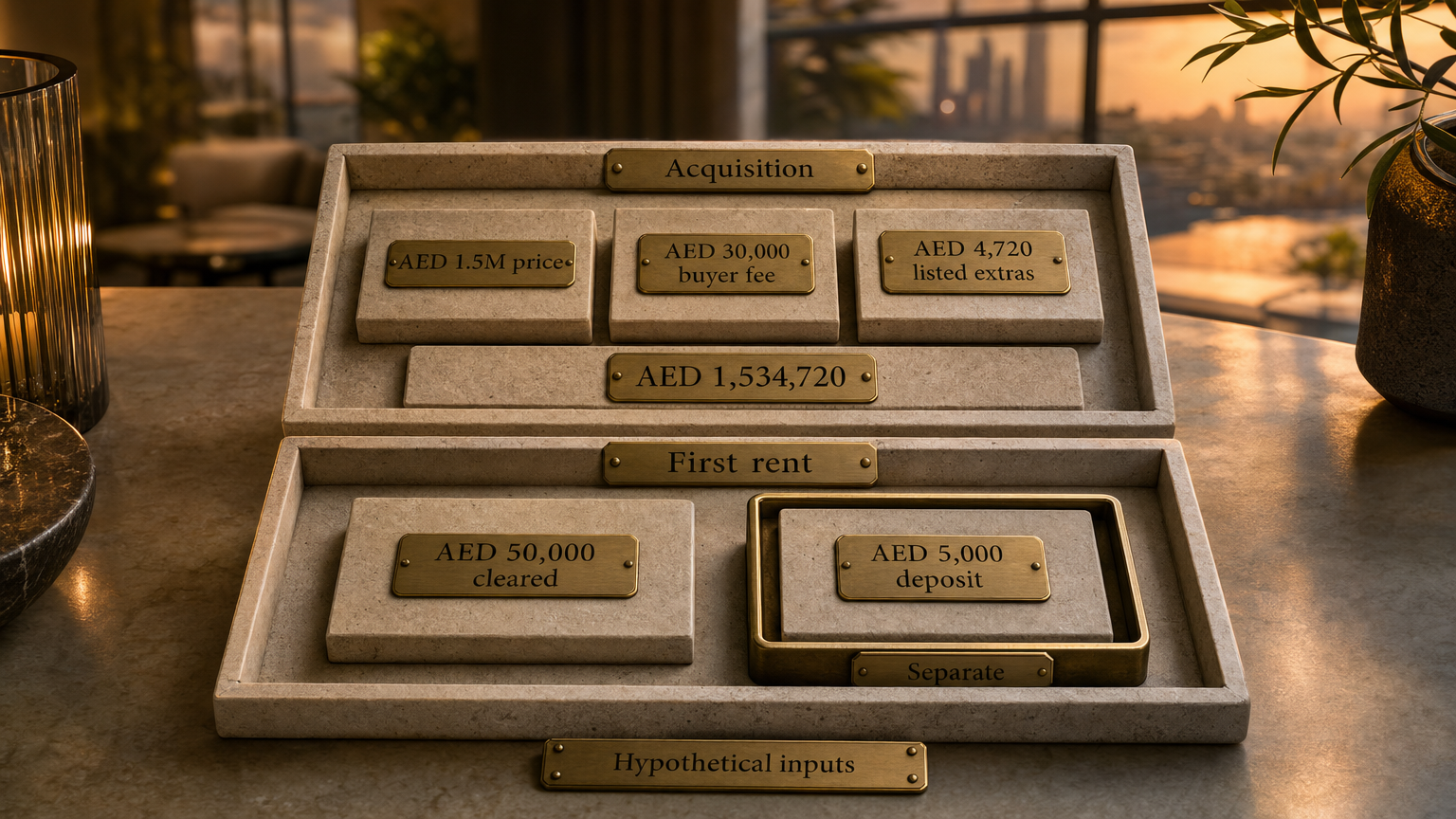
The example below is hypothetical and does not describe a market price, rent, deposit norm or building charge. It assumes a cash purchase of an apartment at AED 1,500,000, a Form F security cheque equal to 10% of that input, and a contract in which the security cheque becomes part of the price on completion.
As verified on DLD's sale-registration service on 19 September 2026, the AED 4,720 line comprises AED 250 for title-deed issuance, AED 250 for a villa or apartment, AED 10 knowledge fee, AED 10 innovation fee and a service-partner fee of AED 4,000 plus VAT. The Federal Tax Authority states that the UAE standard VAT rate is 5%, as checked on 19 September 2026, making that service-partner line AED 4,200 in this example. As of the same date, DLD applies the AED 4,000 plus VAT tier where the sale value is AED 500,000 or more.
Using the DLD fee schedule verified on 19 September 2026, if the signed Form F instead allocates the full 4% sale-registration fee to the buyer, the buyer's fee becomes AED 60,000 and cumulative cash through title becomes AED 1,564,720. That is a contract sensitivity, not a claim that every buyer pays the same share.
This acquisition total excludes brokerage, finance, valuation, developer charges, utilities, furnishing, maintenance and vacancy because no universal amount applies to the example. Each belongs in the ledger only when a contract, official tariff or vendor quote supplies the number.
The buffer belongs between title and stable receipts
The exposed period begins when ownership costs start and ends only when rental payments are clearing as scheduled. A buffer here is working capital, not a forecast of return.
It can hold four categories without inventing a Dubai-wide percentage:
- Building obligations: the matched Mollak service-charge invoice and any balance shown through the approved record.
- Property preparation: vendor quotes for cleaning, repairs, appliances, furnishing or compliance work chosen for the actual home.
- Tenancy setup: the allocated Ejari fee and any documented management or contract-preparation charge.
- Timing gaps: purchase completion, preparation and lease commencement can fall in different banking periods, while post-dated rent remains future cash until it clears.
The useful amount is therefore the sum of known invoices and timed scenarios in the actual file. DLD's pages establish the official fees and records; they do not publish a universal reserve percentage for a ready-property investor.
Gross rent due is not cash received
Gross rent due is the annual contractual amount. Cash received is the amount that has cleared by the measurement date, and the two figures can differ even when the tenancy is fully documented.
Extend the hypothetical example with AED 100,000 annual rent paid in 2 equal instalments, an AED 5,000 tenant security deposit and an AED 12,000 annual service-charge input. None of those inputs is a Dubai norm.
The two yield calculations in the table measure annual contract inputs rather than cash arrival. Immediately after the first instalment clears, rent cash received is AED 50,000, while the later AED 50,000 remains due under the schedule.
If the owner pays the AED 177.75 online Ejari fee in this scenario, the first cleared AED 50,000 leaves AED 49,822.25 before service charges and every other owner cost. If another party pays that fee under the tenancy file, it is not an owner outflow. The evidence decides which ledger line applies.
Official source record, checked 19 September 2026
The transaction rules and charges in this calendar come from Dubai Land Department's sale-registration service, official Contract F, title-deed verification service, Service Charge Index, Mollak guidance, Ejari service and unified tenancy contract. The service-partner VAT calculation uses the Federal Tax Authority's 5% standard rate. Hypothetical inputs are identified wherever they appear.
Is the Form F security cheque an immediate cash outflow?
Not while it remains a security cheque held in trust under the official form. Contract F, checked on 19 September 2026, records the amount and conditions governing whether it is applied to the price, returned or dealt with after a contractual event; the bank record confirms when cash actually moves.
Does the buyer always pay the full 4% DLD sale-registration fee?
DLD's service page, verified on 19 September 2026, shows 2% for the seller and 2% for the buyer, while Contract F records the agreed allocation. The worked ledger therefore shows the buyer's published 2% share first and the full 4% buyer allocation only as a separate contract sensitivity.
What proves that ownership transferred?
DLD lists the electronic title deed, electronic map and fee balances as outputs of an ordinary sale registration. Its separate title-deed verification service, checked on 19 September 2026, provides an immediate validity check through the DLD website or Dubai REST.
How much does Ejari registration cost?
DLD lists AED 177.75 through Dubai REST or its website and AED 220 through a Real Estate Services Trustee Centre, as verified on 19 September 2026. The issued evidence is the e-Contract Registration Certificate.
When does rent become cash received?
The unified tenancy contract, checked on 19 September 2026, records annual rent, security deposit and mode of payment in separate fields. A future-dated or uncleared cheque remains scheduled rent; the cash-receipt line changes when the bank credits the payment, while the deposit stays separate from rent income in this ledger.
Lida MoghaddamArchitect-turned-real-estate-specialist based in Dubai. She helps buyers, sellers, and investors read property with a designer's eye — structure, location, and long-term value.