Mollak service-charge sensitivity: how one input changes net yield
 Lida Moghaddam
Disclaimer: This article is for general informational purposes only. It is based on cited public data and published under Lida Moghaddam's RERA-licensed masthead. It is not financial, legal, or investment advice. Dubai's property market moves quickly, so figures, yields, and rules may change or become outdated by the time you read this. Verify current information with the relevant authority or a qualified professional before acting. Read the full disclaimer.
Table of contents
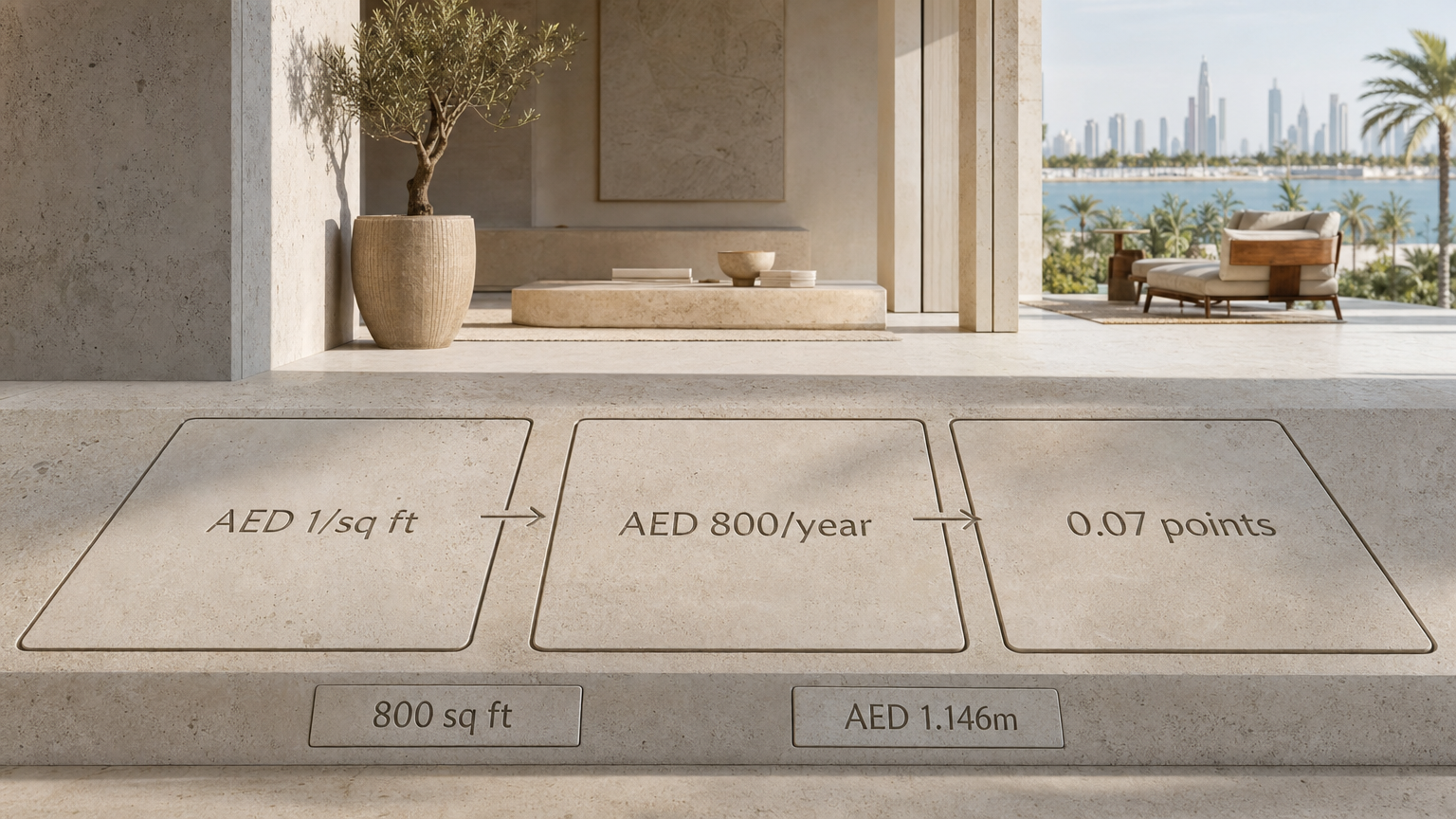
For the worked 800 sq ft apartment below, every AED 1 per sq ft added to the annual Mollak service-charge input removes AED 800 from annual income and about 0.07 percentage points from the modelled net yield. The current market anchor is Bayut's H1 2026 JVC one-bedroom asking average of AED 1,146,000 to buy and AED 79,000 a year to rent; the 800 sq ft area, AED 6,000 other costs and all service-charge rates are hypothetical because no current building-specific approved rate was exposed on a citable page in this run.
The sensitivity is one multiplication and one division
The effect of a service-charge change depends on only two fixed inputs: the chargeable area turns AED per sq ft into an annual cost, and the purchase price turns that cost into a yield change.
Annual income change = change in service-charge rate × title-deed area
Net-yield change in percentage points = annual income change ÷ purchase price × 100
For the worked model:
AED 1 per sq ft × 800 sq ft = AED 800 per year
AED 800 ÷ AED 1,146,000 × 100 = 0.0698 percentage points, rounded to 0.07 percentage points
That relationship is linear while the area and purchase price stay fixed. A change of AED 4 per sq ft therefore moves this model by about 0.28 percentage points. It says nothing about whether a future rate will change; it measures what a stated change would do.
The worked model isolates the service-charge input
The market inputs are current asking averages, while the operating-cost inputs are explicitly hypothetical. Keeping those categories separate prevents a scenario rate from looking like a published charge for JVC or any building.
Gross yield uses no operating costs:
AED 79,000 ÷ AED 1,146,000 × 100 = 6.89% gross yield
The modelled net-yield equation is:
Modelled net yield = [annual asking rent - (service-charge rate × title-deed area) - other recurring owner costs] ÷ asking sale price × 100
This model uses the Bayut price and rent figures as a consistent H1 2026 market anchor. It does not describe a specific unit, completed transaction, tenancy contract or approved building budget.
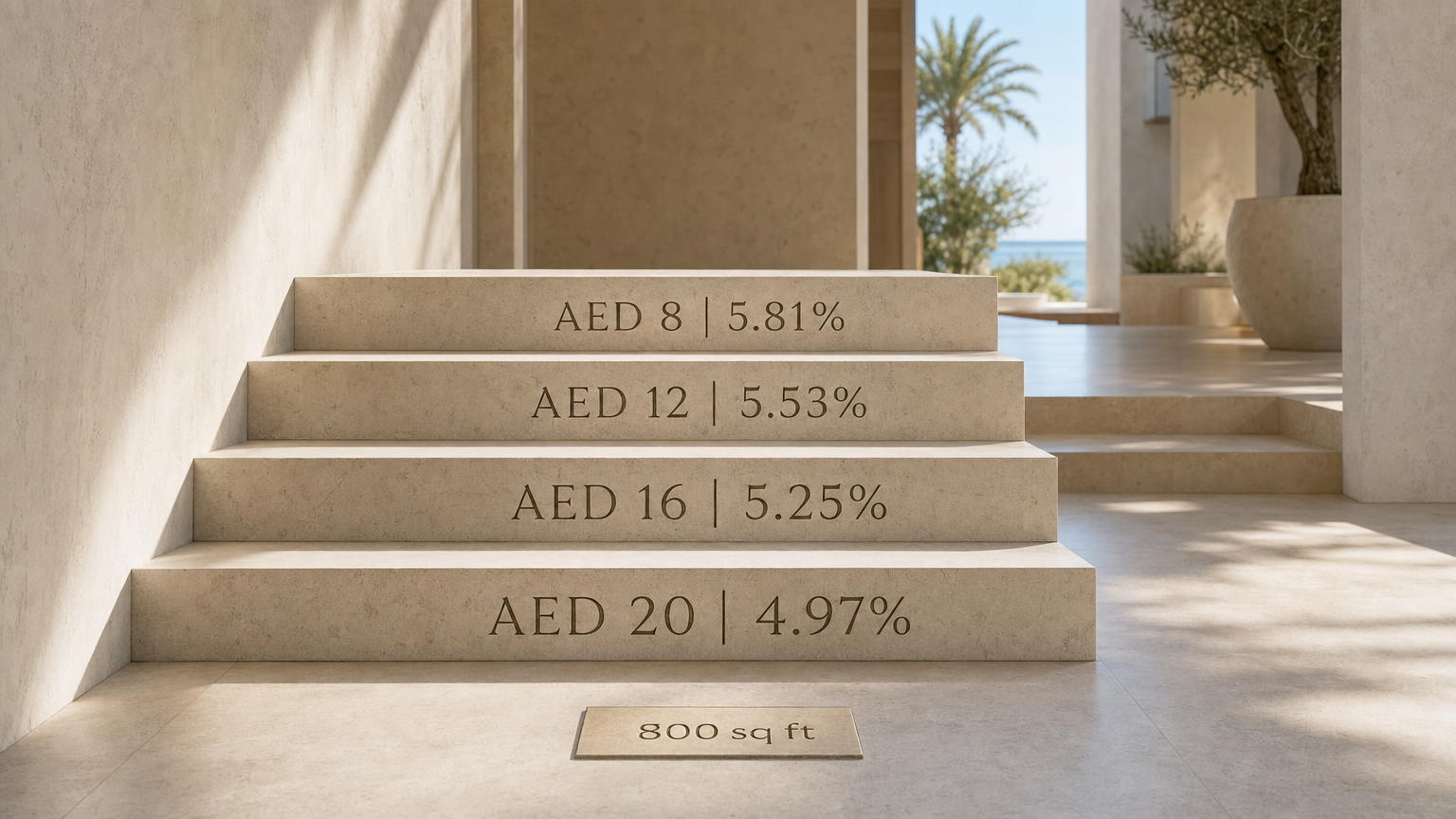
Four charge scenarios move the modelled yield from 5.81% to 4.97%
Across the four hypothetical service-charge inputs, the modelled net yield spans 0.84 percentage points. The price, rent, area and other annual costs stay unchanged, so the service-charge rate causes the whole difference.
At AED 12 per sq ft, the calculation is:
800 sq ft × AED 12 per sq ft = AED 9,600 annual service charge
AED 79,000 rent - AED 9,600 service charge - AED 6,000 other costs = AED 63,400 modelled annual income
AED 63,400 ÷ AED 1,146,000 × 100 = 5.53% modelled net yield
The quoted gross figure of 6.89% and the 5.53% modelled net figure answer different questions. The first compares rent with price. The second includes the stated cost assumptions.
Back-solve the rate from a comparison threshold
A reader-defined yield threshold can be converted into a service-charge rate. This is a comparison tool, not a forecast or a recommendation.
Service-charge rate = [annual rent - other annual costs - (comparison yield × purchase price)] ÷ title-deed area
Using the same worked inputs:
For the 5.50% line:
5.50% × AED 1,146,000 = AED 63,030 required annual income
AED 79,000 rent - AED 6,000 other costs - AED 63,030 = AED 9,970 available for service charge
AED 9,970 ÷ 800 sq ft = AED 12.46 per sq ft
The result is useful only after each input has the same scope. A price quote, asking rent, title-deed area and approved budget-year charge need to describe the same apartment basis.
Mollak supplies the approved input, not a citywide assumption
The official input is specific to the jointly owned property. Dubai Land Department's Service Charge Index says a customer selects the project, use and year to view the RERA-approved service fee, as verified 18 September 2026. RERA is DLD's Real Estate Regulatory Agency, and Mollak is the online system used for jointly owned property service-charge administration.
DLD's frequently asked questions, verified 18 September 2026, say the owner's common service charge is calculated from the approved rate and the area owned in the title deed. DLD also says charges can differ between projects according to the services provided, the common-area size, and the size and number of units sold.
The approval is based on a budget, not a generic Dubai rate. DLD's Mollak approval service, verified 18 September 2026, lists an annual budget statement, service-provider tenders, relevant contracts and an external audit report among the required documents.
The master Mollak worksheet walks through the official lookup and the title-deed-area check. This companion begins after that lookup, once the rate is available.
A complete net-yield file needs more than one input
The sensitivity table isolates service charge. Realised net income can also differ because the actual rent, occupancy, leasing or management cost, repairs, insurance, finance cost and other owner expenses may not match the model.
The hypothetical AED 6,000 line holds all non-service-charge recurring costs constant. Replace that line with documented costs, and keep one-off acquisition costs separate from annual operating costs. If the quoted price or expected rent changes, recalculate the gross yield before testing the service-charge rate.
For broader area-level context, the Dubai rental yield index compares published yield figures. An area figure is a screening reference. The building-specific Mollak rate and the unit's own documents determine this cost line.
Apply the sensitivity test to a quoted yield
The clean test keeps every input visible and changes only one at a time.
Fix the price basis
Use the price attached to the quoted gross yield. Record whether it is an asking price or a completed transaction value.
Match the annual rent
Use the rent basis behind the quote. Asking rent, contracted rent and received rent are not interchangeable.
Retrieve the approved rate
Use the DLD Service Charge Index for the matched project, use and budget year. Record the result and verification date.
Use the title-deed area
Multiply the approved rate by the applicable title-deed area. Do not silently substitute a rounded listing area.
Change one input
Hold price, rent, area and other annual costs fixed while testing the service-charge rate. The resulting difference is the rate sensitivity, not a prediction.
Sources
- Dubai Land Department Service Charge Index, verified 18 September 2026
- Dubai Land Department service-charge approval service, verified 18 September 2026
- Dubai Land Department frequently asked questions, verified 18 September 2026
- Bayut Dubai Sales Market Report H1 2026, updated 2 September 2026 and accessed 18 September 2026
- Bayut Dubai Rental Market Report H1 2026, updated 2 September 2026 and accessed 18 September 2026
What is ROI in Dubai property?
For an income comparison, gross rental yield is annual rent divided by purchase price. In this 18 September 2026 model, AED 79,000 divided by AED 1,146,000 produces 6.89% gross; modelled net yield deducts the stated annual owner costs before dividing by the same price (Bayut H1 2026 sales and rental reports).
How is a Dubai apartment service charge calculated?
DLD says the owner's share uses the RERA-approved rate and the area owned in the title deed. The official index lookup is matched by project, use and year, as verified 18 September 2026 (DLD Service Charge Index).
Can a quoted gross yield be used as net yield?
No. Gross yield does not deduct service charges or other owner costs. In the worked model dated 18 September 2026, 6.89% gross becomes 5.53% after a hypothetical AED 12 per sq ft charge and AED 6,000 of other annual costs.
Which inputs can make a rental-yield result differ from the model?
Actual rent, occupancy, the building-specific approved charge, title-deed area and other recurring costs can all change the result. DLD says service charges differ between projects according to their services, common areas and unit mix, as verified 18 September 2026 (DLD FAQ).
Lida MoghaddamArchitect-turned-real-estate-specialist based in Dubai. She helps buyers, sellers, and investors read property with a designer's eye — structure, location, and long-term value.