
Dubai rental yield: why valuation dates must match
 Lida Moghaddam
Disclaimer: This article is for general informational purposes only. It is based on cited public data and published under Lida Moghaddam's RERA-licensed masthead. It is not financial, legal, or investment advice. Dubai's property market moves quickly, so figures, yields, and rules may change or become outdated by the time you read this. Verify current information with the relevant authority or a qualified professional before acting. Read the full disclaimer.
Table of contents
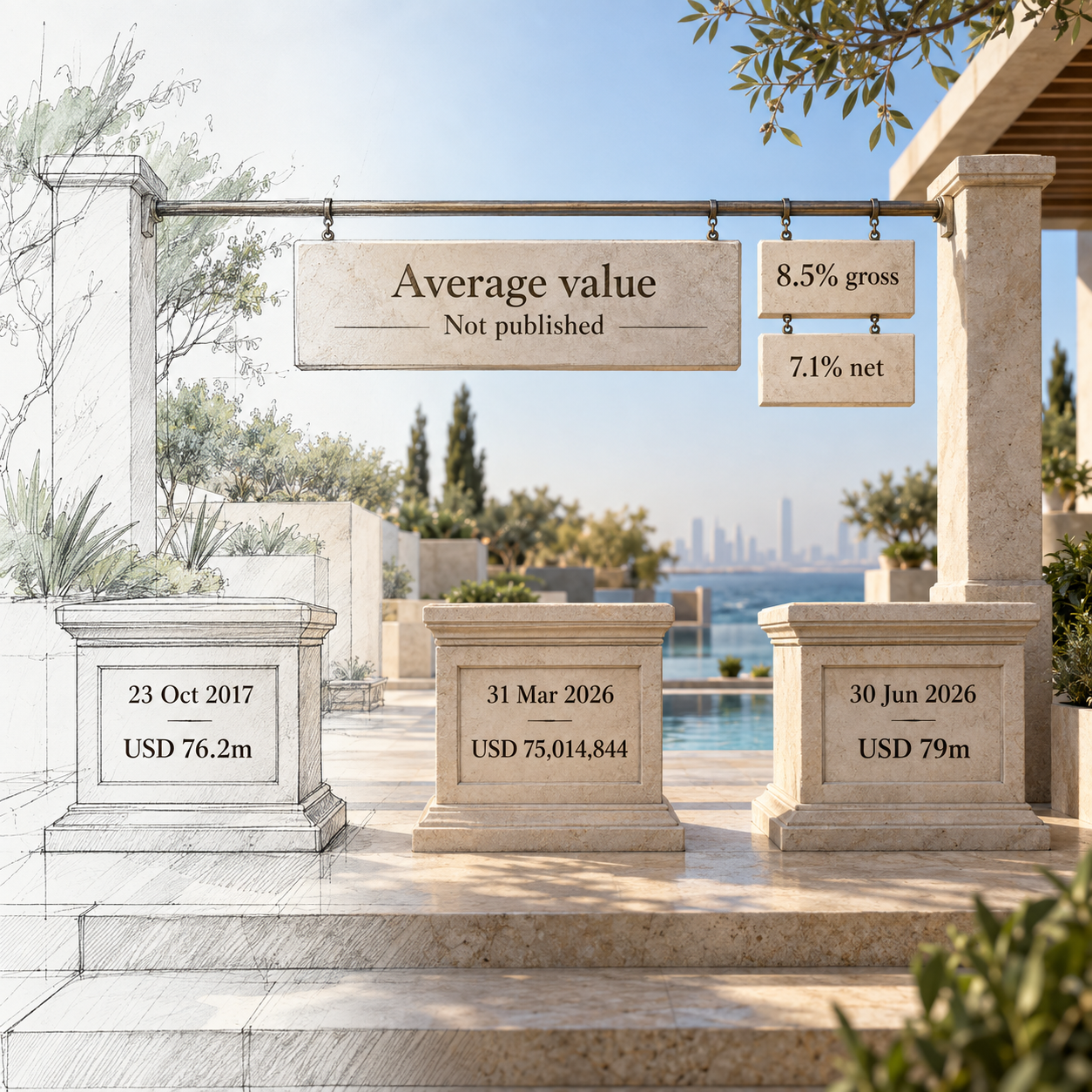
ENBD REIT reported an 8.5% gross yield and a 7.1% net yield for The Edge as of 30 June 2026, but both use prior-12-month average valuations, not the USD 79 million point value shown for that date. Multiplying either rounded yield by USD 79 million therefore does not recover the building's exact rent.
The 8.5% and 7.1% figures do not use the 30 June point value
The published yields and the USD 79 million market value sit in the same asset snapshot, but the footnotes give the yields a different denominator. That distinction is the whole calculation.
The transaction figure comes from ENBD REIT's 23 October 2017 acquisition release. The year-end fair value is in the annual report for the year ended 31 March 2026. The point value, the two yields and both denominator definitions come from the quarterly update as at 30 June 2026.
These records do not say that the acquisition value, the March fair value or the June market value was the average used for either reported yield.
Average valuation is a period measure, not a valuation-date snapshot
The issuer's formula pairs income from a 12-month period with valuations averaged across a 12-month period. A valuation at one date is a different measurement.
In compact form, the published definitions are:
- Reported gross yield = prior-12-month gross rental revenue ÷ prior-12-month average valuations.
- Reported net yield = prior-12-month net rental revenue ÷ prior-12-month average valuations.
Gross rental revenue is the rent measure before the deductions included in the issuer's net-rental definition. Net rental revenue is the post-deduction measure used by the issuer. The public asset table gives the two percentages, but it does not itemise The Edge's deductions.
The denominator also has a time dimension. The 30 June 2026 market value tells the reader what the issuer recorded at that date. The prior-12-month average valuation represents values across the reporting period. Those two figures would be interchangeable only if they were equal, and the public record does not establish that equality.
Multiplying by USD 79 million produces an illustration, not exact rent
Applying the rounded percentages to the point value creates two reproducible products, but neither product is labelled as The Edge's rent in ENBD REIT's records.
The arithmetic was replayed with decimal inputs in the working file for this article. The classification matters more than the multiplication. Calling USD 6.715 million gross rent or USD 5.609 million net rent would silently replace the issuer's average-valuation denominator with the USD 79 million point value.
Rounding is a second limit. The quarterly table displays 8.5% and 7.1% to one decimal place. Even with the correct average denominator, a displayed rounded rate cannot establish an exact rent numerator unless the unrounded rate is also known.
Purchase-price, average-value and current-value yields answer different questions
One rent numerator can be divided by three values, but the result must retain the denominator's name and date. The labels are not interchangeable.
The numerator must stay consistent too. A gross-rent numerator cannot be compared directly with a net-rent numerator. Likewise, an owner's net ledger may include a different cost scope from a fund's published net-rental measure. The records need to define both before the percentages are placed side by side.
This is why the broader after-service-charge net-yield worksheet begins with the actual rent and owner costs, rather than a reported percentage. Its companion on Mollak service-charge sensitivity shows how changing one cost input changes net yield while the other inputs stay visible.
Four inputs remain unknown in the public asset record
The public chain supports the denominator lesson precisely because it shows where the evidence stops. As checked on 2 October 2026, it does not disclose:
- the exact prior-12-month average-valuation series used for The Edge;
- The Edge's exact prior-12-month gross rental revenue;
- The Edge's exact prior-12-month net rental revenue; or
- The Edge's property-level owner-cost ledger.
The 31 March 2026 annual report gives a property fair-value schedule and portfolio-level financial statements. It does not break out The Edge's rent and operating costs. The 30 June 2026 quarterly update supplies asset-level yields and denominator definitions, but not those exact inputs.
That leaves no evidence-based route to reverse-engineer an exact asset rent or an exact owner-cost figure from the displayed percentages.
A valid comparison keeps the period, numerator and denominator together
The clean method is to treat every yield as a three-part record: the income period, the rent definition and the value definition.
Lock the income period
Record the start and end of the rent period. For the ENBD REIT figures, the numerator covers the prior 12 months as at 30 June 2026.
Name the numerator
Mark the income as gross or net. If it is net, retain the published deduction scope or the complete owner-cost ledger.
Name and date the denominator
Write acquisition value, average valuation or current market value in full. For a point value, keep its effective date beside it.
Recalculate only from a known numerator
When the same rent amount is available, divide it separately by each relevant denominator. Do not move a rounded yield percentage onto a new value and relabel the product as rent.
Publish the missing fields
If the exact numerator, average series or cost ledger is unavailable, keep the result as unknown. The gap is part of the record.
This method does not make one denominator universally preferable. It makes clear which question each percentage answers and which inputs a reader would need to reproduce it.
FAQ, checked 2 October 2026
Can a rounded fund yield recover exact annual rent?
No. Exact recovery requires the correct denominator and the unrounded rate. ENBD REIT publishes the denominator definition for The Edge, but not the exact prior-12-month average-valuation series or the unrounded asset yield.
Is yield on purchase price the same as yield on current value?
No. They may use the same rent numerator, but purchase-price yield divides by the recorded acquisition value while current-value yield divides by a value at a stated later date.
What does net yield remove from gross yield?
It depends on the reporting definition. ENBD REIT defines The Edge's net yield with prior-12-month net rental revenue, but the public asset table does not publish the property's owner-cost ledger.
Which valuation date belongs in a Dubai rental-yield calculation?
The denominator must match the question being recorded. An acquisition value measures income against cost, a current value measures it against a dated point value, and the ENBD REIT measure uses prior-12-month average valuations.
Lida MoghaddamArchitect-turned-real-estate-specialist based in Dubai. She helps buyers, sellers, and investors read property with a designer's eye — structure, location, and long-term value.