
Dubai service charges: five records from handover to the annual statement (2026)
 Lida Moghaddam
Disclaimer: This article is for general informational purposes only. It is based on cited public data and published under Lida Moghaddam's RERA-licensed masthead. It is not financial, legal, or investment advice. Dubai's property market moves quickly, so figures, yields, and rules may change or become outdated by the time you read this. Verify current information with the relevant authority or a qualified professional before acting. Read the full disclaimer.
Table of contents
The answer is to keep five records separate. The current DLD Service Charge Index asks for three inputs, project, use and year, but the official DLD and Mollak pages reviewed on 29 September 2026 do not publish a universal interval from handover to a first approved budget, invoice or annual statement. An owner can reconcile each record by period, title-deed area basis, charge categories and document status without implying that one record automatically becomes another.
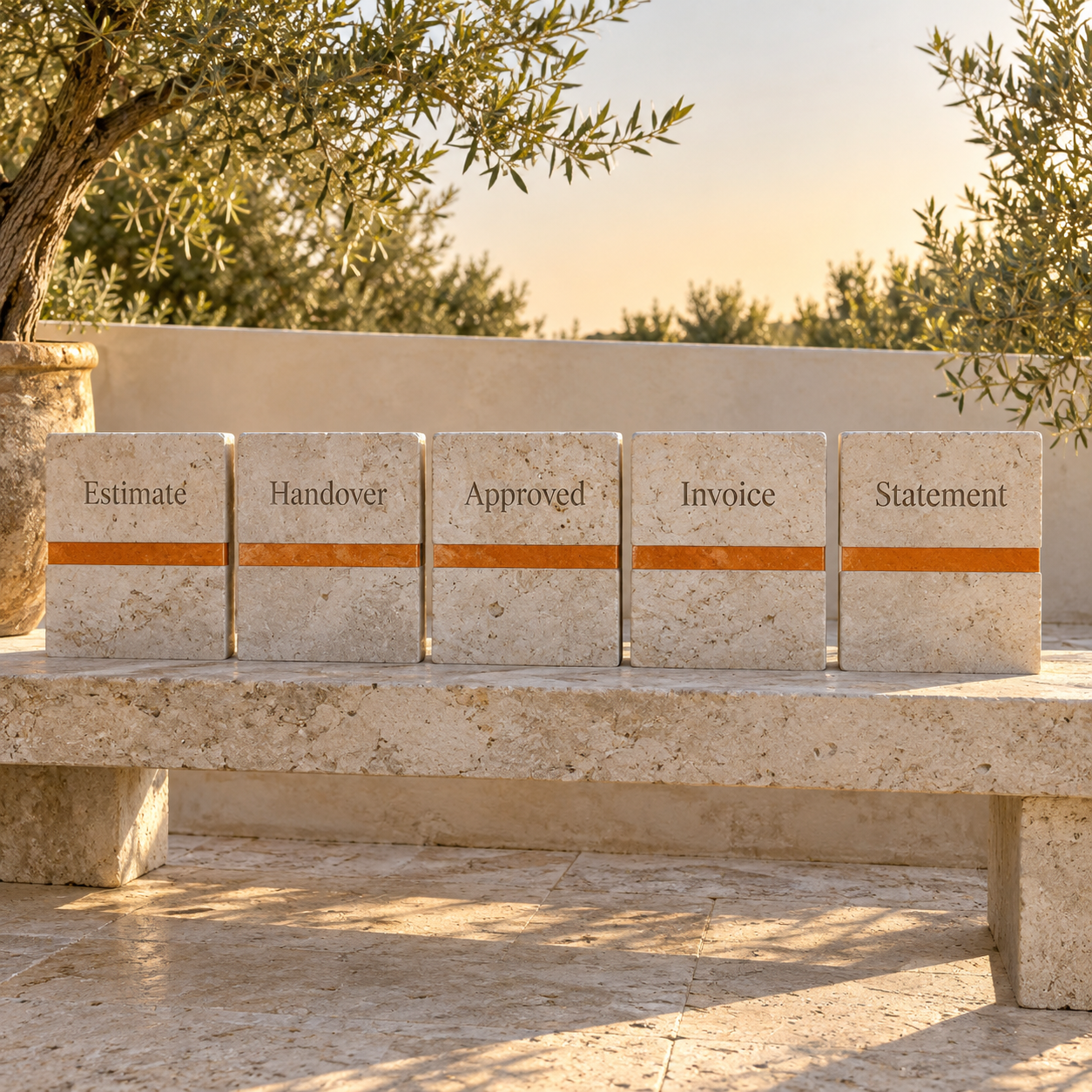
The five records answer five different questions
The useful distinction is authority, not chronology alone. A later record does not silently convert an earlier estimate into an approved charge, and an approved amount does not prove what was invoiced, paid or finally accounted for.
The fifth row is an editorial record class for this workflow. The reviewed official pages do not define one universal document called a first annual statement. The document title and fields can therefore vary, and the file keeps the issuer's noun rather than relabelling it.
The approved amount is a budget record, not a final account
The approved amount begins with a budget process. DLD's approval service, accessed 29 September 2026, requires a detailed annual budget statement, supporting tenders and contracts, utility and insurance records, and an external audit report from a RERA-accredited auditor. RERA is the Real Estate Regulatory Agency within DLD.
DLD's jointly owned property FAQ, accessed the same day, says the service or usage charge budget is approved after an audit by an approved legal accounting office. It lists seven charge categories: service, maintenance, utilities, administration, insurance, master-community and reserve charges.
That approved budget can support a rate. DLD says the owner's common-service share uses the area owned in the title deed and the approved rate. The Index result must therefore travel with the matched project, use, budget year and area basis.
The invoice remains a different record. Mollak, accessed 29 September 2026, describes account monitoring, invoice understanding and payment functions. DLD's FAQ separately lists invoice issuance through Mollak and says payment follows an email or text message through approved channels. Approval, billing and payment are related stages, not interchangeable fields.
The Mollak yield worksheet is the cluster pillar for applying a matched approved rate to the correct area. The present workflow begins one step earlier and continues one step later: it checks where the rate came from, then compares it with the unit's later records.
No reviewed official route gives one handover-to-statement timetable
The official unknown is part of the answer. The Service Charge Index overview describes an immediate enquiry after the customer selects project, use and year. That is the response time for an index lookup, not a rule for when a first budget, invoice or annual statement follows handover.
The Mollak page describes monitoring and payment functions. The DLD FAQ defines annual charges, approval, invoice issuance and payment channels. The approval-service page describes the application and supporting records. None of those pages, read on 29 September 2026, states a universal number of days or months from unit handover to a first approved budget, invoice or statement.
For a project-specific file, the dates printed on each record remain separate facts. A handover date cannot supply a missing budget year. An invoice issue date cannot supply a missing statement period. An absent date stays absent.
Illustrative reconciliation keeps periods and statuses visible
Every amount below is invented for the method. The model is not mapped to a project, building, unit or Mollak identifier. It uses an illustrative AED 1,000,000 purchase price, AED 80,000 annual rent and 800 sq ft title-deed area.
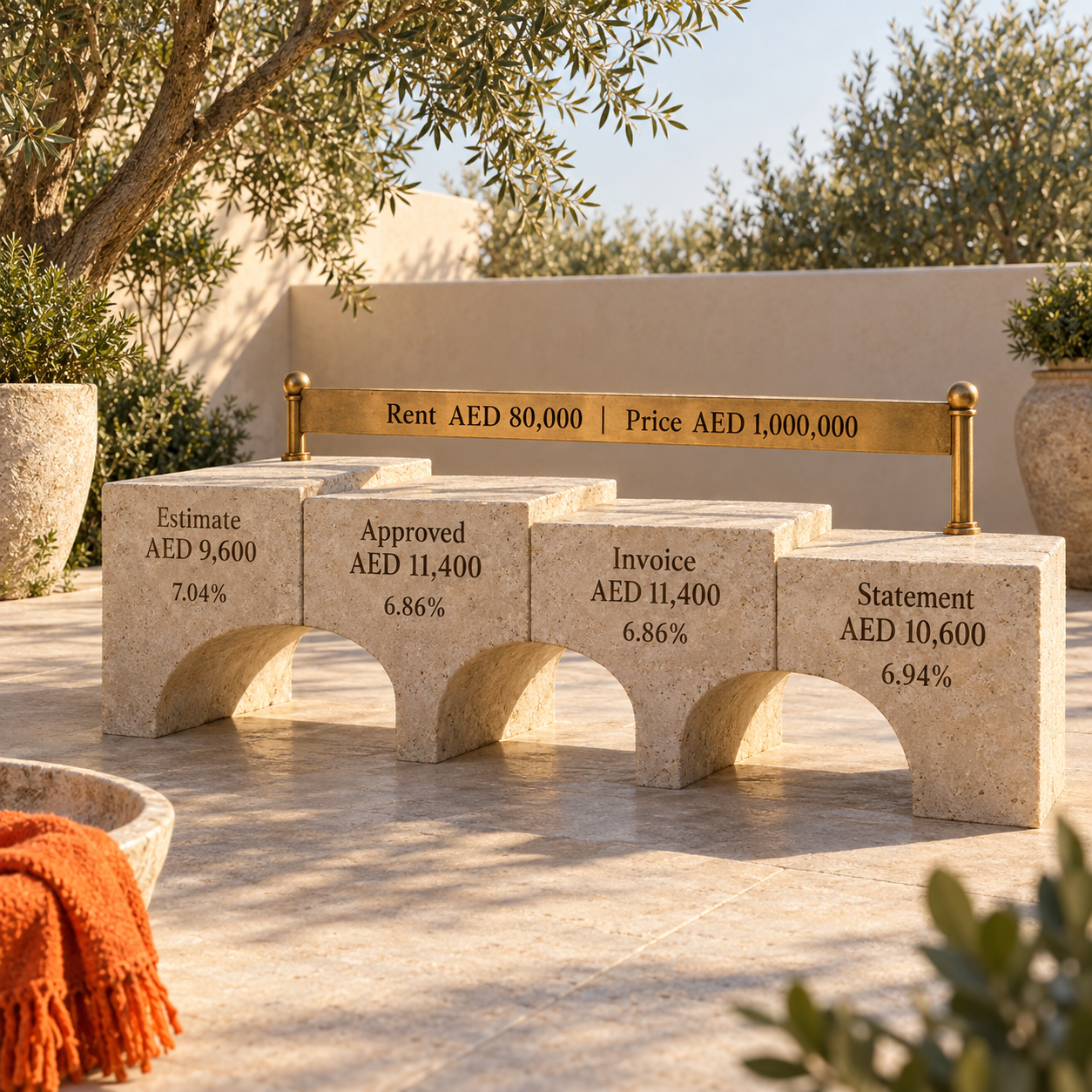
The sales estimate is 800 × AED 12 = AED 9,600. The approved amount is 800 × AED 14.25 = AED 11,400. The invoice adds AED 10,200 and AED 1,200 to the same AED 11,400.
The handover row covers a different period. From 1 October through 31 December 2026 is 92 inclusive days, so 800 × AED 13.50 × 92 ÷ 365 = AED 2,722.19. A full-year equivalent at the same rate is AED 10,800. That annualisation is a comparison calculation, not another document and not proof of a later charge.
The seven final-statement lines sum to AED 10,600. That is AED 1,000 above the sales estimate, AED 200 below the annualised handover equivalent, and AED 800 below both the approved amount and the invoice in this model. Those differences describe only the declared example.
Replace only the matching yield input
The reconciliation changes one owner-cost line. It does not turn an after-service-charge figure into a complete net yield.
With AED 80,000 annual rent and an AED 1,000,000 price, gross yield is 8.00%. Holding both inputs constant gives the following comparison:
The calculation is (annual rent minus period-aligned service charge) divided by purchase price. A broader net-yield model can contain vacancy, management, leasing, maintenance, insurance, finance and other documented costs. Those lines need their own sources, periods and statuses.
The verified sibling, Dubai rental yields: a Mollak budget register, shows why a returned approved budget rate remains a source record rather than a unit's final yield answer.
A closed file preserves both the number and its authority
The strongest match is a five-field join: same project, same use, same period, same area basis and same category scope. Status then answers the remaining question: estimate, approved amount, invoice, payment record or closed-period statement.
If one field does not match, the comparison can still be shown, but the difference is labelled. A partial period can be annualised as a calculation. A missing category can remain blank. An identifier without an official returned mapping stays an identifier, not a building name.
FAQ, checked 29 September 2026
Is the DLD Service Charge Index amount the final invoice?
No. The Service Charge Index provides approved fee information for a selected project, use and year. DLD separately lists invoice issuance through Mollak, so the approved amount and invoice remain different records.
How long after handover does the first annual statement arrive?
The DLD and Mollak routes reviewed on 29 September 2026 do not publish a universal interval. The record file therefore uses the actual handover date, budget year, invoice date and statement period shown by the project-specific documents.
How does service charge affect Dubai rental yield?
It reduces the income numerator by the period-matched owner cost. In the declared model, AED 80,000 rent less the AED 10,600 final-statement amount produces a 6.94% yield after service charge on an AED 1,000,000 price. That is not a complete net yield because other owner costs are outside the model.
Lida MoghaddamArchitect-turned-real-estate-specialist based in Dubai. She helps buyers, sellers, and investors read property with a designer's eye — structure, location, and long-term value.