Dubai rental yields: a Mollak budget register (2026)
 Lida Moghaddam
Disclaimer: This article is for general informational purposes only. It is based on cited public data and published under Lida Moghaddam's RERA-licensed masthead. It is not financial, legal, or investment advice. Dubai's property market moves quickly, so figures, yields, and rules may change or become outdated by the time you read this. Verify current information with the relevant authority or a qualified professional before acting. Read the full disclaimer.
Table of contents
For DLD project ID 867226 and usage ID 1, summing the General Fund categories and Reserved Fund returned by the official service-charge responses produced AED 14.86 per sq ft for 2025 and AED 16.04 for 2026, a code-recomputed difference of AED 1.18, or 7.94%. Those calculated figures become usable in a rental-yield model only while the project ID, usage ID, budget year, category scope and missing unit-area basis remain attached.
The official record is a budget input, not a net-yield answer
Mollak supplies an approved building-level cost input. It does not supply the rent, purchase-price denominator, occupied days or the other owner costs needed for a net-yield calculation.
The DLD Service Charge Index says the customer selects a project, use and year to view RERA-approved service fees for jointly owned property. RERA is the Real Estate Regulatory Agency. Mollak, DLD's system for jointly owned property service charges, says it monitors payments and related accounts and displays the RERA-approved community service-charge rate. Both pages were retrieved on 27 September 2026.
The word budget matters. DLD's approval service says an application includes the annual budget statement, at least three tenders for each service provider, service and maintenance contracts, utilities and insurance documents, and an external audit report from a RERA-accredited auditor, as checked 27 September 2026. That evidence explains the approved rate. It does not prove what a particular owner has paid or what appears on the latest unit statement.
For broader screening, the Dubai rental-yield index is the cluster starting point. The Mollak record enters only after the analysis moves from an area to a matched building and use.
Source register: four records pulled on 27 September 2026
The register below preserves the filters and the omissions. Each response was successful and each project route displayed component rates in AED per sq ft, but the property-level area fields were not returned. The displayed totals were calculated by summing the returned General Fund categories plus Reserved Fund. Additional charges stay separate.
The neutral read: these are reproducible official budget records, not a ranking of buildings. DLD's jointly owned property FAQ says project charges can differ with the services provided, common-area size, and the size and number of units sold, as checked 27 September 2026. A higher returned rate does not by itself establish a better or weaker yield.
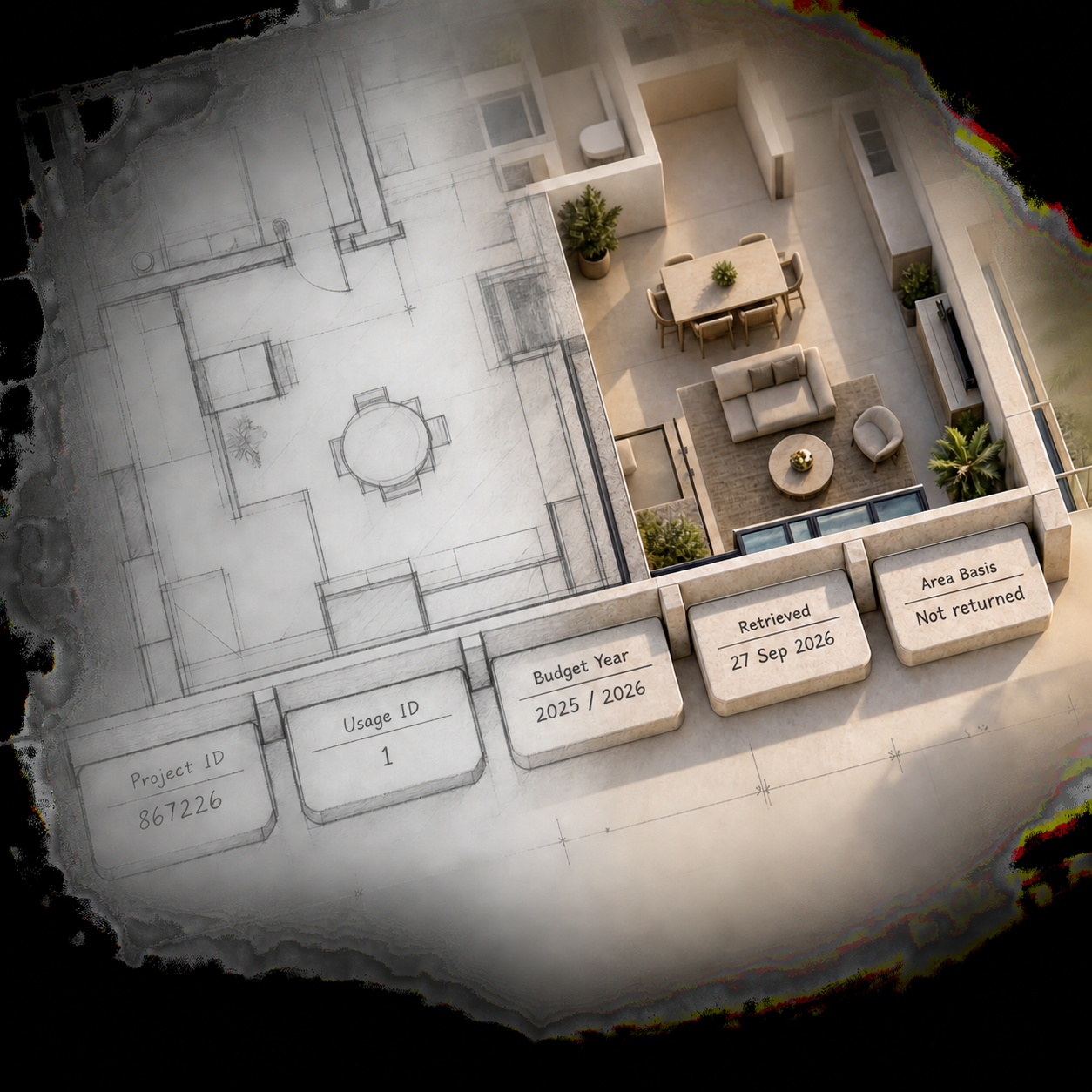
Worked comparison: project ID 867226, usage ID 1, 2025 versus 2026
The clean comparison holds project and use constant, keeps additional charges outside the displayed total and leaves a missing category blank. It does not turn “not returned” into zero.
The 2025 record and 2026 record were both retrieved at 04:08 GST on 27 September 2026.
The code divides AED 1.18 by AED 14.86 and multiplies by 100, producing 7.94%. That is a change in the matched calculated total from the returned component rows. It is not a change in net yield, rent, occupancy or an owner's paid amount.
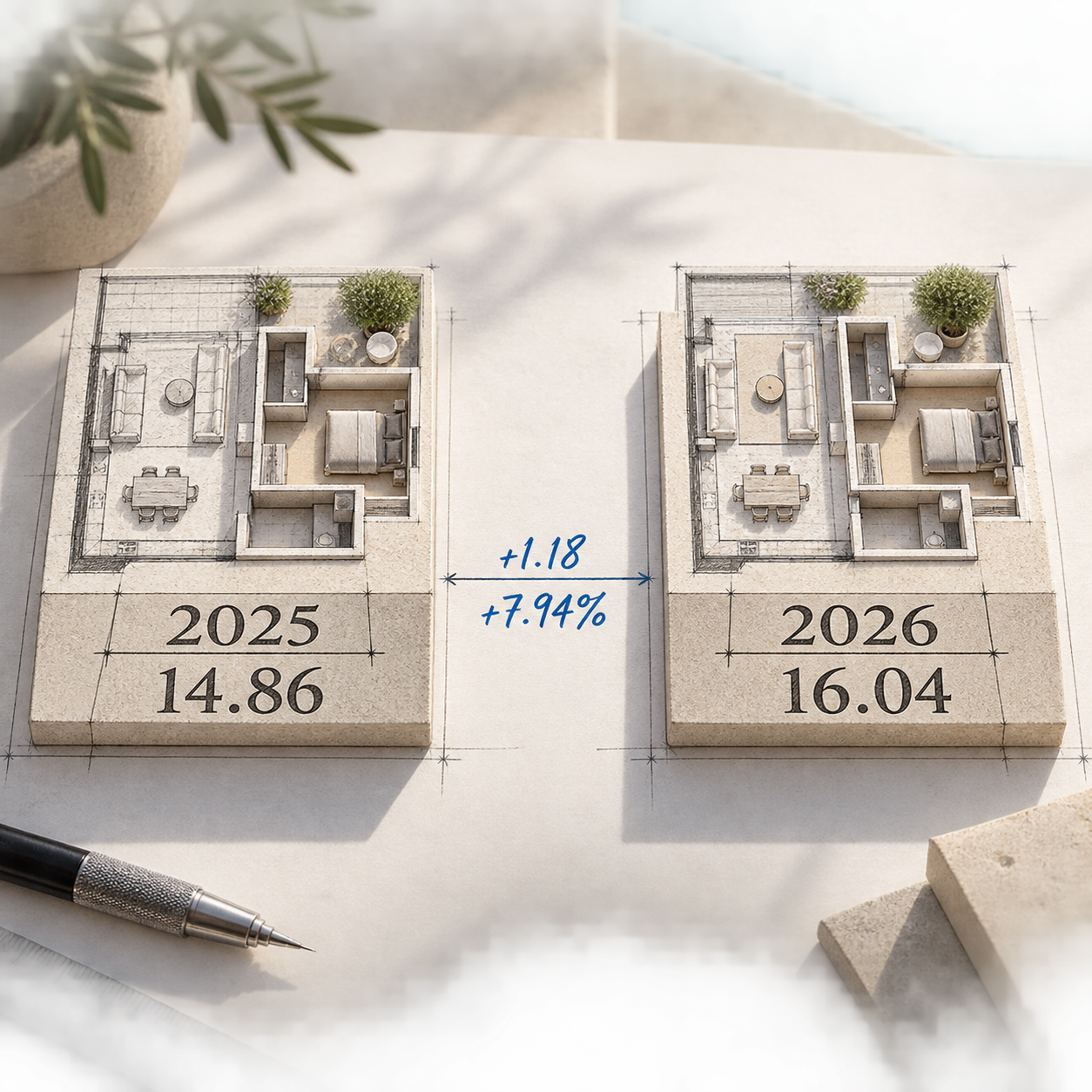
The result is narrower than the rental-yield source methodology. That sibling explains why periods and input families should remain separate. This register shows the same discipline inside one official cost source.
The 3,137.71 field is where the comparison stops
The 2025 response returned 3,137.71 for “Meter Installation” under additional charges. It also returned AED 4.37 for “Unit A/C (Charges).” The 2026 response returned AED 4.17 for Unit A/C and no Meter Installation row.
The project interface groups additional charges beneath a rate heading, but this response supplies no separate property header, applicable-area label, suite-area label or balcony-area label. Multiplying 3,137.71 by a unit area would therefore add a basis the source did not return. Treating it as a fixed unit amount would also add a basis the source did not return.
The reproducible treatment is simple: preserve the exact value, category, project, use, year and retrieval time; flag the missing basis; exclude it from the comparable sum; and reconcile it against the title-deed route or the unit's own current statement before using it. No replacement value is estimated.
Build a yield file without changing the denominator
A defensible after-service-charge yield needs a matched numerator, cost line and denominator. The service-charge record can be exact while the final result is still wrong if a listing area replaces title-deed area, a current asking rent replaces collected rent without a label, or one building's budget is carried into another.
DLD's FAQ says the owner's common-service share is allocated according to the area owned in the title deed and that the approved index rate can be multiplied by the unit area, as checked 27 September 2026. That supports the calculation only when the rate and area describe the same property record.
Freeze the income record
Record whether the annual rent is contracted, collected, asking or modelled, with its period and source. Do not relabel one as another.
Freeze the value denominator
Record whether the denominator is purchase price, current valuation or all-in acquisition cost. Use the same denominator when comparing results.
Match the Mollak record
Save project name, project ID, use, usage ID, budget year, every included charge category and retrieval timestamp. Keep additional charges separate until their basis is confirmed.
Match the area record
Use the area attached to the title deed or the property-specific official result. Record the unit and do not substitute a rounded portal area.
Reconcile the statement
Compare the budget input with the unit's current invoice or statement. Record missing fields, payment status and any line whose scope is not confirmed.
The Mollak yield worksheet begins after the exact approved rate and the correct unit-area record are available. Until then, the output is a source register, not a unit yield.
What can and cannot be compared
The strongest match is the same project, same use, same category scope and two named budget years. Even that comparison describes approved returned rates, not a final owner statement.
The best fit for a yield analyst is therefore a two-stage file. Use the DLD/Mollak record as the dated building-cost source, then join it to the unit only after the title-deed area and current statement agree. If a field cannot survive that join, the calculation stops there.
What is the average rental yield in Dubai?
Area-level averages depend on period, property mix and source method. The published Dubai rental-yield index is the screening reference; this 27 September 2026 register addresses only the building service-charge input and does not create a city average.
What is ROI in Dubai property?
For an income calculation, gross rental yield divides annual rent by the chosen property-value denominator. An after-cost measure subtracts every named cost first. As checked 27 September 2026, the DLD/Mollak rate supplies one approved service-charge input, not the rent, value, occupancy or full cost ledger.
Lida MoghaddamArchitect-turned-real-estate-specialist based in Dubai. She helps buyers, sellers, and investors read property with a designer's eye — structure, location, and long-term value.