Dubai supply source concordance, H1 2026: schedules and completions
 Lida Moghaddam
Disclaimer: This article is for general informational purposes only. It is based on cited public data and published under Lida Moghaddam's RERA-licensed masthead. It is not financial, legal, or investment advice. Dubai's property market moves quickly, so figures, yields, and rules may change or become outdated by the time you read this. Verify current information with the relevant authority or a qualified professional before acting. Read the full disclaimer.
Table of contents
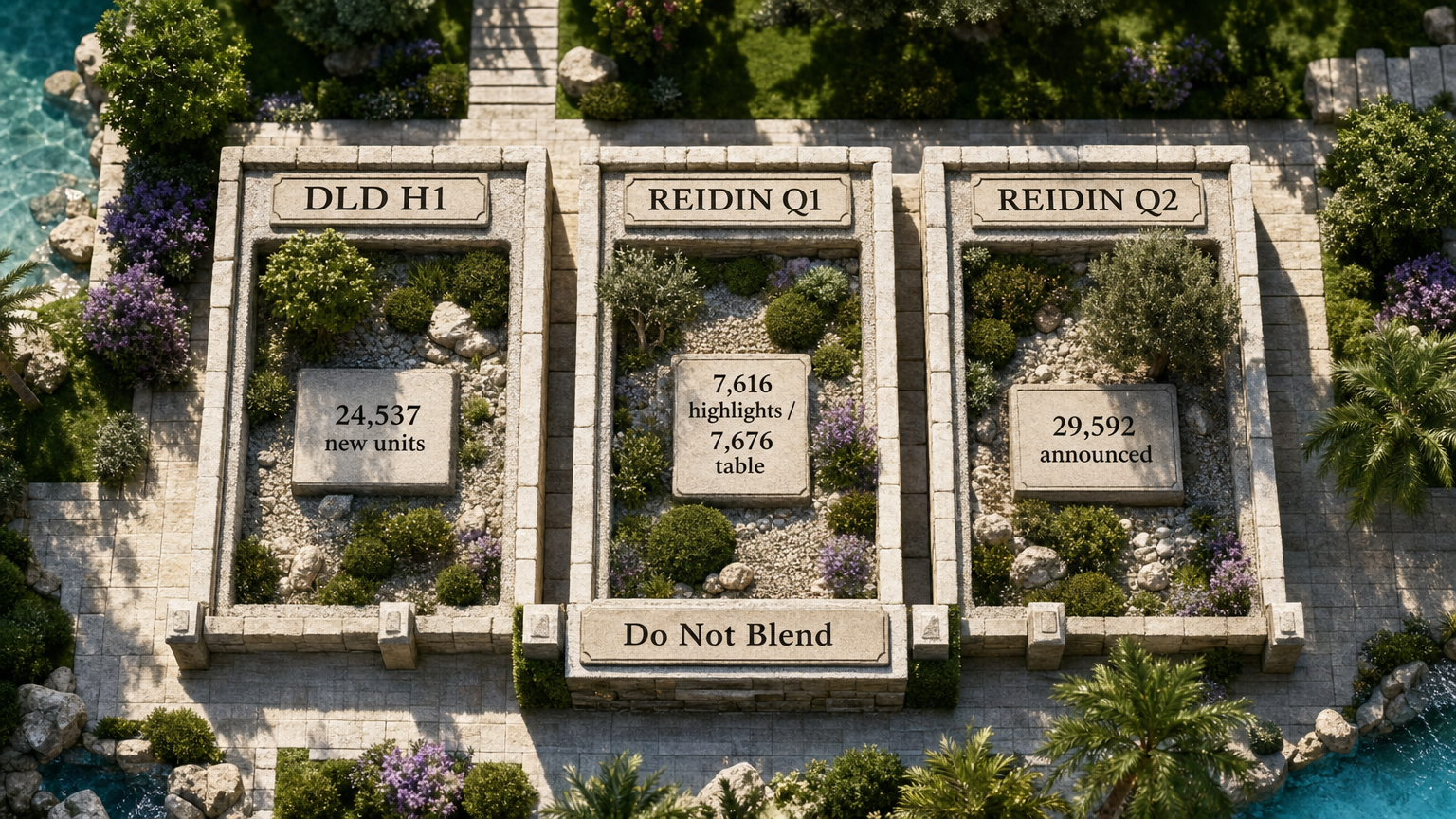
Dubai Land Department reported 104 completed real estate projects and 24,537 new units for the first half of 2026. That is an official H1 release, not the same evidence set as a residential delivery schedule, a consultancy completion estimate or a live project-register query.
The H1 figures sit side by side, not on one scale
The most citable current official figure is DLD's H1 release: 104 completed real estate projects added 24,537 new units, attached to more than AED 111 billion of investment value. A direct DLD register query, using completion dates from 1 January to 30 June and a finished-status filter, returned 96 project rows when retrieved on 19 September 2026.
The neutral read: these rows share an H1 date frame, but they do not share one population or one unit of observation, so subtraction and completion-rate arithmetic would not be supported.
This distinction extends the H1 2026 delivery scorecard. The scorecard tracks the delivery question; this concordance explains why its source labels cannot be collapsed into one number.
Source concordance: three records, three proper uses
Each record answers a different question. DLD publishes both point-in-time releases and a live project register. REIDIN separates completed residential supply from developer-announced future pipeline.
The neutral read: source authority does not remove the need for a population label. An official release, live registry row and consultancy residential series can all be valid while remaining non-interchangeable.
A schedule is a forward inventory, not a completion count
REIDIN's Q1 report makes the status difference explicit, but its own Q1 completion count is internally inconsistent. The key-highlights text and detailed supply table publish different values, so both are preserved below rather than selecting one as definitive.
The neutral read: both Q1 rows describe actual completions but disagree by 60 units inside the same report. The later rows preserve the report's forward schedule as it stood at that publication date.
The numbers also show why an attractive ratio can be wrong. REIDIN's 29,592 is a Q2 residential schedule snapshot. DLD's 24,537 is an H1 official release for new units whose cited sentence is not labelled residential-only. Dividing one by the other would mix both period and population.
The DLD register answers a project-status question
The live register is strongest when the question is project specific: what status does DLD show, which completion date is stored, and what project details sit on that row? It is not a ready-made residential handover series.
The neutral read: the query supports the statement “96 finished project rows carried an H1 completion date at retrieval,” not “96 residential projects handed over exactly within H1.”
DLD's table exposes project status, completed percentage, inspection date, completion date, total villas and total units among other fields. Those inventory fields describe what is attached to each project record. Summing them is not automatically a residential flow measure because the query does not apply a residential-use filter and an inventory count is not the same thing as units handed over during the period.
For an individual development, DLD's Project Status Enquiry accepts a land number, project number or project name. The separate completion-record table method shows how to preserve that project evidence beside developer and resale records.
The comparison test before any arithmetic
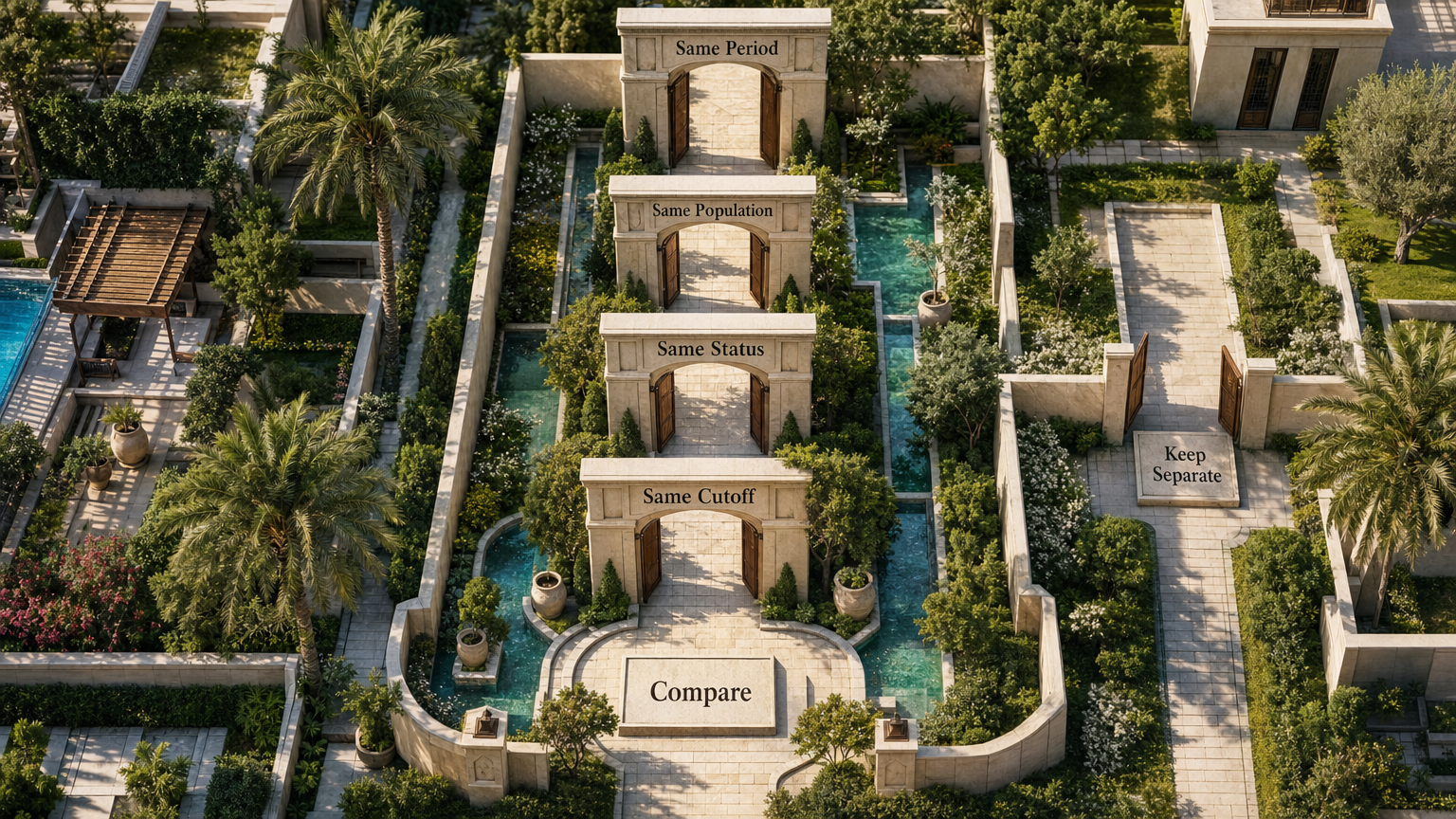
A numeric gap is supportable only when five fields match. If one fails, retain a side-by-side source table and explain the mismatch instead of calculating a rate.
The neutral read: the H1 figures can be quoted side by side as two published observations, but the evidence does not support subtracting them or treating either as the denominator for a delivery rate.
Use the source that matches the question
The correct source is the one whose population matches the reader's question. A journalist citing the official H1 release needs the DLD wording. A buyer checking a named project needs the live status service. An analyst modelling future residential supply needs a dated pipeline series kept separate from actual completions.
The neutral read: there is no universal Dubai property supply total without a period, population and status label attached.
FAQ, checked 19 September 2026
How many units will be delivered in Dubai in 2026?
No single current figure answers every version of that question. REIDIN's Q1 report contains an unresolved discrepancy: its key highlights state 7,616 completed residential units and its detailed supply table states 7,676 actual delivered units. The same report places 145,809 units on developer-announced timelines across Q2 to Q4 and treats those later quarters as pipeline estimates whose actual entry depends on project progress.
What does Dubai REST project completion status show?
DLD says its Project Status Enquiry accepts a land number, project number or project name and returns completion percentage and project details. Record the check date because it is a live status observation, not a fixed quarterly delivery total.
Why do Dubai property supply figures differ?
The sources may count planned residential units, completed residential units, completed real estate projects or project-register rows. Period, population, unit, status definition and retrieval cutoff must match before the figures can support arithmetic.
Lida MoghaddamArchitect-turned-real-estate-specialist based in Dubai. She helps buyers, sellers, and investors read property with a designer's eye — structure, location, and long-term value.