Dubai rental-yield sources: periods, inputs and limits (2026)
 Lida Moghaddam
Disclaimer: This article is for general informational purposes only. It is based on cited public data and published under Lida Moghaddam's RERA-licensed masthead. It is not financial, legal, or investment advice. Dubai's property market moves quickly, so figures, yields, and rules may change or become outdated by the time you read this. Verify current information with the relevant authority or a qualified professional before acting. Read the full disclaimer.
Table of contents
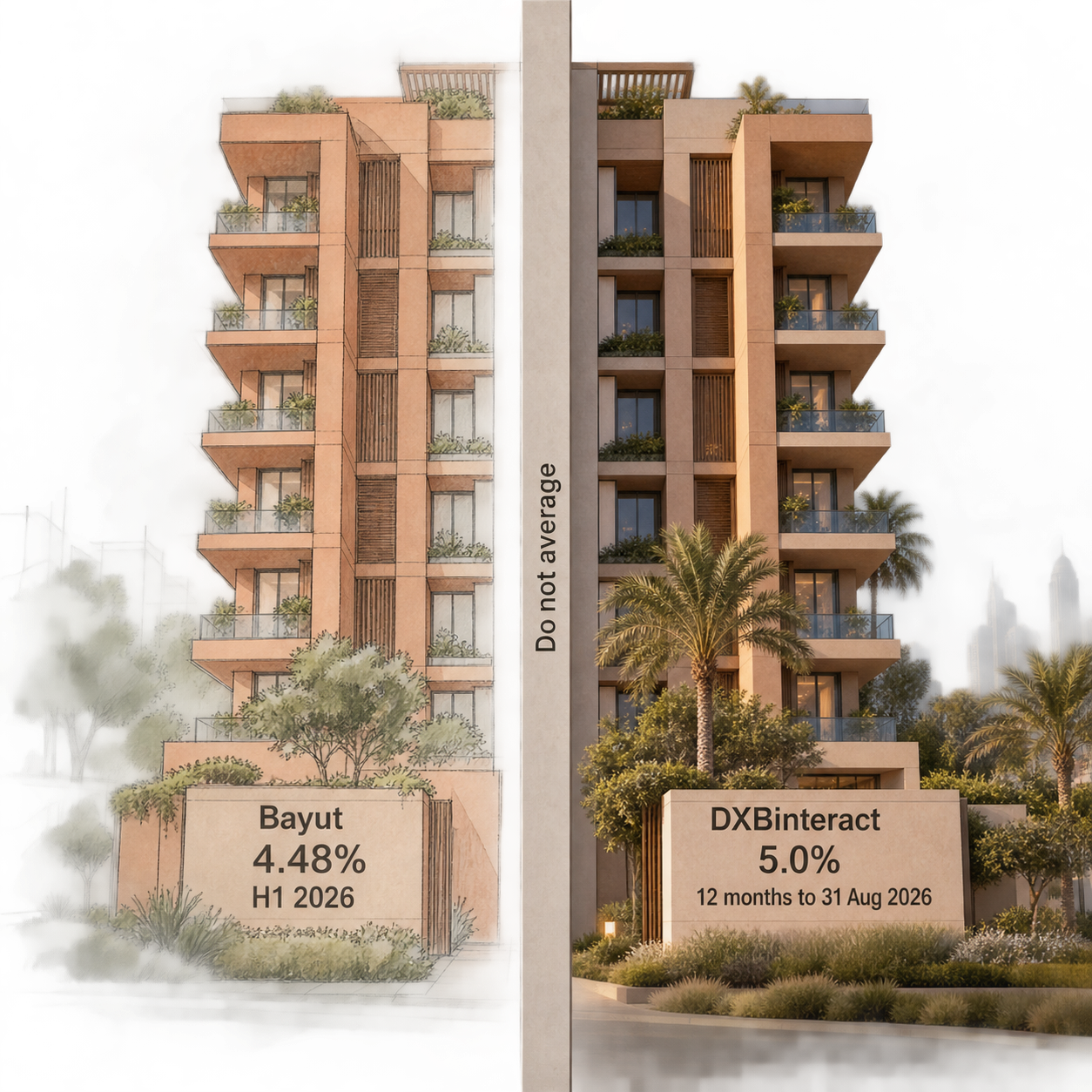
Palm Jumeirah apartments carry two current published rental-yield figures that should not be blended: Bayut reports 4.48% for H1 2026, while DXBinteract reports 5.0% for resale apartments over the 12 months to 31 August 2026. The periods, price inputs and aggregation rules differ, so the gap is a methodology result rather than a single figure to average away.
One address can carry two valid published yields
The 4.48% and 5.0% Palm Jumeirah figures answer different questions. Bayut's H1 2026 sales report presents a projected ROI for a half-year report built around advertised listing prices. DXBinteract's Palm Jumeirah analysis presents a gross area-level yield for resale apartments over a trailing period ending 31 August 2026.
The neutral read: the two figures should remain side by side because their periods and measurement frames do not match.
This is the practical reason a methodology note belongs beside the Dubai rental yield index by area. An index table can make areas comparable within one method. It cannot make every outside source interchangeable.
Asking and registered inputs answer different questions
An asking figure records what was advertised; a registered figure records what entered the transaction or tenancy system. Both can be useful, but the label must stay attached. Bayut's H1 reports state that their figures reflect prices advertised by agencies on behalf of clients unless a table explicitly says otherwise. Bayut also says its reported price metrics use a trimmed mean, which removes some influence from extreme observations.
Property Finder's live rental transactions and sale transactions pages take another route. Each says the displayed residential data comes from DLD after a cleanup that excludes outliers, and each warns that the displayed values may differ from DLD's own site. When fetched on 21 September 2026, the newest visible rent registrations were dated 20 September 2026 and the newest visible sales were dated 19 September 2026.
DXBinteract's rental analysis says its rent series is based on verified DLD transactions. It lets the reader separate new from renewed contracts and filter by bedroom count. Its transaction-data method, published 12 February 2026, also explains that sales reports exclude mortgage registrations, refinancing and gifts, and that some legal classifications are reassigned to functional property types.
The neutral read: asking and registered series can be compared as separate market views, but one should not be relabelled as the other.
Gross and net yield require separate ledgers
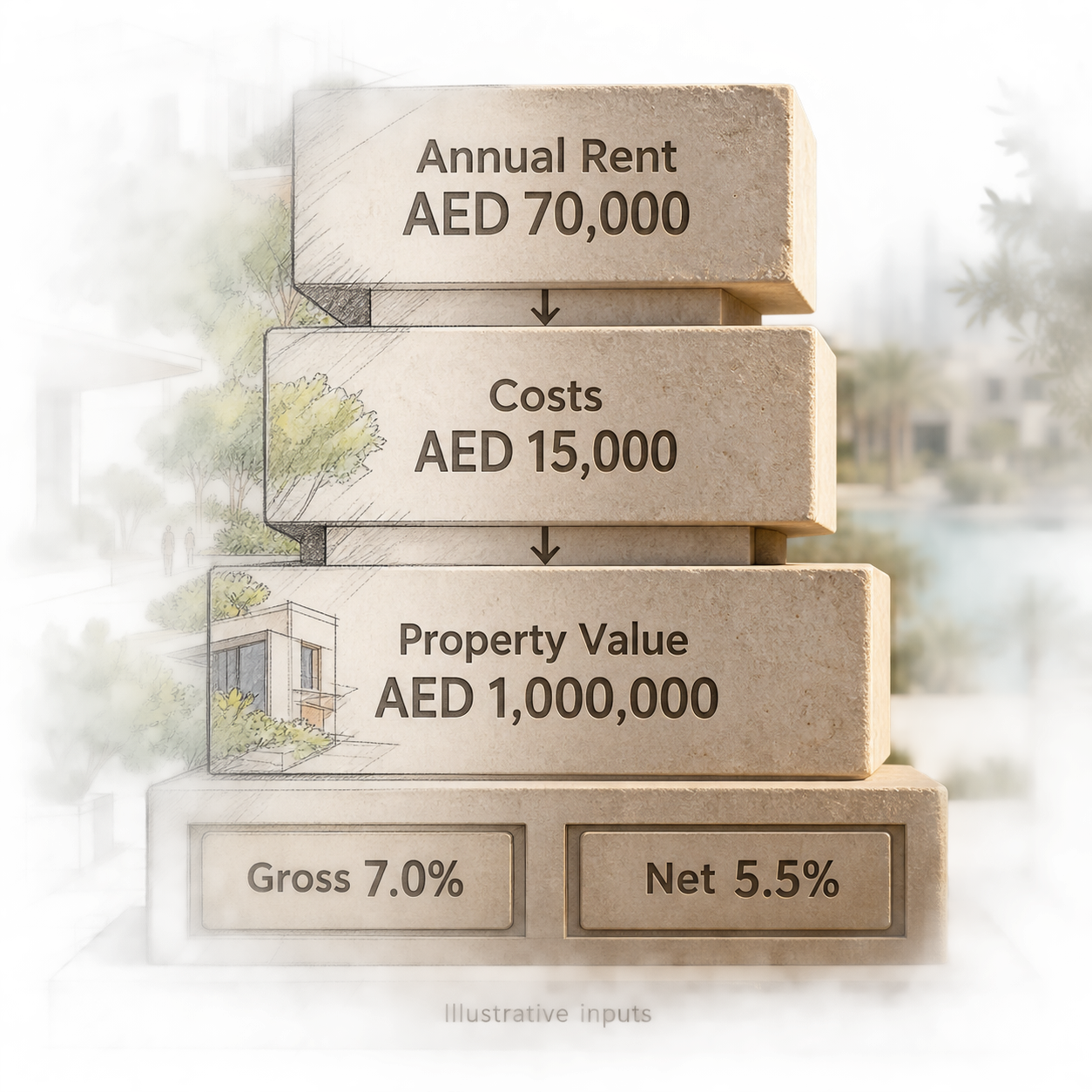
Gross yield uses rent and value before operating costs. Net yield subtracts the costs named in the method before dividing by the chosen value. A publisher can use purchase price, current value, median sale price or an all-in acquisition cost as the denominator. The label "net" is incomplete unless those choices are listed.
The neutral read: DLD and Mollak provide an official service-charge input; the net result still depends on the rest of the ledger.
The DLD Service Charge Index describes an immediate lookup in which the customer selects the project, use and year. Mollak, the DLD and RERA system for jointly-owned-property service charges, describes its index as the place to view the RERA-approved rate. Both pages were fetched on 21 September 2026; the DLD page displayed a site update date of 8 September 2026.
A transparent hypothetical calculation
The amounts below are teaching inputs, not observed prices, rents or project charges. Replace the service-charge line with the selected project's approved Mollak rate and state every other deduction used.
The gross-to-net change in this illustration is entirely explained by the two named cost lines. It does not represent a Dubai average. The Mollak service-charge sensitivity worksheet extends this same discipline across different approved service-charge inputs.
Bedroom and property mix can move the headline
An area-wide apartment yield can combine studios and larger apartments, while another source may isolate one bedroom count or one building. The area label can match even when the underlying unit set does not.
Bayut's H1 2026 report groups apartments and villas into four market segments and publishes bedroom-level advertised prices within those sections. Its area ROI remains a summary figure. DXBinteract's rental analysis exposes apartment, villa and commercial filters, then lets the user select studio through nine-bedroom records as well as new or renewed contract status. Property Monitor's PMiQ says its building data includes unit typology, bedroom count, built-up area, views, features and amenities.
The neutral read: compare studio with studio, villa with villa and new lease with new lease before interpreting a difference as a market signal.
Update cadence changes what "current" means
A publication date is not always the end of the measurement period. Bayut's H1 2026 reports were updated on 2 September 2026, while their measurement label remains H1 2026. A live transaction table can contain later registrations. A monthly dashboard can still use a trailing period.
The neutral read: "current" needs two dates, the period end and the date the page was retrieved or published.
A six-field record makes a yield reusable
Every cited yield should carry six fields: period, rent input, price input, cost treatment, property mix and source date. A seventh field, aggregation method, belongs beside it when the publisher discloses one.
The neutral read: if one of the first six fields is missing, the figure can be quoted only with that limitation made explicit.
For analysts and journalists, the record can sit in a spreadsheet beside the value. For a buyer comparing a particular apartment, it can sit above the calculation. The same rule applies in both settings: preserve the published number, preserve its method and do not average incompatible sources.
Why do Dubai rental-yield figures differ between websites?
As checked on 21 September 2026, the main differences are period, asking versus registered inputs, gross versus net cost treatment, aggregation and property mix. Two pages can name the same area and still measure different populations.
Are Bayut rental yields based on actual transactions?
Bayut's H1 2026 sales-report disclaimer says the report is based on prices advertised by agencies on Bayut and is not representative of completed transactions unless stated explicitly. The report calls its yields projected ROI and says price metrics use a trimmed mean.
Does DLD publish net rental yield?
The DLD Service Charge Index page checked on 21 September 2026 publishes approved service-fee inputs by project, use and year. A net yield still requires a stated rent, denominator and the other costs included in the calculation.
How often should a Dubai rental-yield comparison be refreshed?
Refresh it when the selected period or any input changes. DXBinteract describes a monthly refresh for its area-performance page, Property Monitor describes same-day data in PMiQ, and Bayut publishes period reports, so the source date must remain attached.
Lida MoghaddamArchitect-turned-real-estate-specialist based in Dubai. She helps buyers, sellers, and investors read property with a designer's eye — structure, location, and long-term value.