
Signed lease to cleared rent: the Dubai owner evidence chain
 Lida Moghaddam
Disclaimer: This article is for general informational purposes only. It is based on cited public data and published under Lida Moghaddam's RERA-licensed masthead. It is not financial, legal, or investment advice. Dubai's property market moves quickly, so figures, yields, and rules may change or become outdated by the time you read this. Verify current information with the relevant authority or a qualified professional before acting. Read the full disclaimer.
Table of contents
A Dubai Land Department Ejari registration produces an e-Contract Registration Certificate, not evidence that rent has cleared the owner's bank. For an overseas owner, the clean audit trail keeps the signed lease, Ejari certificate, contractual due date, payment acknowledgement and bank credit as separate events.
One rent can have five different dates
The five dates answer different questions, so no single record can safely stand in for the whole chain. A signed contract establishes agreed terms. Ejari adds the official registration record. A due date says when an instalment falls due. A receipt acknowledges an instrument or payment if one is issued. The owner-side bank record shows whether cash was credited.
DLD describes its service as registering or renewing a tenancy contract and names the e-Contract Registration Certificate as the issued document (DLD, checked 26 September 2026). That service scope is why the Ejari certificate belongs in the registration column rather than the cash column.

This is the operating distinction that sits beneath a Dubai property investment file. A yield assumption may start with annual rent, but an owner cash ledger needs dates and records, not one headline number.
Ejari records the tenancy, not the bank credit
The current official route ends with a registration certificate. It does not end with a bank statement. As of 26 September 2026, DLD lists the Ejari website, Dubai REST and Real Estate Trustee Centres as service channels. Where a property-management company manages the property, DLD also identifies that company in the service-centre route (DLD, checked 26 September 2026).
Open the official channel
Use the DLD Ejari service or Dubai REST for the online route. DLD says Dubai REST lets owners and tenants manage lease registration, renewal and cancellation (DLD, checked 26 September 2026).
Enter the contract details
DLD's online procedure asks the user to select the service, fill in the required information and upload the necessary documents. The app route lists a copy of the Unified Tenancy Contract as a required document.
Complete review and payment
The published route places staff review and approval after the information and payment steps. This is the official service sequence, not a statement about rent collection.
Save the issued certificate
DLD says the e-Contract Registration Certificate arrives by email through the Ejari system or Dubai REST route. Its separate certificate-download page uses the Ejari contract number or property identifiers (DLD, checked 26 September 2026).
The certificate should therefore be reconciled to the signed contract details, property and parties. The payment schedule then needs its own reconciliation against receipts and bank entries.
Billed rent, rent due, a receipt and cleared cash are separate columns
Each label describes a different point in the evidence chain. Combining them can make a cash position look earlier or later than the supporting records allow.
A bill is an issuer record. A contractual due date comes from the agreement. A receipt is an acknowledgement. Cleared cash comes from the bank record. The workflow does not use any of those dates as an accounting or tax recognition date.
This distinction also keeps yield and liquidity in their proper places. The after-service-charge yield worksheet compares annual inputs, while a cash ledger records when the owner's account actually receives money.
Illustrative schedule: AED 120,000 in four instalments
The example below is an editorial illustration, not a Dubai norm and not a real tenancy. Assume a lease signed on 5 October 2026, Ejari registered on 7 October 2026 and annual contractual rent of AED 120,000 split into four equal cheque instalments of AED 30,000. The due dates and bank-credit dates are scenario inputs. They make no claim about standard cheque timing.
The four instalments total AED 120,000. At the end of 15 January 2027, two instalments are contractually due, so due-to-date rent is AED 60,000. Only the first AED 30,000 is cleared in the scenario because the second credit appears on 18 January 2027. The difference is AED 30,000 for a three-calendar-day window. On 18 January, cumulative cleared cash becomes AED 60,000.
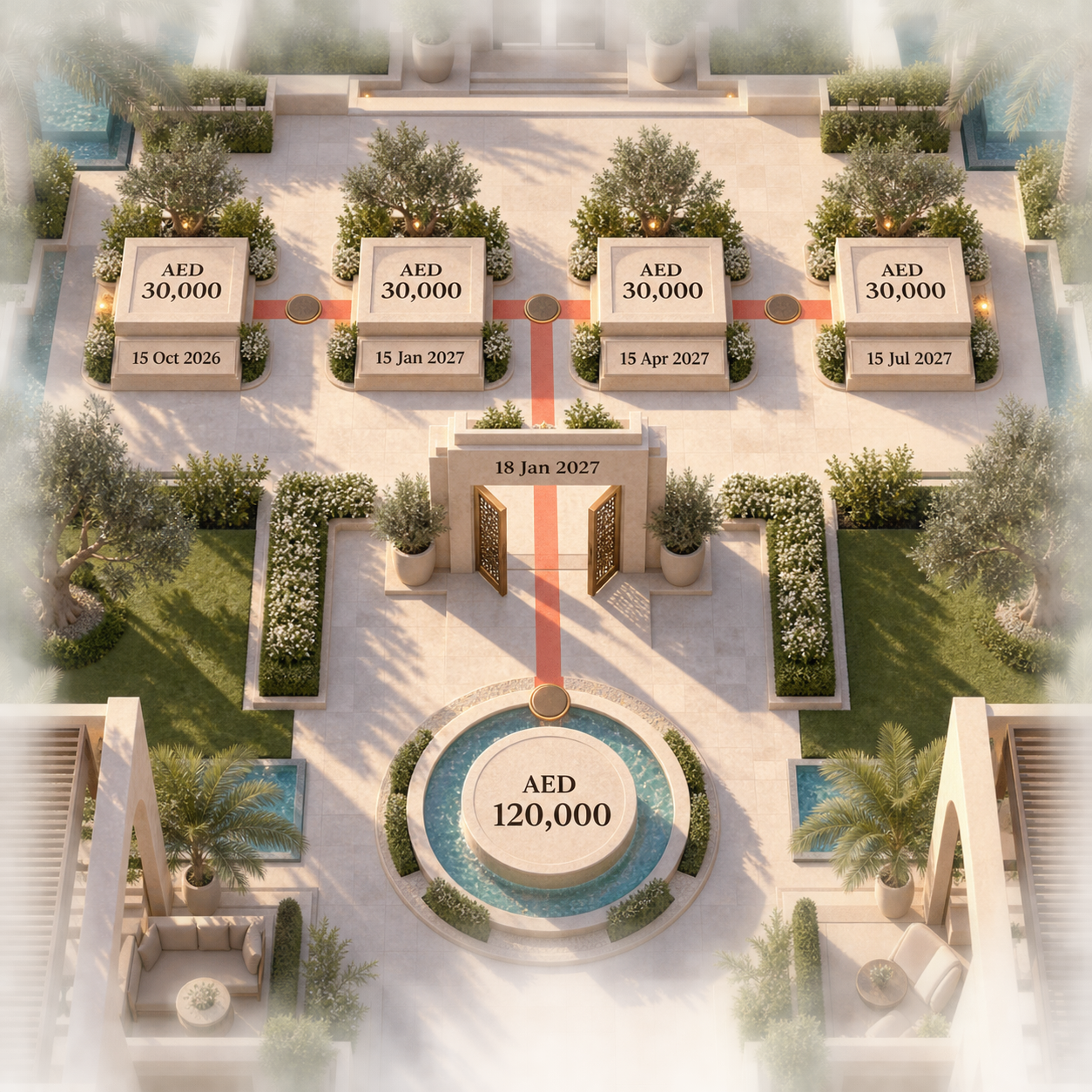
The calculation uses Decimal arithmetic and saved date logic. No building rent, transaction document or market convention sits behind the inputs. For the larger acquisition-to-first-rent sequence, the companion ready-property cash-flow calendar places the tenancy leg inside the owner file.
A deposited cheque is still a separate stage from cleared cash
The bank credit remains the closing record even when the cheque-clearing system is fast. CBUAE says its Image Cheque Clearing System lets banks settle cheques from electronic images. It also publishes a specific branch cutoff: cheques deposited by 10am are cleared by 5pm the same day (CBUAE, checked 26 September 2026).
That published system statement does not replace the transaction record. Deposit evidence shows presentation into the banking process. The owner-side statement shows what happened to the specific payment and on which date it was credited. This article does not assign a treatment to a bounced or replaced cheque because no transaction-specific record was supplied for either event.
For a transfer rather than a cheque, the same evidence logic applies: retain the tenant or manager reference if one exists, then reconcile it to the owner-side bank entry. The payment instrument may change, but the cleared-cash test remains tied to the bank record.
Build the overseas owner file in reconciliation order
The most useful file can be read from contract to cash without guessing which date another person used. Keep the records in the order below and retain the original issuer or system metadata.
- Signed lease, including the recorded rent and payment schedule.
- Ejari e-Contract Registration Certificate.
- Invoice or owner-ledger entry, if the owner or manager issues one.
- Due-date schedule with instrument references where they exist.
- Dated receipt or manager acknowledgement, if issued.
- Bank deposit evidence, where relevant.
- Owner-side bank statement or transaction record showing the credit.
- Reconciliation note matching amount, date and reference across the file.
The monthly owner view can then show three amounts without collapsing them: contractually due to date, acknowledged but not yet matched to a credit, and cleared cash. Any unexplained difference remains a reconciliation item until another record resolves it.
No transaction documents were supplied for this article. The records above describe what each document would establish if it exists in an owner's actual file.
FAQ, checked 26 September 2026
Does a signed tenancy contract mean the rent has been paid?
No. The signed contract records the agreed rent and schedule. A receipt can acknowledge a later payment or instrument if one is issued, while the owner-side bank record shows whether cash was credited.
Does Ejari prove that the tenant paid the rent?
No. DLD describes the service as registration or renewal of a tenancy contract and lists the e-Contract Registration Certificate as its issued output, as checked on 26 September 2026.
When does scheduled rent become cleared cash in this workflow?
It enters the cleared-cash column on the date the owner-side bank record shows the funds credited and available. The contract due date and any receipt remain separate evidence dates.
What document does DLD issue after online Ejari registration?
DLD lists an e-Contract Registration Certificate, sent by email after the Ejari system or Dubai REST process is reviewed and approved, as checked on 26 September 2026.
Lida MoghaddamArchitect-turned-real-estate-specialist based in Dubai. She helps buyers, sellers, and investors read property with a designer's eye — structure, location, and long-term value.