Dubai rental yield: a maintenance-reserve sensitivity model
 Lida Moghaddam
Disclaimer: This article is for general informational purposes only. It is based on cited public data and published under Lida Moghaddam's RERA-licensed masthead. It is not financial, legal, or investment advice. Dubai's property market moves quickly, so figures, yields, and rules may change or become outdated by the time you read this. Verify current information with the relevant authority or a qualified professional before acting. Read the full disclaimer.
Table of contents
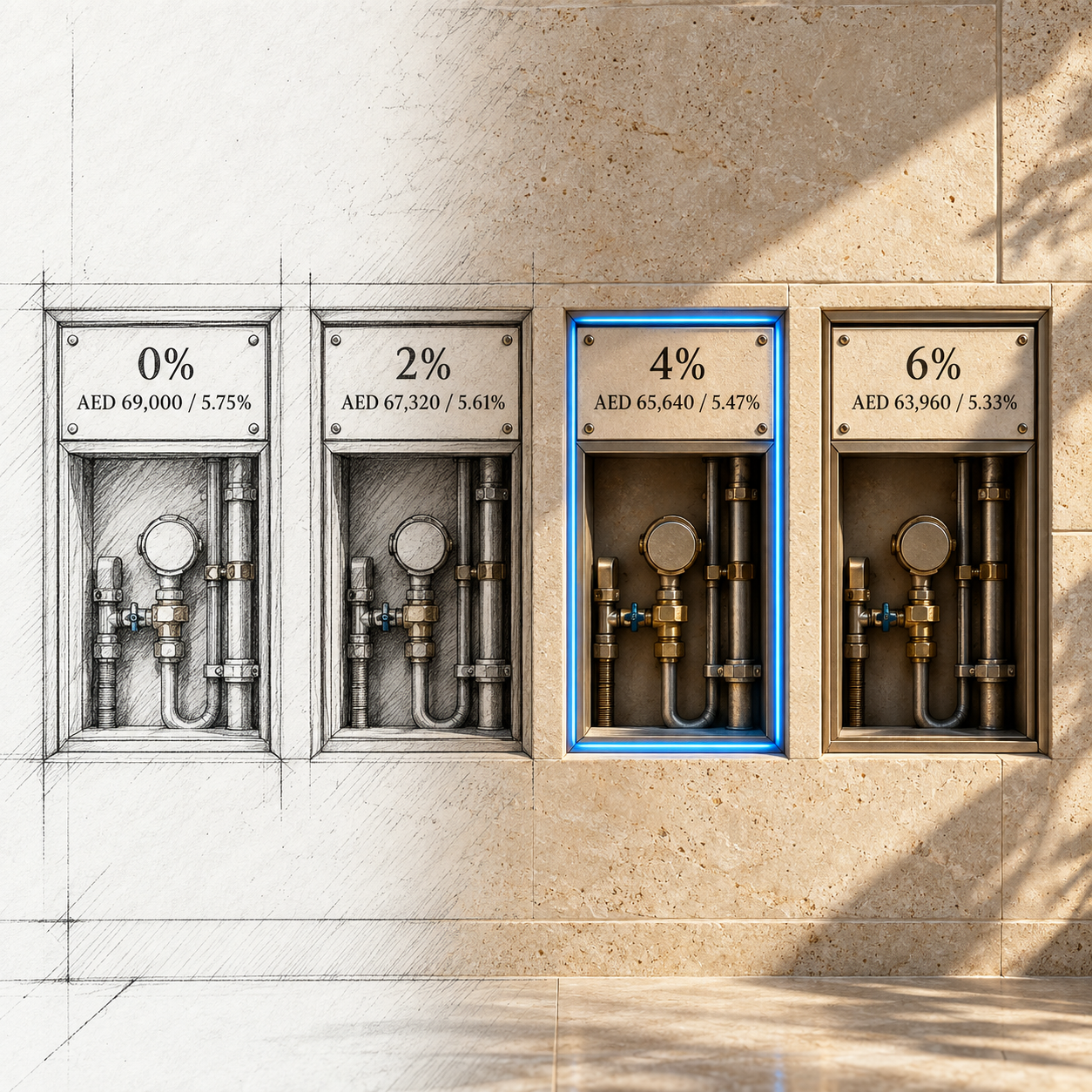
In the illustrative model dated 30 September 2026, adding a maintenance allowance equal to 4% of AED 84,000 gross annual rent to the declared AED 1.2 million price basis reduces modelled annual income by AED 3,360 and modelled net yield by 0.28 percentage points, from 5.75% before that allowance to 5.47%. The 4% is an owner-selected sensitivity input, not a rate published by Dubai Land Department or a forecast of repairs.
The base case keeps every input separate
The 4% base case is useful because its status is visible: it is an editorial sensitivity selected by the owner, while the AED 10,800 service-charge line is a separate illustrative input. Neither number is presented as a returned official record.
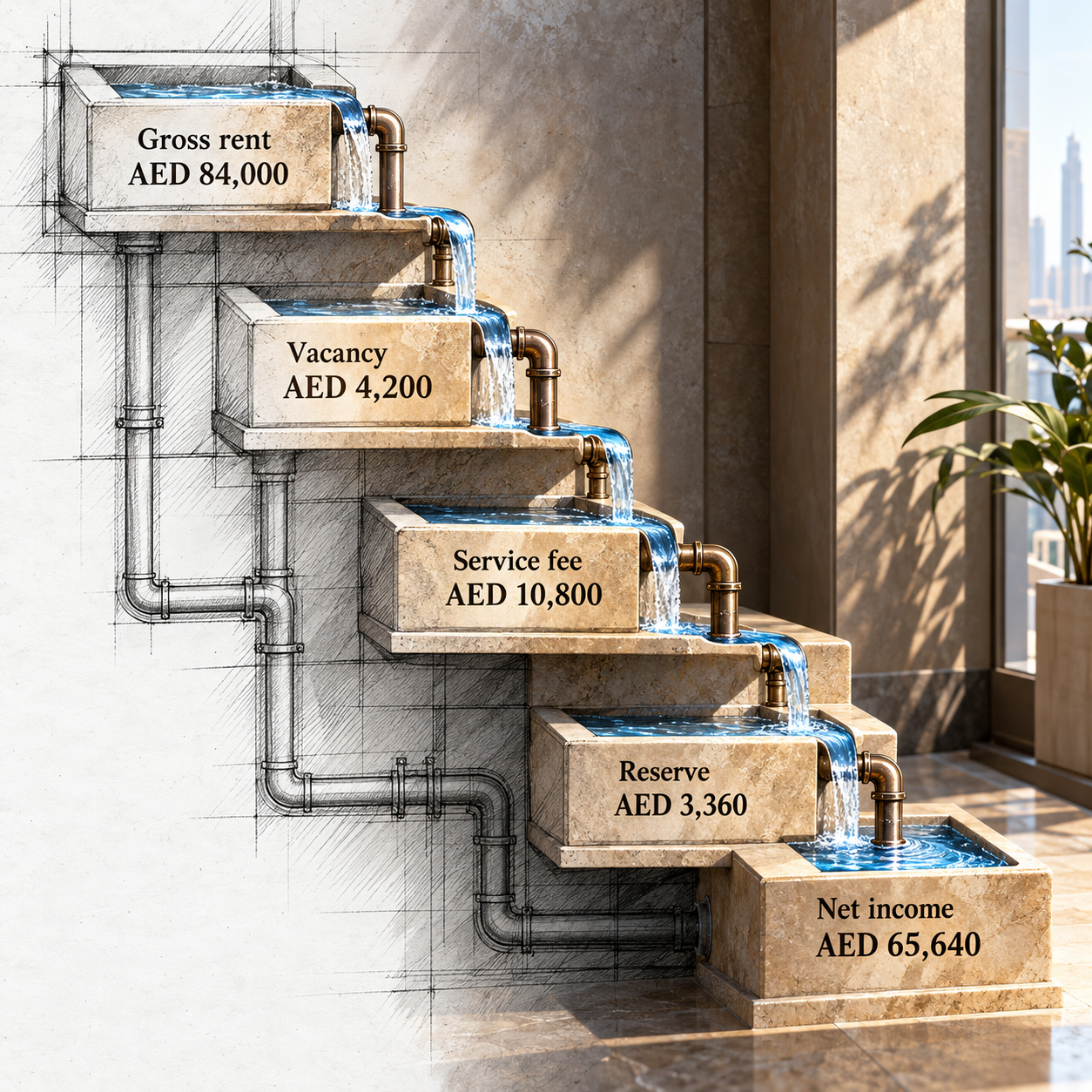
Gross yield is AED 84,000 divided by AED 1,200,000, or 7.00%. After the vacancy and service-charge inputs, modelled annual income is AED 69,000 and modelled yield is 5.75%. Deducting the base maintenance allowance leaves AED 65,640 and 5.47%.
The base-case deductions total AED 18,360, equal to 21.86% of gross scheduled rent. That total is not a Dubai cost benchmark. It is the sum of the three stated deductions in this one model.
Four declared allowances move modelled yield from 5.75% to 5.33%
Changing only the maintenance allowance produces a 0.42 percentage-point span across the four scenarios. Price, gross rent, vacancy and the annual service-charge input stay fixed.
At 4%, the arithmetic is:
Vacancy allowance: AED 84,000 × 5% = AED 4,200
Maintenance allowance: AED 84,000 × 4% = AED 3,360
Modelled annual income: AED 84,000 - AED 4,200 - AED 10,800 - AED 3,360 = AED 65,640
Modelled net yield: AED 65,640 ÷ AED 1,200,000 × 100 = 5.47%
The 6% row is not a forecast of higher repairs, and the 0% row does not say repairs will cost nothing. They are boundaries in a sensitivity table.
One percentage point of rent moves this model by 0.07 yield points
The marginal effect is fixed while rent and price stay fixed. One percentage point of AED 84,000 gross rent is AED 840. Dividing AED 840 by the AED 1.2 million price basis gives 0.07 percentage points of yield.
This distinction matters. A reserve set at 4% of rent does not reduce a 5.75% yield by 4%. It reduces annual income by AED 3,360 and this model's yield by 0.28 percentage points. The base-case 5.47% is 1.53 percentage points below the 7.00% gross yield, but vacancy, service charge and maintenance allowance together create that gap.
The model is the closest fit for an owner comparing the same unit under different declared maintenance allowances. The rental-yield source methodology is the closer reference when price, rent, period or property population also changes.
A project reserve category is not a private unit allowance
Record names identify different levels of evidence. A category inside a jointly owned property's service-charge budget cannot be relabelled as the owner's allowance for repairs inside a unit.
Mollak is the public-facing system name. DLD's approval page calls the supporting artifact a detailed statement of the annual budget for the service allowance of the project. On this page, “Mollak annual budget” is editorial shorthand for that project-level artifact, not a separate legal record name.
Dubai Land Department's service-fee approval route says the application includes a detailed annual budget statement for the project's service allowance, at least three tenders for each service provider, service and maintenance contracts, consumption bills and an external audit report. The page exposes no page-specific update date, so these points are labelled accessed 30 September 2026.
Law No. 6 of 2019 defines Service Charges as annual charges collected from owners for management, operation, maintenance and repair of jointly owned real property, in the official DLD legislation compilation, issue year 2019 and accessed 30 September 2026. That legal term sits at the jointly owned property level. In this article, maintenance allowance is editorial shorthand for a separate owner-selected unit-level model input.
Match the official service-charge input before testing maintenance
The official route supplies a specific lookup, not a citywide assumption. DLD's Service Charge Index asks for project, use and year, accessed 30 September 2026. The static route reviewed for this article did not expose a reproducible returned record with all three fields, so the worked model uses a fully declared illustrative AED 10,800 input and names the official value as unknown.
The canonical after-service-charge Mollak worksheet covers the official lookup and title-deed-area match. Its service-charge sensitivity companion changes that official-cost input. This companion holds service charge fixed and changes only the private maintenance allowance.
The two DLD service routes reviewed on 30 September 2026 do not publish a universal percentage for an owner's private maintenance allowance. That is a bounded finding about those routes, not a claim that every owner will incur the same repair cost.
Rebuild the model from records, not labels
A reproducible file keeps returned values, calculations and editorial classifications in different columns. The result can then be updated without rewriting history.
Fix the unit and price basis
Record whether the AED price is a completed transaction, an asking price or another declared basis. Keep the project, building and unit names separate.
Record gross rent and vacancy separately
State whether rent is contracted, asked or received. Label vacancy as an editorial allowance unless a dated unit record supports it.
Retrieve the service-charge record
Match project, use and year in the DLD Service Charge Index. Keep the returned rate or amount with its source fields and access date.
Choose the maintenance sensitivities
Name each allowance as owner-selected. Do not describe a scenario percentage as a usual Dubai rate.
Recompute every row
Deduct the same vacancy and service-charge inputs in every scenario, then divide each annual-income result by the same price basis.
This model excludes finance costs, acquisition costs, leasing and management fees, insurance, utilities, tax and unplanned costs beyond the selected allowance. Add a cost only when its record level and period are clear. The result remains a modelled net yield under declared inputs, not cash actually received.
Sources
- Dubai Land Department Service Charge Index, accessed 30 September 2026
- Dubai Land Department service-fee approval route, accessed 30 September 2026
- Mollak public service page, accessed 30 September 2026
- Dubai Land Department Real Estate Legislation of Dubai, issue year 2019, accessed 30 September 2026
FAQ, checked 30 September 2026
What is the average rental yield in Dubai?
An average depends on the source period, property population and whether the figure is gross or net. This sensitivity model does not estimate a Dubai average; it shows how one declared maintenance allowance changes a fixed case.
How do I calculate the maintenance fee for my property?
First identify the record. For a jointly owned property's approved service fee, DLD's index uses project, use and year. For the private maintenance allowance in this model, multiply gross scheduled rent by the owner-selected scenario percentage; that is an editorial sensitivity, not an official fee.
What is the formula for calculating maintenance costs?
This model does not forecast maintenance cost. It tests a declared allowance as gross scheduled annual rent multiplied by the selected percentage, then shows the effect on annual income and yield.
How much should I budget for house maintenance?
The DLD Service Charge Index and service-fee approval route reviewed on 30 September 2026 do not publish a universal percentage for an owner's private unit allowance. A sensitivity can be tested against the unit's own dated repair records without presenting it as a Dubai rate or a future cost.
Lida MoghaddamArchitect-turned-real-estate-specialist based in Dubai. She helps buyers, sellers, and investors read property with a designer's eye — structure, location, and long-term value.