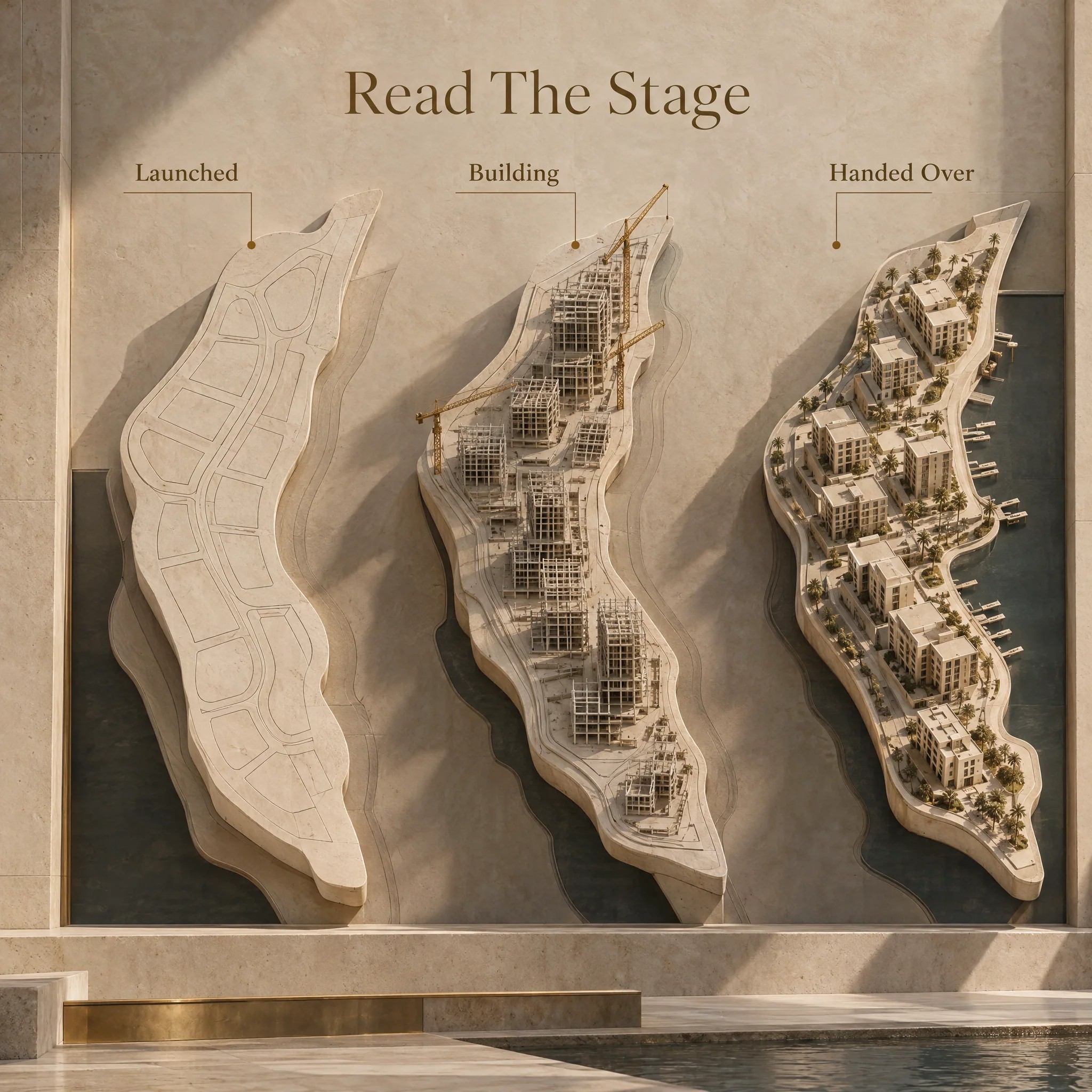
Dubai project escrow checks: the official verification route
Dubai's Law No. 8 of 2007 defines an escrow account as the project bank account into which off-plan buyer and project-financier payments are deposited. As of 19 September 2026, the practical buyer check is to match the exact project number, registered developer and escrow bank or account in Dubai Land Department records before interpreting any payment schedule.
Five checks answer five different questions
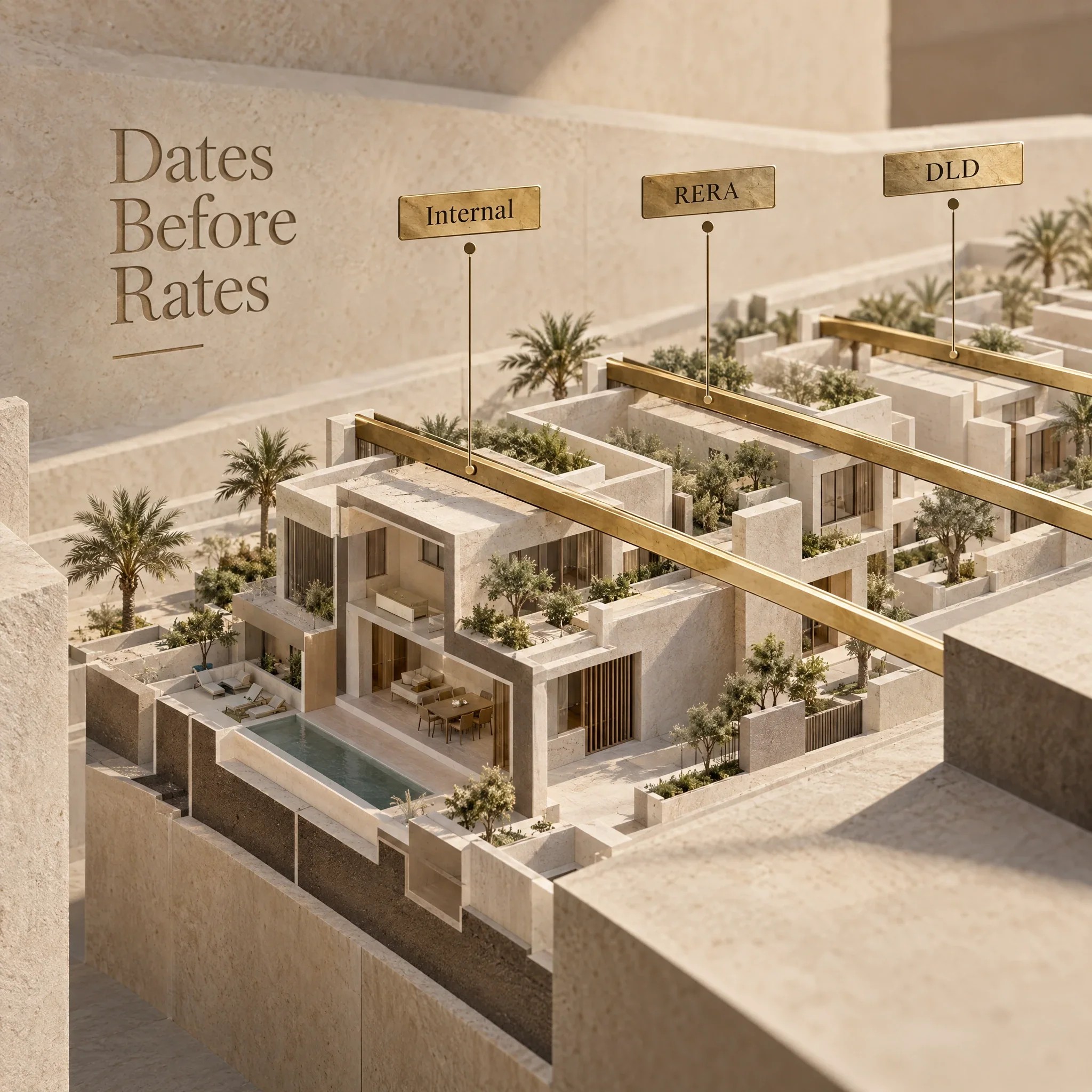
No single document answers every off-plan question. The project record establishes identity, the status screen gives a dated regulatory view, the developer and permit records establish registration facts, the escrow fields identify the project account, and the payment plan states the proposed obligation.
The sequence matters because a polished payment table can be internally consistent while still lacking enough identifiers to connect it to the official project record. Start with the project and the payee. Read the instalment percentages only after those fields reconcile.
Follow the official route in this order
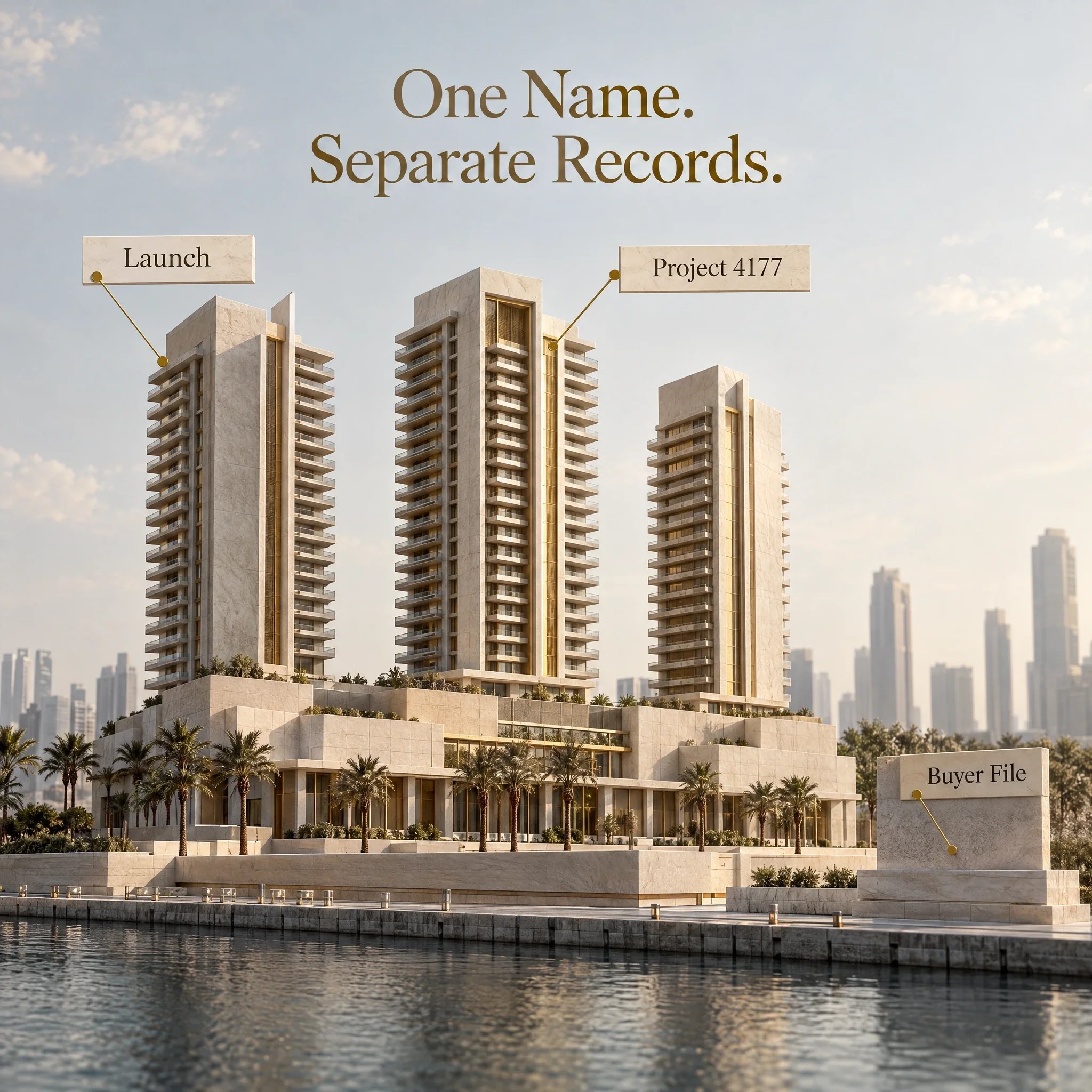
The route begins with exact names, not a brochure title. Marketing names can be shortened, translated or shared across phases, while the DLD project number and registered developer name are much tighter identifiers.
Collect the identifiers
Ask for the exact project name, DLD project number, registered developer's legal name, Trakheesi permit transaction number, escrow bank and account details, and the draft contractual seller name. Put them in one worksheet without correcting spelling or abbreviations.
Find the project in Mashrooi
Search DLD's Project Status Enquiry by the exact name or project number. Compare the project number, registered date, location, developer name and number, status, completion field and comments-updated date with the document pack. DLD also exposes inspection and escrow sections on the result screen.
Verify the developer and permit separately
Check the legal developer name against DLD's Licensed Developers service. If the marketing material supplies a Trakheesi permit transaction number, use DLD's Verify License and Permits service to validate that electronic record. Law No. 8 of 2007 requires developers to be entered in the developer register and requires written DLD authority for off-plan advertising (DLD legislation, Articles 4 and 5, checked 19 September 2026).
Match the escrow payment details
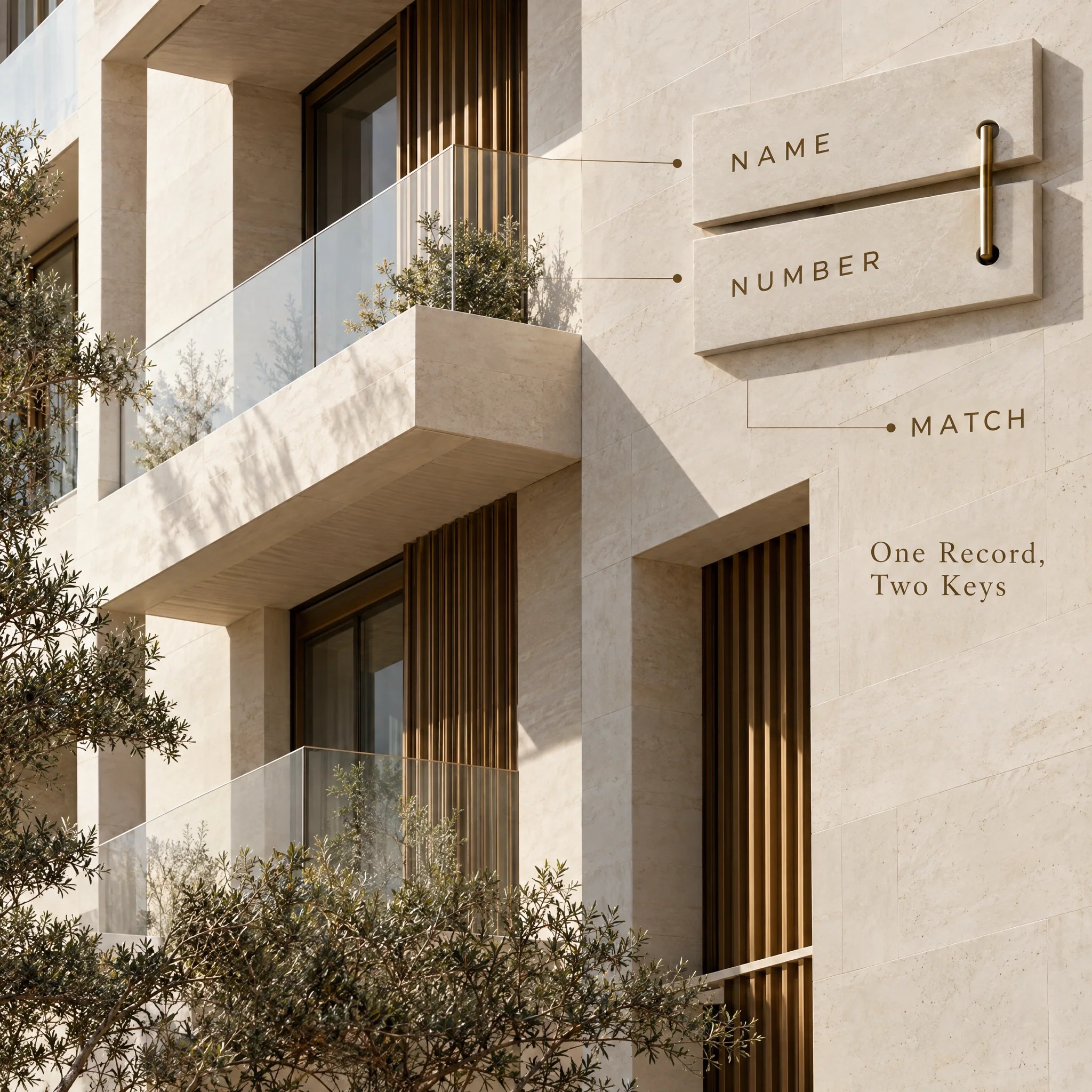
Open the escrow section of the project record. Compare bank name, account identifier and project identity character for character with the beneficiary instructions. A difference is a question for DLD, RERA, the account trustee or a licensed professional before funds move, not a field to infer from a similar project name.
Read the payment plan against the match
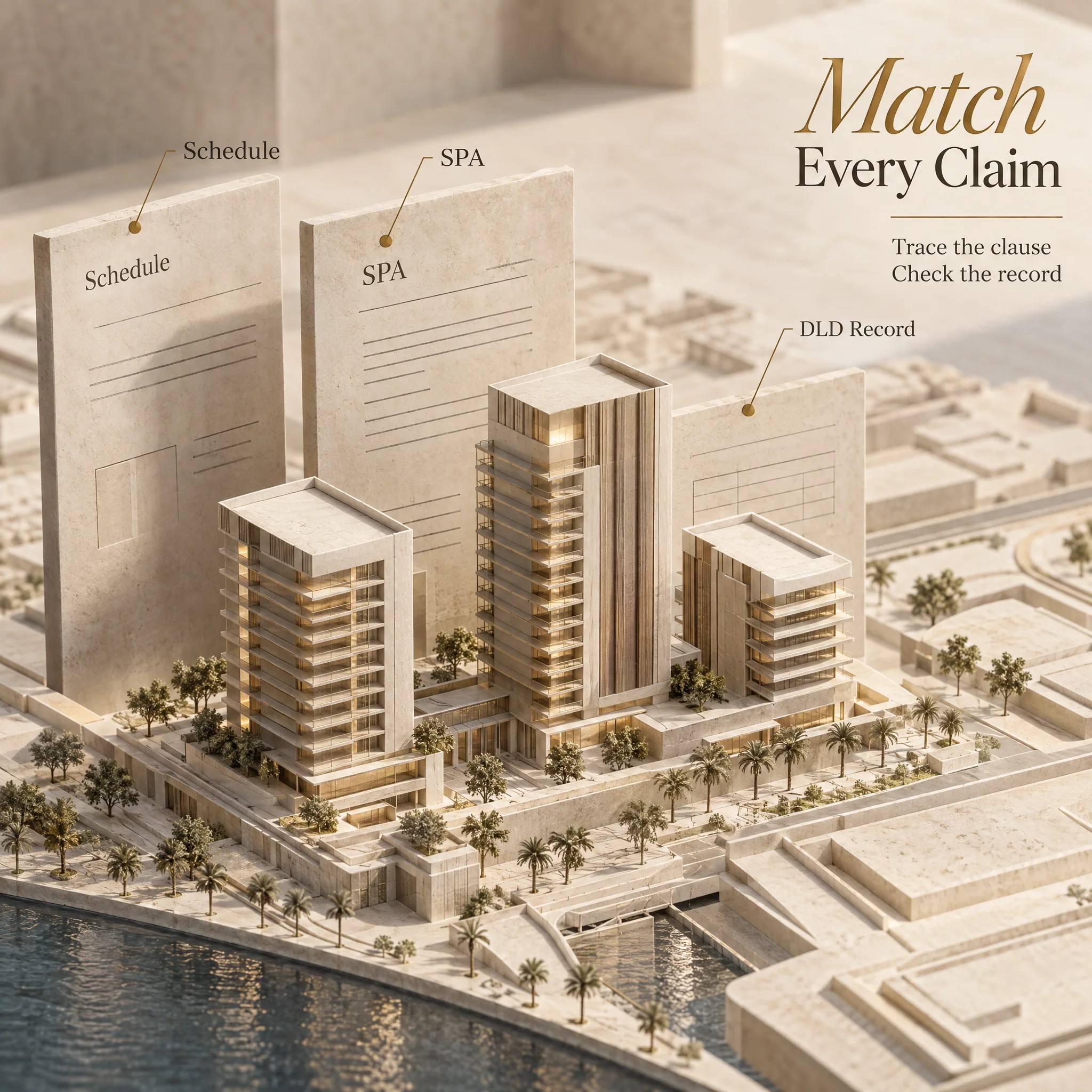
Mark every instalment as calendar-linked or construction-linked. Then confirm that the seller, project, payee and account in the schedule agree with the records already checked. The signed contract and its attachments control the actual obligation, not a standalone marketing table.
Save the dated evidence
Retain the DLD results, comments-updated date, verified permit result, payment instructions and the version of the draft documents reviewed. A later change can then be compared with a known record rather than memory.
The wider launch-price verification method begins after this identity check. Price evidence cannot repair a mismatch in project, seller or payment account.
Escrow registration establishes a narrow set of facts
An escrow match establishes a project-specific regulated account trail, not an outcome. Under Article 7 of Law No. 8 of 2007, purchaser and project-financier payments are deposited with an escrow agent in an account opened in the name of the real-estate development project. Article 9 says the account is dedicated to that project and that a developer with multiple projects must have a separate account for each one (DLD legislation, checked 19 September 2026).
DLD's FAQ adds the operating detail. It says all amounts received from buyers of off-plan units are deposited in the project escrow account. It also says the account agreement sets the major construction stages for disbursement, and the account trustee's engineer checks a completed stage before an authorised payment to service providers (DLD FAQ, checked 19 September 2026). Article 11 requires the escrow agent to provide DLD with regular revenue and expenditure statements and allows DLD to request data and audit those statements.
Those facts support four conclusions: the account is tied to the named project, the account sits inside DLD's escrow framework, buyer receipts are meant to enter that account, and disbursement is governed by the account arrangement and oversight process.
They do not answer four other questions: whether the future completion date will match an estimate, what the finished workmanship will be, what the developer's wider financial position is, or whether the price and contract terms fit a particular buyer. Those require separate evidence. The contract also needs its own legal review where the buyer wants advice on rights or remedies.
A hypothetical pack shows how the match works
The worked example below uses invented names and numbers. It is not a real project, seller, account or offer.
Assume a buyer receives a pack for Project Cedar. The draft reservation form names Cedar Development LLC, gives DLD project number 90001, and asks for payment to Gulf Example Bank, account ending 4321. The attached plan labels the home as Building B, unit 1204. The payment schedule asks for an initial amount on signing, followed by calendar and construction-stage instalments.
The first pass is a straight reconciliation:
If the official project number and developer agree but the bank differs, the pack is not fully reconciled. The correct next step is to obtain current confirmation through DLD, RERA, the account trustee or a licensed professional. It is not to assume that two accounts are equivalent because the beneficiary names look related.
If every identity and account field agrees, the pack has cleared the record-matching stage. The buyer still has to read price, area, specifications, timing, charges, cancellation provisions and other terms on their own evidence. The Nourelle project fact sheet shows how a named-project article keeps launch facts, construction evidence and buyer checks in separate source columns.
Read the payment plan after the registry match
A payment plan answers when and under what stated trigger an amount becomes due. It does not replace the project record. Read each line in the context of the draft SPA, because a launch sheet may summarise terms that the contract defines more precisely.
Use two columns for timing:
- Calendar-linked: a fixed date or a period after signing.
- Construction-linked: a stated stage or percentage of work.
For a construction-linked instalment, compare the request with the current DLD status and the evidence required by the contract. DLD says its project-status service provides the percentage of completion and project status. Its FAQ also explains that escrow disbursement stages are checked by the account trustee's engineer, but that escrow process is not the same document as the buyer's payment schedule (DLD, checked 19 September 2026).
For every line, record the amount or percentage, due trigger, recipient, account, document version and source date. If a schedule mixes a booking amount, dated instalments and construction milestones, keep those categories separate. Do not convert an estimated completion date into a contractual certainty.
Keep a dated file before and after signing
The pre-contract file should let another reader repeat the match. Save the Project Status result, developer-list result, permit verification, escrow fields, payment instructions, draft reservation form, draft SPA and schedule, each with the date checked.
Oqood is the provisional register used for an individual off-plan sale. DLD's initial-sale service says the developer submits the property and contract details through Oqood and the purchaser receives the output by email (DLD, checked 19 September 2026). That buyer-specific output belongs in the file after the sale is registered. Before signing, it cannot substitute for the project-level checks because the individual sale does not yet exist in the provisional register.
The resulting evidence pack has a clear order: official project identity, dated status, developer and permit records, escrow match, contract terms, then buyer-specific Oqood evidence when issued.
What is off-plan property in Dubai?
An off-plan unit is sold before the real-estate development is complete. Law No. 8 of 2007 applies to Dubai developers selling such units and receiving payments from buyers or project financiers (DLD legislation, checked 19 September 2026).
Is it worth buying off-plan property in Dubai?
As of 19 September 2026, the official checks do not answer that personal decision. They establish project identity, dated status, developer or permit records and escrow details; price fit, timing, contract terms and the buyer's circumstances need separate analysis.
Who are the most trusted off-plan developers in Dubai?
DLD publishes a list of licensed developers, but a company-level licence is only one record. As of 19 September 2026, the repeatable method is to verify the specific project's registration, current status, permit and escrow account, then read the contract on its own terms (DLD Licensed Developers).
Does an escrow account confirm the handover date?
No. As of 19 September 2026, the escrow record identifies the project account and its regulatory framework. The current status is a separate dated field, while future timing and handover terms sit in the sale documents and should be verified in their current form.