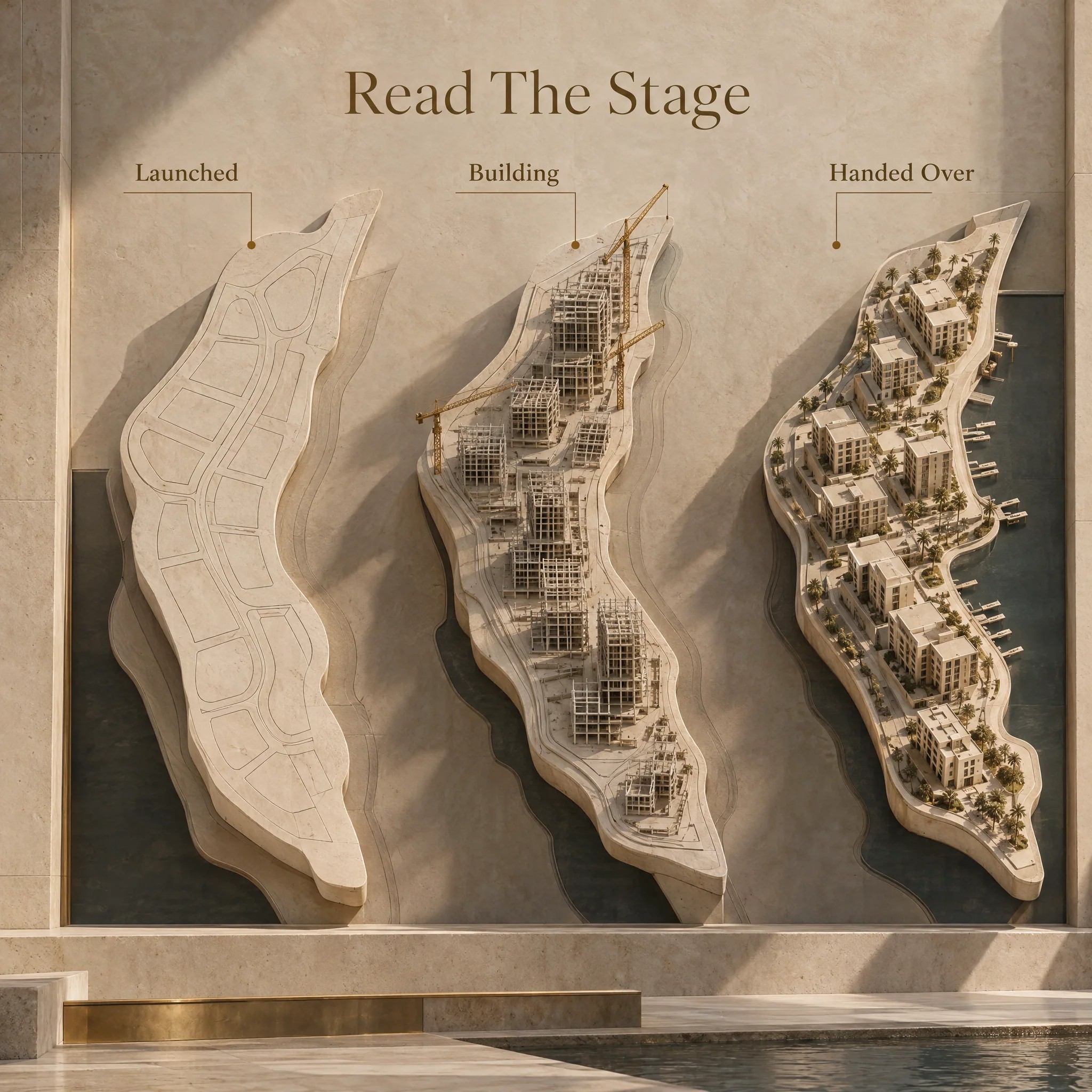
DLD project-status snapshots: 27 September vs 1 October 2026
Across two official Dubai Land Department responses captured four days apart, the same eight project identifiers produced 39 stable declared field values, one field that returned null on both dates, no changed values, no missing rows and no calculation errors. The comparison covers 27 September and 1 October 2026, and it does not turn a stable status field into evidence of handover, completion quality or an event outside the response.
The declared status fields did not change
The direct answer is that none of the five declared fields changed for any of the eight records. The DLD Project Status Enquiry says it returns project completion percentage and details and accepts a land number, project number or project name. For this comparison, the query key was the same numeric project identifier on both dates, and the declared fields were fixed before the second snapshot was interpreted.
Each dated cell below reads in the same order: status; project completion ratio; completion date; latest inspection date and percentage. The official English name has its own column. Values are from the saved DLD responses captured on 27 September and 1 October 2026.
The record-by-record reading is deliberately neutral:
- 1743, Jumeirah Living Marina Gate: all five declared fields were stable.
- 1456, Marina Quays: four declared fields were stable; the latest-inspection field returned null on both dates.
- 1495, The Residences At Marina Gate 1: all five declared fields were stable.
- 1547, The Residences At Marina Gate 2: all five declared fields were stable.
- 845, Escan Marina Tower: all five declared fields were stable.
- 221, Princess Tower: all five declared fields were stable.
- 1827, Liv Residence: all five declared fields were stable.
- 130, Cayan Tower: all five declared fields were stable.
These are project-level response values from the official service, accessed again on 1 October 2026. They do not describe a particular apartment, contract or buyer file.
Five outcomes keep absence separate from change
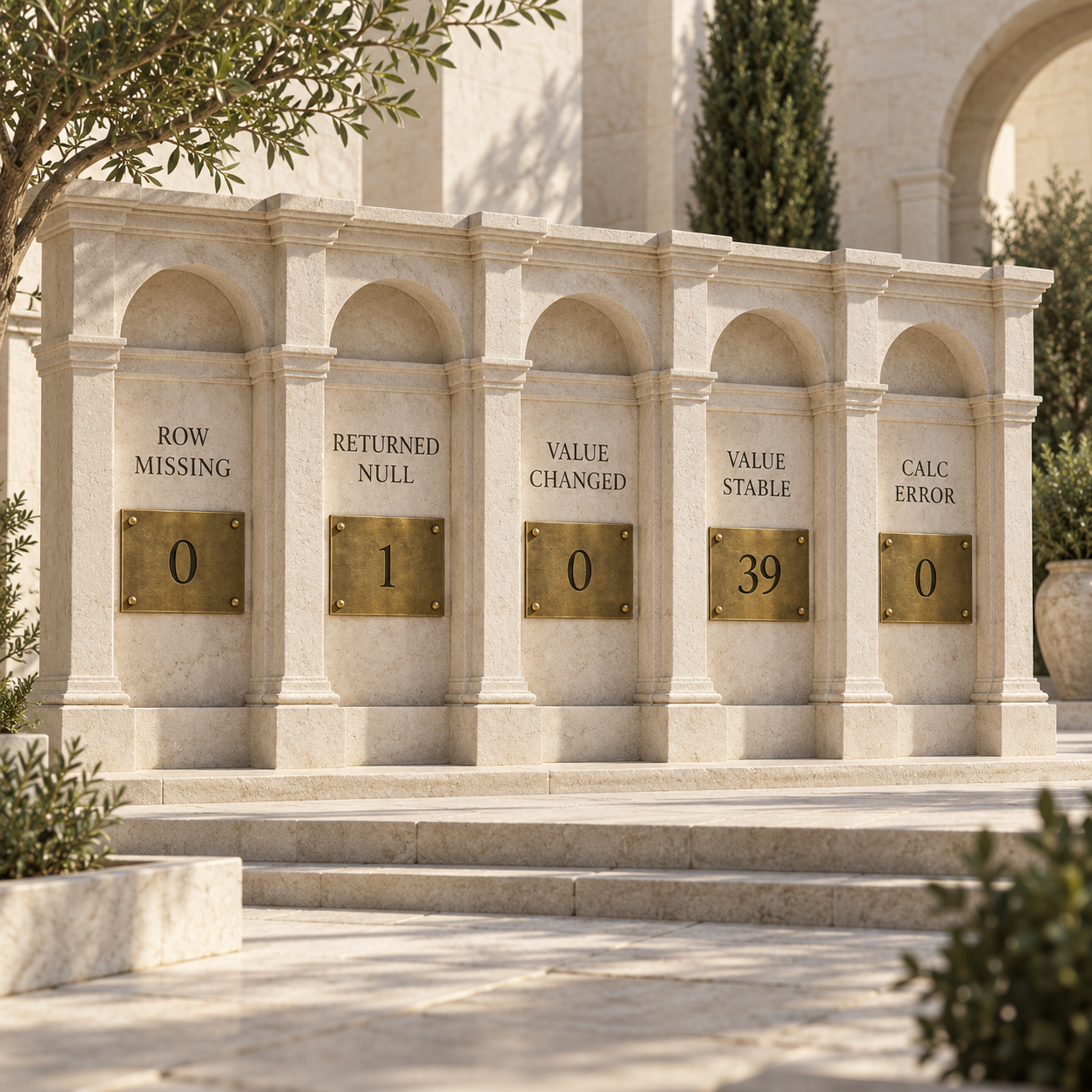
The editorial classification model is dated 1 October 2026 and uses five mutually distinct labels. This matters because a missing row, a null field and a changed value are different findings.
The one null is the latest-inspection field for identifier 1456. Calling it stable would hide the absence. Calling it changed would invent a difference. The correct statement is narrower: that field returned null in both saved responses.
Raw-response difference is not status-field change
All eight dated response pairs were byte-different, while none of the 40 declared field comparisons changed. The distinction is important: a raw response contains more than the project fields being tested, including its own capture timestamp and response material outside the declared comparison.
The method therefore does not treat a changed file hash as a changed project status. It preserves each raw file, records its SHA-256 hash and compares only the five fields named before the result. The 16-source manifest and the deterministic comparison output were generated on 1 October 2026 from the saved DLD responses.
This boundary also prevents array order or a response-side identifier outside the declared fields from becoming a reader-facing conclusion. A wider comparison could declare more fields, but it would be a different question and would need its own method.
Project ratio and latest inspection are separate fields
Identifier 221 shows why the project completion ratio cannot be substituted for the latest visible inspection percentage. Both snapshots returned a 100.0% project completion ratio, while the latest visible inspection pair was 19 April 2012 at 98.11%. Both values were stable across the two captures.
That is not a contradiction to solve with an average. They are separate fields with separate dates and scopes. The project ratio belongs to the project title block returned by DLD. The inspection percentage belongs to one dated inspection entry. The earlier guide to reading DLD project-status fields explains the boundary between registration, inspection, completion and handover records.
The same rule applies to the table as a whole. A Finished status and 100.0% project ratio on both capture dates establish what the service returned for those fields. They do not prove a buyer's handover date, the condition of a specific unit or current construction quality.
Repeat the comparison with the same question
A repeatable status check preserves the inputs before it interprets the output.
Fix the identifier list
Write the exact numeric project identifiers first. Do not replace an identifier with a similar marketing name, brand or building name.
Save each raw response
Keep the full response, its capture timestamp and its source route. A screenshot alone cannot be replayed field by field.
Declare like-for-like fields
Name the fields before comparing dates. This run used official English name, status, project completion ratio, completion date and the latest inspection date-percentage pair.
Classify before summarising
Assign row missing, returned null, value changed, value stable or calculation error. Do not force a null into the stable or changed bucket.
Add buyer-specific records separately
If the question concerns a purchase, keep the executed sale and purchase agreement, current developer notices, unit inspection record and handover communication in separate dated columns. The cluster's launch-price and area-evidence method shows how to keep project identity and price evidence separate too.
What the result establishes
The bounded conclusion is simple: for these eight identifiers, across these five fields, between the official captures dated 27 September and 1 October 2026, there were 39 stable values, one repeated null, no changed values, no missing rows and no calculation errors.
It does not establish that nothing happened to any project during those four days. It establishes that no change appeared in the declared fields returned through this route. A later response can be compared with the same method, but it becomes a new dated snapshot rather than a revision of this result.
What are some upcoming projects in Dubai in 2026?
The broad [dubai new projects](/projects/dubai-new-projects-dld-status-fields) search returns launch directories and developer pages. This sample is not an upcoming-project list: it compares eight exact DLD project identifiers and reports only what their dated status responses returned.
What is the latest development in Dubai?
“Latest” needs a named subject and date. DLD Project Status can verify a named project's returned status fields, while a launch announcement and a buyer's handover record belong to separate dated sources.
What are the top 10 upcoming projects in Dubai?
This is an eight-record status comparison, not a ranking. DLD Project Status can be used to check a specific project number or name, but the returned fields do not create a top-project list.