How to read a listed Dubai developer's annual report
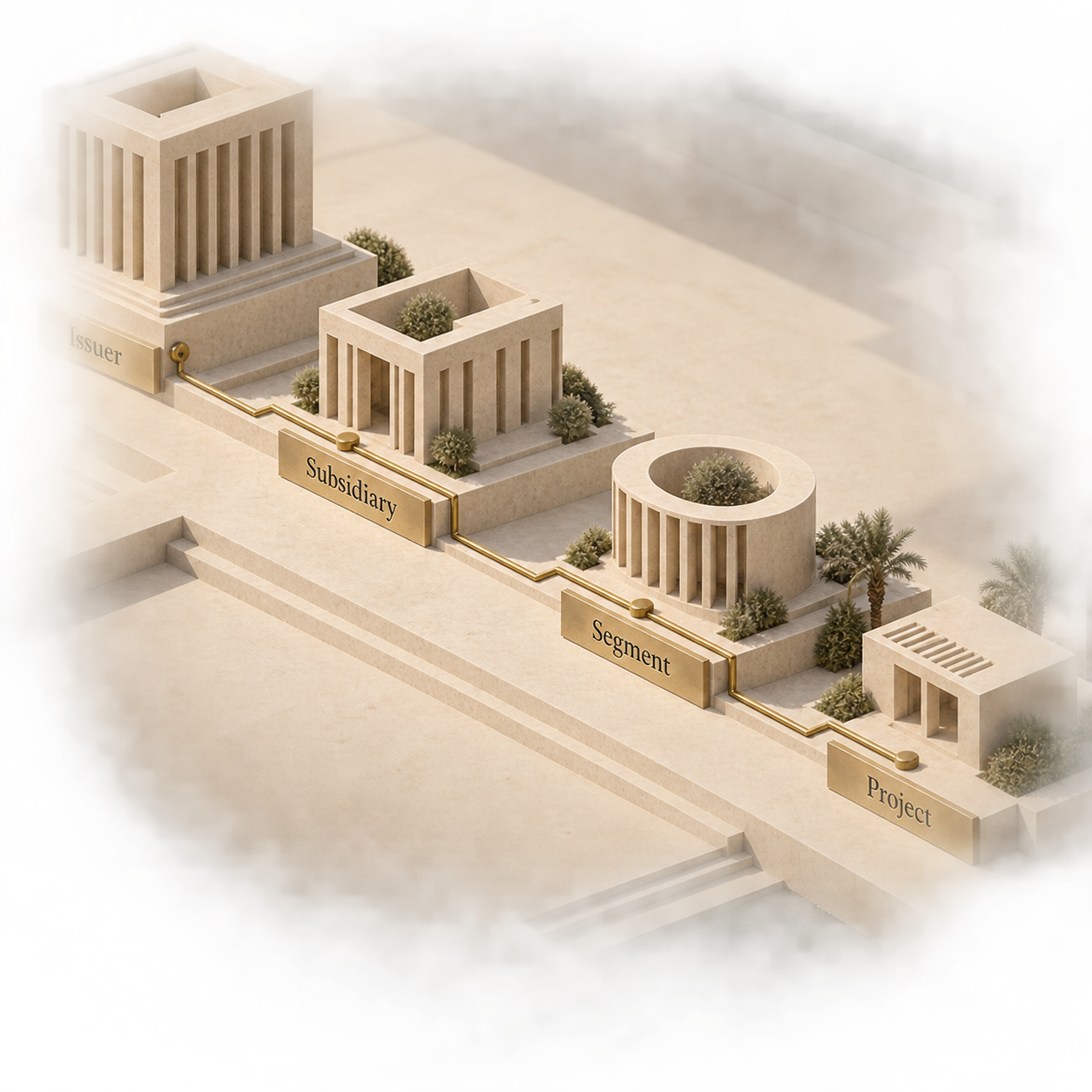
Read a listed Dubai developer’s annual report in four layers: the legal issuer, the significant subsidiaries, the reportable business segment, then the project or community labels. Emaar Development PJSC’s 2025 filing says the group had one reportable segment for the year ended 31 December 2025, while separate notes identify the company, its parent and six significant-subsidiary rows, so those names cannot be treated as one interchangeable developer record.
Start with the record level, not the shared word
The section carrying a name tells you what kind of fact the filing is publishing. The 2025 Integrated Annual Report, accessed 28 September 2026, separates the issuer and parent in Note 1, significant subsidiaries in Note 2.1, the segment in Note 3, and property labels in its performance pages.
The important distinction is not semantic. “Dubai Hills Estate LLC” appears in the subsidiary note, while “Dubai Hills Estate | UAE” appears in a launch list. Those placements support two different facts. The shared words alone do not close the legal relationship between them.
Use a six-step filing workflow
The shortest bounded route is to move from the legal cover to the notes, then to the property narrative. Each step answers one question and leaves the next one open.
Fix the listed issuer
Match the full company name on the report to the exchange profile. The current DFM profile, accessed 28 September 2026, pairs
EMAAR DEVELOPMENT PJSCwith symbolEMAARDEV. That proves the exchange identity used for this example, not a project or licence relationship.Read the domicile and activities note
Note 1 names Emaar Development PJSC as the Company and Emaar Properties PJSC as Parent and Ultimate Parent. It also says the group’s principal activities are property development and development management services in the UAE. The statements were authorised for issue on 12 February 2026 and cover the year ended 31 December 2025.
Read the consolidation rule before the subsidiary table
Note 2.1 says the consolidated statements comprise the Company and entities it controlled as at 31 December 2025. This matters because percentage interest is only one field. The filing’s Emaar Estate footnote says Emaar Hills L.L.C had 50% effective interest and then explains the contractual basis on which the group obtained control.
Copy subsidiary labels exactly
The significant-subsidiary table has six rows: Dubai Hills Estate LLC; Emaar Mina Rashid Development Owned By Emaar Development L.L.C; Mina Rashid Properties L.L.C; Emaar Gardens L.L.C; Rukn Mirage L.L.C; and Emaar Hills L.L.C. Keep punctuation and qualifiers because a shortened brand name may refer to a different record.
Separate the segment
Note 3 says the group was organised into one reportable segment, the real estate development business. A segment is the unit management monitors for resource allocation and performance. It is not another company in the subsidiary table.
Read project and community names in context
The Year in Review and Performance Review publish labels such as “Dubai Hills Estate | UAE”, “Parkwood”, “The Oasis Masterplan” and “Grand Polo Club & Resorts Masterplan”. Record the section heading beside each name. Do not upgrade the label into a legal owner, licence holder or completed handover unless another official record states that fact.
This is the filing-specific extension of the publication’s company and project record pillar. The broader developer name field guide explains why brand, company and project labels remain separate across official systems.
Read the 2024 and 2025 figures at issuer scope
The compared figures show the reporting group’s disclosed performance, not the performance of every project name nearby. Page 20 reports UAE Property Sales and UAE Development Net Profit for 2023 to 2025. The table below copies the 2024 and 2025 values and labels the arithmetic separately.
The calculation is (2025 value minus 2024 value) divided by 2024 value. It reproduces the four returned values from the 2025 report, p.20, then rounds the derived percentage to one decimal place. The local audit gives 8.7% for property sales and 48.7% for net profit.
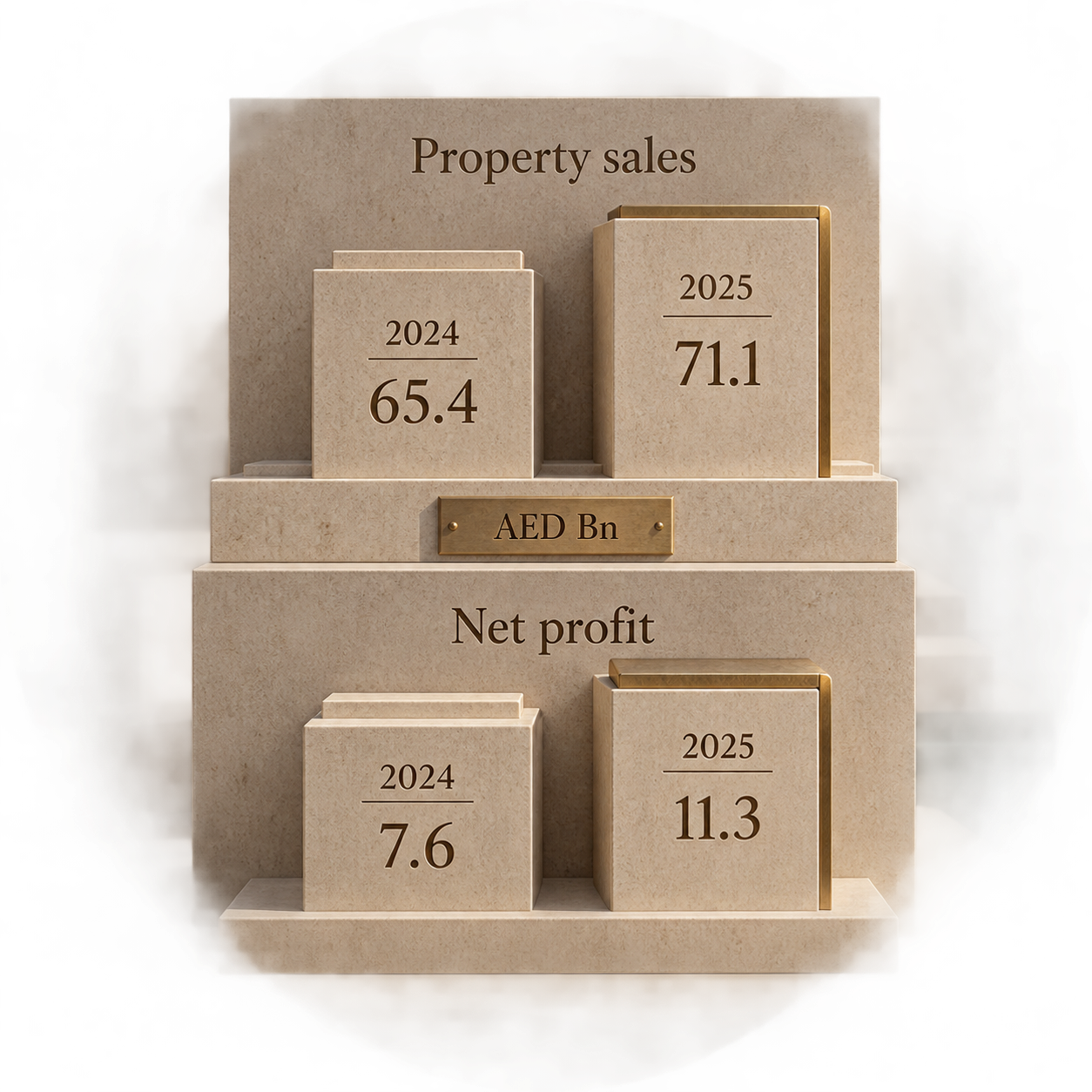
These values establish two group-level comparisons for the stated periods. They do not assign sales or profit to Parkwood, The Oasis or Grand Polo Club & Resorts, and they do not show a licence or ownership edge for any project label.
Treat name overlap as a question, not an answer
Name overlap is a prompt to find the mapping sentence. It is not the mapping itself.
The report gives a useful positive example in the Emaar Hills L.L.C footnote. It identifies that company as “Emaar Estate”, states a 50% stake, describes the joint-venture and development-service agreements, and says the contractual arrangement gave the group the ability to direct the relevant activities. As at 31 December 2025, the same footnote states an AED 150 thousand investment, AED 293,215 thousand of net assets and an AED 293,065 thousand reserve from the venture partner’s in-kind capital contribution. Those fields belong to that exact footnote and entity.
Dubai Creek Harbour shows a different boundary. The related-party note says Dubai Creek Harbour LLC was a wholly owned subsidiary of the Parent Company and a related party of Emaar Development PJSC. The performance pages also use “Dubai Creek Harbour | UAE” as a development label. The filing supplies both contexts, so the company-level relationship should be copied from the related-party note rather than inferred from the development name.
Know where the annual report stops
An annual report can prove the issuer’s own reporting relationships, but it is not a universal Dubai developer register. The current DLD Licensed Developers service description, accessed 28 September 2026, says that service lets a customer view the real estate developers list approved by the Land Department. That description defines the service. It is not a returned company result, a project-status result or a DET trade-licence result.
Keep the evidence in separate columns:
- Issuer filing: company, parent, consolidation, significant subsidiaries, segments and the issuer’s own project narrative.
- DFM profile: exchange-facing issuer identity and symbol.
- DLD Licensed Developers return: the company label and fields actually returned by that official service.
- DLD Project Status return: the project fields actually returned for a specific query.
- DET trade-licence result: the company and licence fields returned by that separate authority.
If one of those returns is unavailable, label that edge unresolved. The annual report remains useful, but it cannot substitute for the missing record.
How do you read a company annual report?
As at 28 September 2026, start with the exact issuer on the exchange surface, then read the domicile, consolidation, subsidiary and segment notes before interpreting project names in the narrative. Preserve the reporting period and access date beside each extracted fact.
How are subsidiaries accounted for?
Emaar Development’s 2025 report says subsidiaries are consolidated from the date the group obtains control until control ceases. Its Emaar Estate footnote shows why the contractual-control explanation must be read beside the 50% effective-interest figure.
Where can I read Emaar Development’s annual report?
As accessed 28 September 2026, the current Emaar Development reports page links annual reporting and interactive financial data, while the worked example here uses the official DFM-hosted 2025 Integrated Annual Report.
Does an annual report prove a Dubai developer licence?
No. It can state company and group relationships for its reporting scope. A DLD approved-developer return or a DET trade-licence result is a different official record and must be checked on its own terms.
Can one annual report show which Dubai developer is biggest?
Not by itself. A comparison requires the same measure, period and reporting scope for every issuer. Property sales, revenue, assets, delivered units and market value answer different questions.