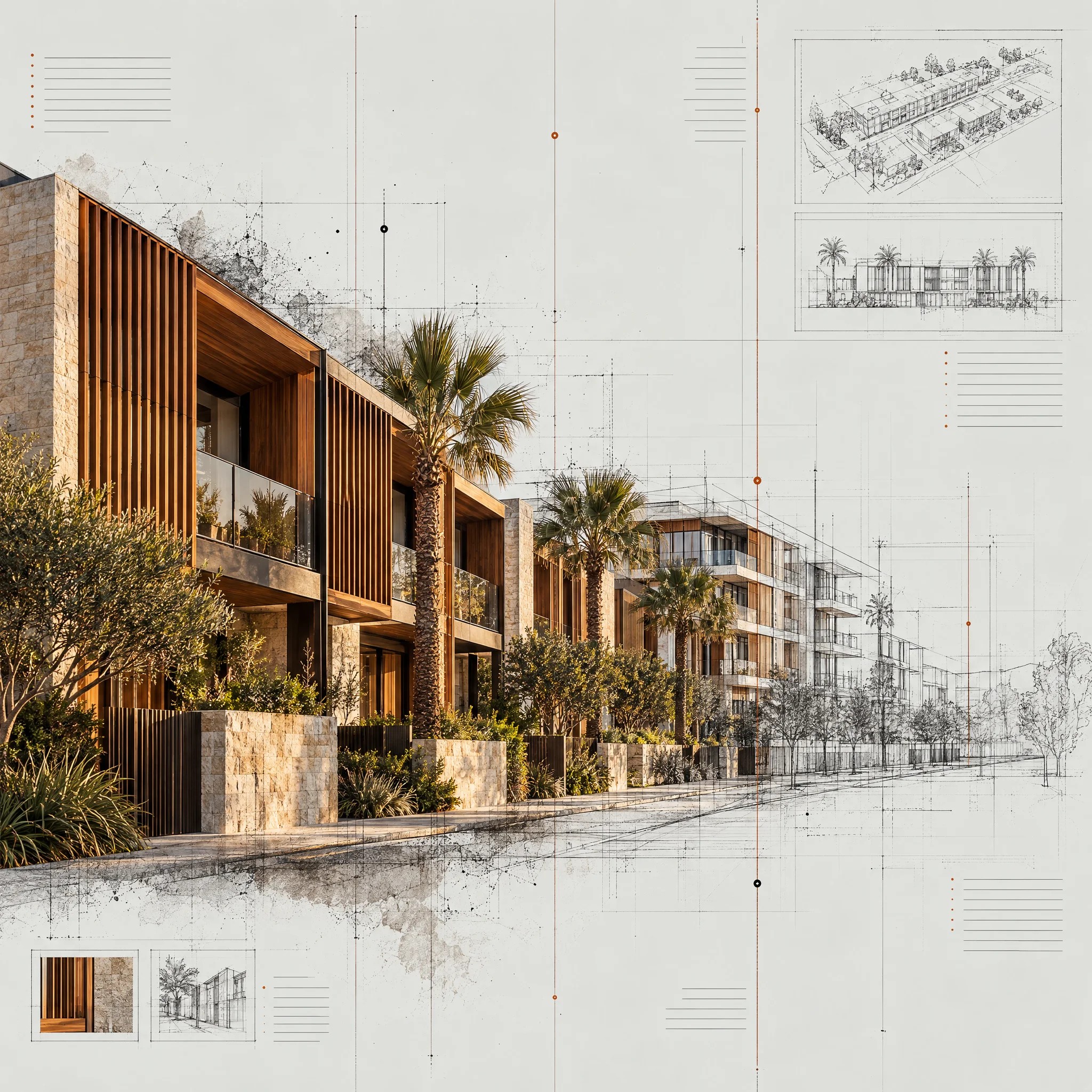
Emaar Properties: completed track record, resale performance & best fit (2026)
Emaar reports delivering more than 118,000 homes worldwide since 2002 and posted its highest ever property sales of AED 80.4 billion in 2025 (Emaar, DLD), which makes it the strongest fit for a buyer who wants a proven master community with a deep, liquid resale market behind it.
Who Emaar is and the segments it owns
Emaar Properties is the master developer behind most of the Dubai names a buyer already knows. It was founded in 1997 by Mohamed Alabbar, listed on the Dubai Financial Market in 2000 as the first property company to open its shares to foreign nationals, and today carries a market capitalisation of around AED 104 billion (DFM, mid 2026). Its anchor shareholders are the Investment Corporation of Dubai, the emirate's sovereign investment arm, at roughly 22 percent, and the Emirate of Dubai itself at roughly 7 percent, with the majority of the company held as a public free float that includes global institutions such as Vanguard and BlackRock. In plain terms: government-linked, publicly traded, and accountable to a listed balance sheet rather than a private owner.
That structure matters to a buyer because it sets the segment Emaar plays in. This is not an opportunistic single-tower developer. Emaar builds and then operates master communities: large, planned districts where it controls the roads, the retail, the parks and the schools, and then sells homes inside them over many years. The model produced Downtown Dubai, revealed in 2003 and anchored by the Burj Khalifa and The Dubai Mall, the world's tallest building and its largest mall. It produced Dubai Marina, the company's first project announced in 2000, and it has since produced Arabian Ranches, Emirates Living, Dubai Hills Estate, Dubai Creek Harbour, Emaar Beachfront, Emaar South, Rashid Yachts and Marina, The Valley and The Oasis.
The segment Emaar owns, then, is the proven, amenity-led freehold community at the mid-to-upper end of the market. Its homes sit in designated freehold zones with 100 percent foreign ownership, and its off-plan sales run through DLD and RERA regulated escrow accounts, where buyer payments are released against construction progress rather than paid directly to the developer. For a buyer weighing where to commit, the useful read is not that Emaar is large, but what that scale has actually delivered, and how those completed communities hold their value. That is what the rest of this page measures.
The completed delivery track record
Emaar reports more than 118,000 residential units delivered worldwide since 2002, and the bulk of that sits in the Dubai master communities below. The value of a track record like this to a buyer is concrete: a community Emaar finished years ago has a settled service charge, a known resale price, occupied neighbours and a working amenity base, which is a very different risk profile from buying into a plan and waiting.
On the market-position question buyers actually ask, the DLD data for 2025 is the cleanest answer. Emaar recorded the highest sales value of any Dubai developer, at around AED 65.8 billion (DXBinteract), ahead of DAMAC at AED 35.9 billion and Binghatti at AED 26 billion. Measured a different way, by number of transactions, the 2025 leaderboard reads Binghatti at 17,061 deals, DAMAC at 15,393 and Emaar at 13,149, a reminder that high transaction counts and high sales value measure different strategies: Emaar's deals are larger and concentrated in its established communities. At the group level, Emaar's 2025 revenue reached a record AED 49.6 billion, up 40 percent, on property sales of AED 80.4 billion, with net profit before tax of AED 25.7 billion. Its build-and-sell arm, Emaar Development, recorded AED 71.1 billion of UAE property sales on its own.
The longevity point is worth making concretely. Emirates Living, the cluster of The Meadows, The Springs and The Lakes, was delivered in the early 2000s and still transacts as a liquid family-villa market two decades on, which is the single hardest thing for a buyer to verify in advance and the clearest thing a long track record proves: not that a community looked good on launch, but that it still trades, still maintains itself and still holds residents many years after handover. That, more than any single tower, is what an Emaar buyer is paying a premium for.
For a buyer, the practical takeaway from the track record is liquidity. A developer that has actually completed eleven master communities and sells at this volume gives a future seller a working, comparable secondary market to exit into, which is exactly what thins out under a developer with a shorter delivery history. The backlog figure says the same thing forward: AED 155 billion of contracted, not-yet-recognised revenue at the end of 2025 means a long, funded delivery runway rather than a developer dependent on the next launch to finish the last one.
Resale performance by community
Here is where a track record turns into the reader's decision. The figures below are 2026 secondary-market rates drawn from DLD transaction data as compiled by the major Dubai portals; treat them as the band a buyer is realistically transacting in, not a fixed quote, since floor, view and the exact tower move every line.
A few of these reward a closer look. Dubai Hills Estate has been one of the fastest moving Emaar communities, with the golf-facing villa stock pricing near AED 2,700 per sqft, so an end-user buying there today is entering a community that is already largely built and still appreciating, with a thick set of comparable sales to value against. Emaar Beachfront sits at the other end, around AED 4,100 per sqft, which buys a gated waterfront tower with a branded-lifestyle premium and a tighter, more specialist resale pool. Dubai Marina, by contrast, is the liquid workhorse: around AED 2,000 to 2,200 per sqft puts a buyer into one of the city's deepest rental markets, where exit demand rarely dries up.
The honest reading of the table is that "an Emaar home" is not one price or one bet. It runs from a sub-AED 2,200 Marina apartment bought for yield and liquidity, to a AED 6 million Beachfront unit bought for a branded address, and the resale behaviour differs accordingly. Creek Harbour sits in between as the appreciation story, where the per-sqft rate has risen around 28 percent since early 2023 as the district has filled in. That spread is why the next section routes by who you are, not by a single verdict.
Best fit by buyer profile
The most useful thing an independent read can do is match the right buyer to the right part of the portfolio, because Emaar's range is wide enough that the same name suits very different people for very different reasons.
Downtown Dubai and Dubai Hills Estate are the strongest matches. Both are largely delivered, both carry the deepest comparable-sales pools in Emaar's portfolio, and both pair a working amenity base with a liquid resale market. If your priority is to buy something finished, live in it, and know you can sell into real demand later, this is the core of why Emaar's track record matters.
One honest caveat on routing. A buyer whose single priority is the lowest possible entry ticket in a high-volume launch market, or a maximalist branded-tower aesthetic, may find a closer match elsewhere in the city: a high-volume specialist suits the first, and a branded-luxury house such as DAMAC suits the second, each on its own strengths. Emaar's edge is specifically the proven master community with a deep resale market, so route to it for that, and route past it when that is not what you are buying for.
The forward view on Emaar's active segments
This is a neutral, segment-level outlook, not a prediction about the company. The single most important number for a 2026 buyer is supply: Emaar has more than 50,000 units under construction, with deliveries scheduled to accelerate through 2026 to 2029. Dubai Creek Harbour alone carries a Phase 3 of more than 7,000 residences and over 7,600 units in the wider pipeline, supported by the planned Dubai Square retail anchor. Emaar's newer launches have also concentrated increasingly on Dubai South, near Al Maktoum International Airport, where it is building out a large new community footprint (AGBI, 2026).
What that means for a buyer is timing, not avoidance. In the communities still in active delivery, principally Creek Harbour and the newer Dubai South and Emaar South land, a wave of handovers in the same window can soften short-term resale pricing as completed stock comes to market together, which is worth factoring into an exit horizon. In the largely finished communities, Downtown, Dubai Marina, Arabian Ranches, Emirates Living and most of Dubai Hills Estate, that supply pressure is far lower, which is part of why those addresses carry the steadier resale behaviour in the table above. The forward read is therefore the same as the resale read: match your hold period to the community's delivery stage, and in the active-delivery districts, give the per-sqft band a wider margin of safety.
Who owns Emaar Properties?
Emaar is a public joint stock company listed on the Dubai Financial Market. Its anchor shareholders are the Investment Corporation of Dubai at around 22 percent and the Emirate of Dubai at around 7 percent, with the majority held as a public free float that includes global institutional investors.
Is Emaar government owned?
It is government-linked rather than government owned. The Investment Corporation of Dubai and the emirate hold large minority stakes, but most of the company trades as a public free float on the DFM.
Are Emaar properties freehold?
Yes. Emaar's communities sit in designated freehold zones, which allow 100 percent foreign ownership of the property.
How many homes has Emaar delivered?
Emaar reports delivering more than 118,000 residential units worldwide since 2002, the bulk of them across its Dubai master communities.
Was Emaar the top developer in Dubai in 2025?
By sales value, yes: Emaar recorded the highest sales value of any Dubai developer in 2025 at around AED 65.8 billion (DXBinteract). By number of transactions the leaderboard differs, with Binghatti recording the most deals, a reflection of different strategies rather than a single ranking.
How to read this page
The reason to anchor a developer decision in DLD data rather than a star rating is that the data tells you what you actually own after you sign: a place in a real, completed community with a working resale market, or a place in a plan. Emaar's record reads as the former across eleven master communities, with AED 80.4 billion in 2025 sales, a AED 155 billion backlog, and a resale market that runs from around AED 2,000 per sqft in the Marina to AED 4,100 per sqft at Beachfront. The figures here are sourced to DLD transaction data and Emaar's own reported results to mid 2026; re-check the current per-sqft band for your specific tower and community before you commit, because the bands move with the market and with the delivery wave described above.
If you want this turned into a shortlist for your own budget and goal, with the current DLD comparables for the specific Emaar communities you are weighing, that is exactly the kind of read we send.
Get the data-led developer brief
Sourced DLD reads on Dubai's developers and communities, sent when they matter. Join the withlida list.