Emaar vs DAMAC: track record, resale & who each suits (2026)
As of 16 October 2026, Emaar and DAMAC both describe apartments, villas and townhouses in their named Dubai Hills Estate and DAMAC Hills communities. Emaar's FY2025 report counts 125,600+ units delivered globally since 2002, including joint ventures; DAMAC's company counters have no comparable reporting cutoff. The home comparison rests on layout, completion evidence, facilities access and itemised costs. (Emaar FY2025, DAMAC.)
Source: withlida.com, 16 October 2026, from Emaar's FY2025 report, DAMAC's company page and the official Dubai Hills Estate and DAMAC Hills pages. Facilities are developer descriptions, not inspection findings, confirmed opening dates or home-level access rights.
Last verified: 16 October 2026. Company report periods are identified separately below.
How do the companies differ?
Emaar's annual report describes a group spanning development and operating businesses; DAMAC's company page describes a property portfolio spanning communities, towers and resort residences. These sources explain company scope, while a home purchase has its own named seller, property and contract.
Emaar Properties was incorporated in 1997 and listed on the Dubai Financial Market, Dubai's stock exchange, on 26 March 2000, according to its FAQ, verified 16 October 2026. Its FY2025 report covers UAE and international development alongside malls, community retail, hospitality, leisure, entertainment and commercial leasing. The report records AED 49.6 billion in group revenue for FY2025. That is a company revenue measure across its reporting scope, not a Dubai residential resale total. (Emaar FY2025 report.)
DAMAC Properties was formed in 2002 as the DAMAC Group of Companies' property development division. Its About page, verified 16 October 2026, names Hussain Sajwani as founder and lists Ali Sajwani and Amira Sajwani as Managing Directors in a leadership section describing the DAMAC Group of Companies. That wording identifies the scope of the leadership page; it does not identify the contracting company for every DAMAC home.
The distinction matters on both sides. Emaar's FAQ explains that a sale agreement may name a subsidiary as vendor. For a particular home under either brand, the agreement and property records identify the legal parties. Company leadership, company ownership and the seller named in a home contract are separate questions.
What homes and communities do they describe?
Dubai Hills Estate and DAMAC Hills both describe several residential formats around parks and golf, with different named community facilities. The shared formats make the actual plan and address more informative than a developer-wide label.
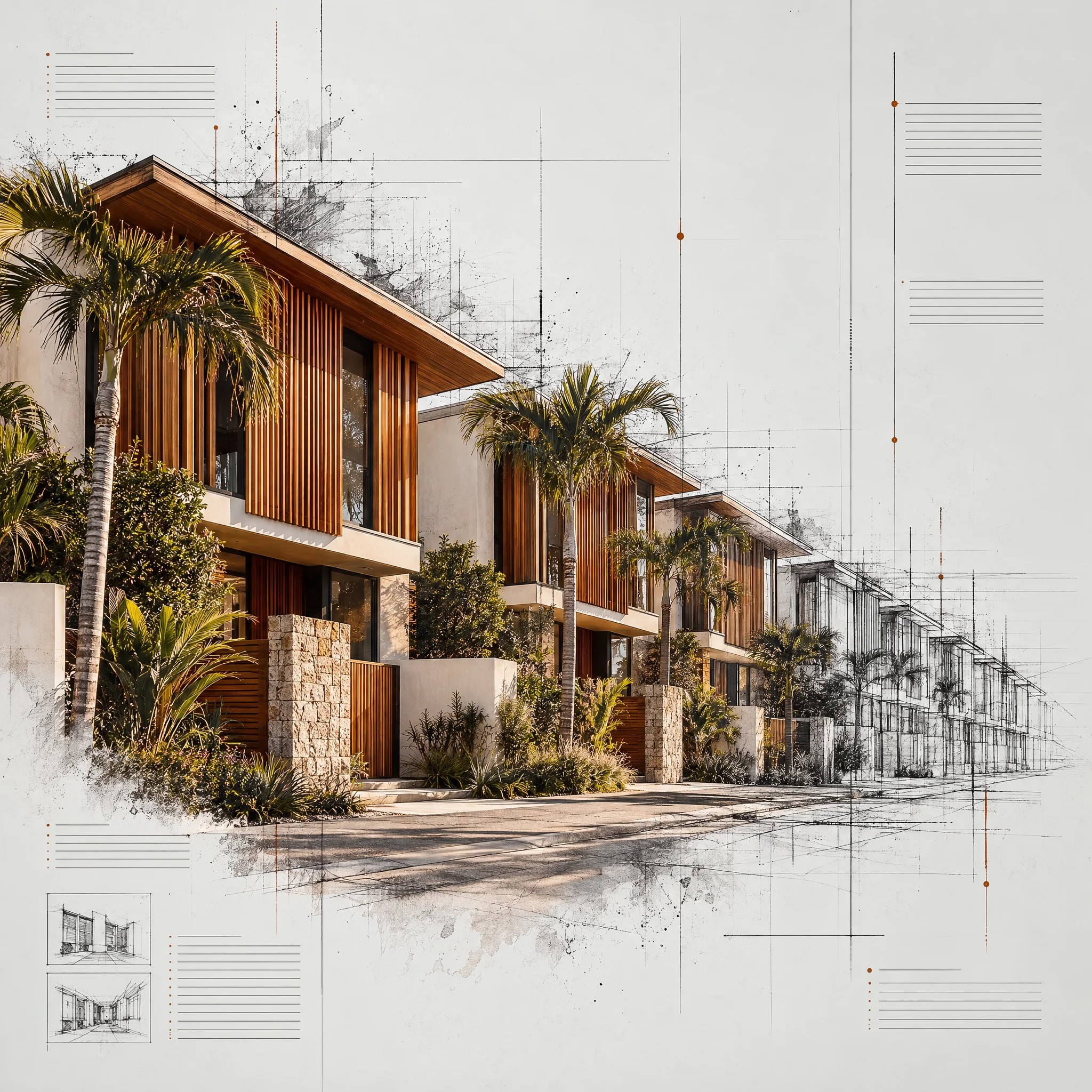
Dubai Hills Estate: Emaar's community page, accessed 16 October 2026, describes apartments, villas and townhouses. It names Dubai Hills Park, parks and open spaces, a golf course and Dubai Hills Golf Club. Its facilities description also includes Dubai Hills Mall, schools and nurseries, healthcare, supermarkets, fitness facilities, restaurants and cinemas. The separate Dubai Hills Estate guide covers the place in more detail.
For an apartment, the layout comparison concerns internal rooms, balcony, storage and the building's shared spaces. For a villa or townhouse, it also concerns the plot, garden, parking and the boundary between private upkeep and community services. Those are questions for the actual plan, property documents and management information. The community's mix of formats does not describe the layout of an individual home.
DAMAC Hills: DAMAC's community page, accessed 16 October 2026, describes villas, townhouses and apartments, with parkland and Trump International Golf Club Dubai. Its named amenities include a swimming pool, the Malibu Bay wave pool, tennis courts, stables, a fishing lake, a skate park and the DAMAC Hills community centre. This comparison concerns DAMAC Hills; DAMAC Hills 2 is a separate named community. The DAMAC Hills guide provides the wider residential context.
For either community, a facility description answers what the developer describes. Current opening status needs dated operator evidence; physical condition needs a dated inspection; a resident's access needs the applicable agreement and operator terms. A golf-course view, for example, is a different attribute from golf-club membership. School places and healthcare services likewise have their own admissions or service arrangements.
What do delivery totals actually count?
Emaar's retained delivery figure is cumulative, global and inclusive of joint ventures; DAMAC's company counters do not establish a matching reporting cutoff. They cannot establish a common-period delivery ranking.
The Emaar FY2025 report reports 125,600+ units delivered globally since 2002, including 80,600+ in the UAE, with a footnote stating that the numbers include joint ventures, businesses undertaken with partners. These are cumulative figures in the FY2025 report, whose financial year ended 31 December 2025. They are not deliveries during FY2025 alone. The UAE subtotal is not a Dubai-only count, and it sits within the global total rather than being added to it.
DAMAC's About page, accessed 16 October 2026, displays delivered and in-progress/planning counters without a comparable reporting cutoff or a matching explanation of geographic and joint-venture boundaries. Their values are omitted here rather than assigned an assumed year-end date.
A company delivery count also answers a different question from whether a particular building, phase or home is complete. That requires the named project's dated record and the home's own completion, handover and ownership documents. A cumulative company figure cannot supply those documents.
Which costs depend on the building?
Sale-registration charges follow the official transaction schedule; recurring service charges and private upkeep depend on the actual property and billing scope. A developer name supplies neither a building rate nor a complete ownership budget.
The Dubai Land Department (DLD) is Dubai's property registry. Its Property Sale Registration service, verified 16 October 2026, publishes the following charges. These apply to the sale-registration service described by DLD, rather than every possible purchase or financing route.
Source: withlida.com, 16 October 2026, transcribing DLD's Property Sale Registration schedule. VAT means value-added tax. The applicable property/document lines and transaction route require confirmation; this table is not an all-in purchase-cost total.
For either community, the published percentage charge has the same arithmetic: 2% of the actual sale value + 2% of that value = 4% combined. Document charges, the service-partner fee and its VAT remain separate. No sample home or purchase price is assumed.
Payment allocation in a resale needs a further distinction. In Lida's practice, confirmed 21 September 2026, the buyer usually pays the full 4% DLD transfer charge. Confirm that allocation in the sale contract. This describes her practice, while the table preserves DLD's published split.
The recurring record is property-specific. DLD's Service Charge Index, verified 16 October 2026, retrieves charges approved by the Real Estate Regulatory Agency (RERA) for jointly owned property, property with individually owned units and shared parts. The official procedure selects the project, use and year. A comparison therefore needs the correct building or phase label, residential use, approved budget year, charge components and applicable unit area, followed by the invoice and account statement. The Service Charge Index guide explains that matching process; its worked record is not a rate for either developer's portfolio.
An itemised home budget also identifies contractual agency fees, any developer administration or no-objection charges, applicable financing costs, utility and cooling accounts, insurance, private maintenance and separately paid facility memberships. Each line needs its own agreement, invoice or current quote, including any applicable tax. Purchase payments, annual costs and refundable deposits belong on separate lines. No combined total is stated until those inputs are known.
What documents distinguish a completed home from a development plan?
A completed-home comparison combines ownership, project completion, handover and inspection evidence. A development-plan comparison starts with contractual plans, specifications, payment stages and estimated completion terms. Each document answers a different part of the household's question.
DLD's Project Status Enquiry, verified 16 October 2026, provides project completion percentage and details using a land number, project number or project name. Its project-level output is separate from a unit inspection and the household's handover documents. DLD's sale-registration service lists identity evidence and a developer e-NOC, an electronic no-objection certificate, for freehold areas, where property can be owned outright. Its outputs include an electronic title deed, the official ownership document, and electronic map. Those records serve different purposes from a brochure.
Worked comparison: turning each community page into a home file
Consider the same question for a home in each community: what exactly is being acquired, at what stage, with which access and costs? The starting evidence is the pair of official community pages above. No unit has been selected and no home inspection or building-charge lookup is represented as completed. The table shows what those sources establish and the specific documents needed to finish each comparison.
Source: withlida.com, 16 October 2026. Publication document-comparison method based on the official Dubai Hills Estate and DAMAC Hills descriptions, DLD's project enquiry, sale registration and approved-charge enquiry. No unit-specific findings or amounts are asserted.
The worked result is precise: the starting sources establish residential formats and named facilities for both communities. They leave the actual layout, home-level completion evidence, contractual access and payable amounts unresolved. Adding the documents closes each question independently. A title deed does not describe the present condition of a kitchen; a condition report does not establish golf membership; a community photograph does not identify an approved annual charge.
For a home still represented by a development plan, the file instead starts with the signed sale and purchase agreement (SPA), its plan and specification, payment milestones and completion terms. Emaar's FAQ, verified 16 October 2026, expressly distinguishes an estimated construction completion date in the agreement. The applicable agreement for either home supplies its own terms. A dated project-status record can sit beside that agreement, while planned facilities remain identified as planned until separate dated evidence establishes their status. Company delivery totals cannot turn those plans into a completed-home inspection.
FAQ, verified 16 October 2026
Which company is bigger, Emaar or DAMAC?
The answer depends on the measure, legal group, geography and period. Emaar's FY2025 report and DAMAC's company-page counters do not provide a common-period delivery comparison. The company scope and community portfolio above preserve those boundaries rather than produce a brand ranking.
Who owns Emaar and DAMAC?
The sources used here do not establish a current comparable shareholder breakdown. Emaar's FAQ expressly dates its shareholder observation to 31 May 2014; it cannot establish today's ownership percentage. DAMAC's About page identifies its founder and group leadership, which is different evidence from a current share register. (Emaar FAQ, DAMAC About, verified 16 October 2026.)
Who delivered more homes, Emaar or DAMAC?
These sources do not support a common-cutoff ranking. Emaar's FY2025 count is cumulative since 2002 and includes joint ventures. DAMAC's company counters lack a comparable reporting cutoff, so they are not placed beside it as year-end figures. (Emaar FY2025, DAMAC About.)
Is Emaar more expensive than DAMAC?
A developer label does not supply a matched home-price comparison. That comparison needs the actual home's price, plan, building or phase, completion stage, specification, access terms and ownership costs. This page states no developer-wide price band or resale-value conclusion.
Does a community golf course mean membership comes with the home?
The developer's description establishes that it names a golf facility. The actual home's agreement and current operator terms are needed to establish membership, resident access and any separate payment. The community descriptions above are not a finding about those home-level rights.
Checked by the publication's independent check, 16 October 2026.
Get the withlida publication brief
Sourced company, community and property-process reporting by email.
CHANGE LOG: 2026-10-16 · refreshed · replaced buyer routing, brand rankings, unsupported resale and price comparisons, and mismatched company counters with a neutral company-and-community comparison. Emaar figures now use its FY2025 report, with cumulative scope and joint ventures identified; DAMAC's undated counters are omitted. Company history and leadership, developer-described community facilities, DLD sale-registration charges and the home-document method were checked against the linked primary sources on 16 October 2026.