Dubai developer resale cohorts: compare projects by completion year
Five finished Dubai Land Department project records checked on 26 September 2026 fall into four completion-year cohorts and name four registered developer entities. That is the useful starting point for a Dubai developer comparison: group exact projects by actual completion year, then attach one later resale period without merging the brand, legal company and project record.
A cohort starts with the DLD completion year
A completion cohort is a set of exact projects that share an actual completion year and can later be narrowed by place, property type and unit characteristics. The year is a grouping field, not a verdict on a developer.
The DLD Project Status Enquiry is the official starting point. As checked on 26 September 2026, DLD says the service accepts a land number, project number or project name and returns project completion details immediately.
Keep these layers separate before any resale calculation:
The brand is not a substitute for the legal entity. The legal entity is not a substitute for the project number. The completion year is not a resale result. Each field does one job.
For the broader evidence structure, start with the completion-record comparison framework. This companion takes its project-level rows and shows how to turn them into dated cohorts.
Five DLD records form four completion cohorts
The worked sample has one editorial brand bucket, five exact DLD projects and four registered developer entities. All five DLD responses showed Finished at 100.0% when pulled on 26 September 2026. The completion dates run from 4 January 2009 to 30 August 2022, a 13-year completion-year span.
The later resale period below, 1 January to 31 December 2025, is an editorial worksheet choice. It is not a claim that matching transactions or prices were obtained.
Source: exact records from the DLD Project Status Enquiry, pulled 26 September 2026. Emaar's current issuer pages connect Urbana to Emaar South and Joy to Arabian Ranches III, checked on the same date. The brand bucket is an editorial research label; it is not a DLD status field.
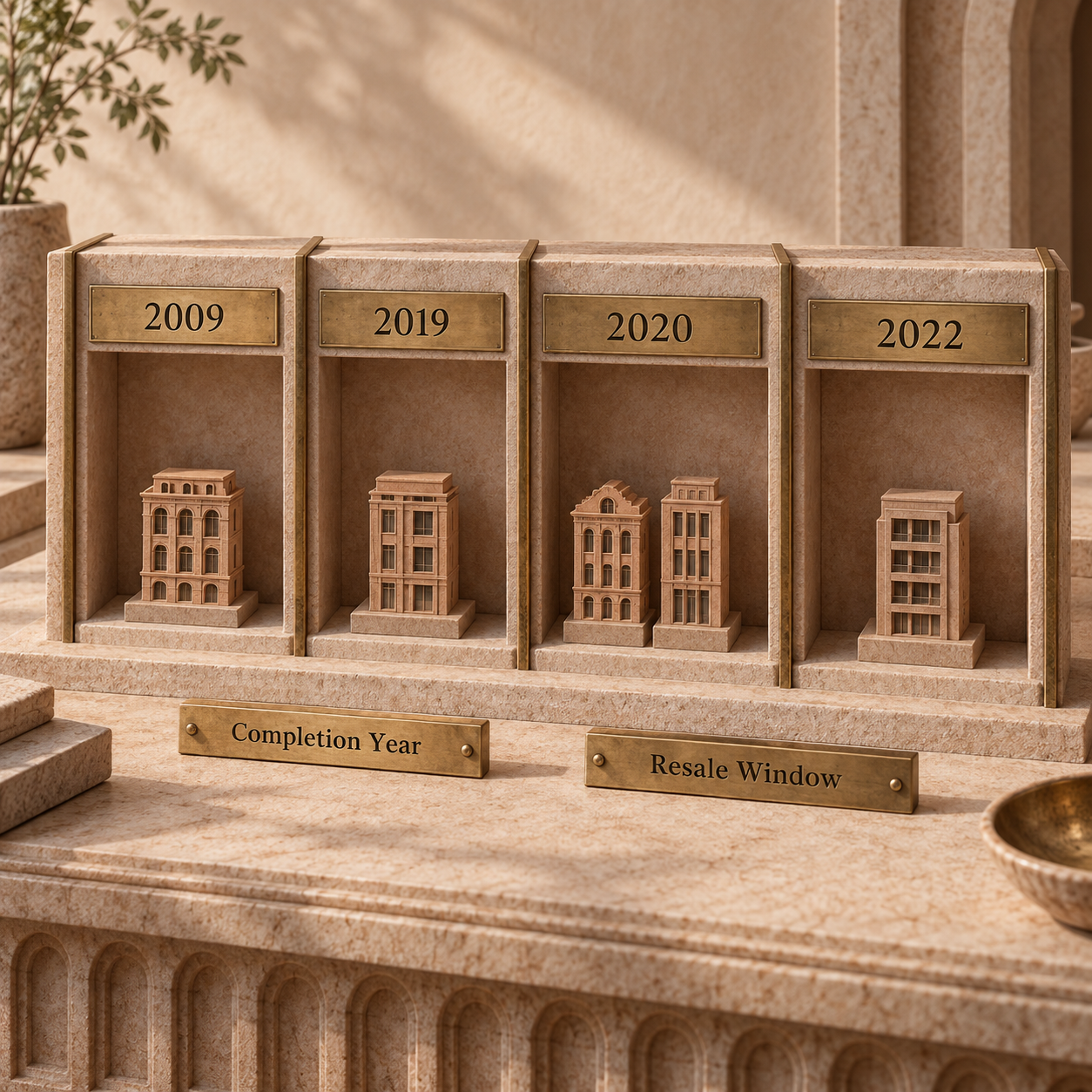
The code-recomputed cohort roll-up is compact: 2009 has one record, 2019 has one, 2020 has two and 2022 has one. That roll-up does not make the two 2020 projects automatically comparable. Urbana and Park Heights II still need the same asset type, location logic and later transaction window before their resale fields can sit beside each other.
Registration year is not completion year
The DLD record can expose a registration date and a completion date that belong to different parts of the record. Preserve both. Do not silently replace one with the other.
Project 1019 makes the distinction clear. The current DLD response names Arabian Ranches -La Avenida I as Finished at 100.0%, with a completion date of 4 January 2009 and a registration date of 7 December 2023. The method uses 2009 as the completion cohort because that is the DLD completion field. It retains 2023 as the registration year because that is the separate field returned by DLD. It does not infer why the dates differ.
The same discipline applies to a future project date. A developer-published target belongs in a stated target field with its publication date. It does not enter a completed cohort until an official current record supports actual completion.
The developer licence, company and project-record method explains the identity chain behind this distinction. A project row can name a legal vehicle that differs from the consumer brand, while still preserving an exact project number and dated status.
Attach resale records only after the cohort is fixed
The resale step begins with an exact project join and one common observation window. A brand-wide total cannot be assigned to the five rows, and a community median cannot be treated as the price of each project.
The DLD Real Estate Data page, checked on 26 September 2026, exposes separate transaction fields for transaction date, type and subtype, registration type, amount, property and transaction size, master project and project. Its current public form was reCAPTCHA-gated in this run and returned no transaction rows. A DXBinteract area page also returned its numerical fields in a loading state. No price, count, median or percentage change from either source is therefore carried into this article.
Fix the project list
Store the DLD project number, exact project name, registered developer name and developer number. The project number is the cleanest join when names vary in punctuation or capitalisation.
Choose one completion cohort
Start with projects sharing the same DLD completion year. Then split the cohort by property type, location and unit characteristics needed for the buyer's question.
Lock one later transaction period
Use the same start date and end date for every row. The worked worksheet uses 1 January to 31 December 2025 only to show the structure.
State the resale inclusion rule
Name the transaction type and subtype included, the fields used to exclude developer-origin sales, and how duplicate or amended records are handled. If the source does not expose a field, mark it as unavailable rather than estimating it.
Publish count beside price
When a robust extract exists, place the matched transaction count beside any median sale amount or median price field. A price without its observation count and period is incomplete evidence.
Read the result by buyer question, not developer rank
The strongest cohort is the one matched to the buyer's actual shortlist. Different questions need different filters, even when they begin with the same developer brand.
- A ready-apartment buyer can compare completed apartment projects from the same year, then narrow by area, bedroom type, size band and one later resale period.
- A townhouse buyer can build a separate townhouse cohort. Urbana and Joy belong in that property-type conversation only after their completion years and later period are made explicit.
- A buyer comparing one master community starts from the exact projects inside that place. The Emaar community completion record shows how a community label resolves into separate project numbers and legal entities.
- A buyer comparing corporate breadth can use a developer-level inventory as context, then return to project rows for completion and resale analysis. Group scale and project-level resale are different factual kinds.
This routing stays positive and specific. A large portfolio may suit a buyer seeking broad community choice. A narrower same-type cohort may suit a buyer focused on one home format. Neither route requires a league table.
What this sample can and cannot establish
The sample establishes a repeatable record structure. As of 26 September 2026, it contains five exact DLD project numbers, four completion-year cohorts, four registered developer entities and one clearly labelled later observation window.
It does not establish a developer-wide resale result. It does not publish a transaction count, price, average, median or percentage change. It does not merge an issuer's group results with Dubai project rows. It also does not treat a target date as a completed handover.
That boundary is useful. Once an exact transaction extract is available, the empty resale cells can be populated without changing the identity and cohort logic underneath them.
FAQ, checked 26 September 2026
Who are the biggest developers in Dubai?
"Biggest" needs a metric and a period. Delivered projects, delivered units, current sales and corporate assets answer different questions; a completion cohort compares exact project rows rather than assigning one all-purpose size label.
How do I compare Dubai developers fairly?
Start with exact DLD project numbers, group by actual completion year, then match property type, place and one later resale period. Keep the consumer brand and registered legal entity in separate columns.
Is a DLD registration year the same as a completion year?
No. They are separate fields. Project 1019, checked on 26 September 2026, returned a completion date in 2009 and a registration date in 2023, so both should be preserved and labelled.
Can resale price alone compare developers?
No single resale price isolates the developer. Place, property type, size, condition and transaction period also shape the observation, so use matched project rows and publish the transaction count beside any median.