JVC service-charge records: 4 projects, one use and one year (2026)
Four JVC project records in the Dubai Land Department's current Service Charge Index produced calculated 2026 totals of AED 14.98, AED 15.22, AED 15.14 and AED 17.93 per sq ft for Residential use ID 1, captured on 30 September 2026. They are project records, not a JVC rate, and the approved budget data is not an owner's final invoice, final statement or amount paid.
A DLD service-charge record starts with three fields
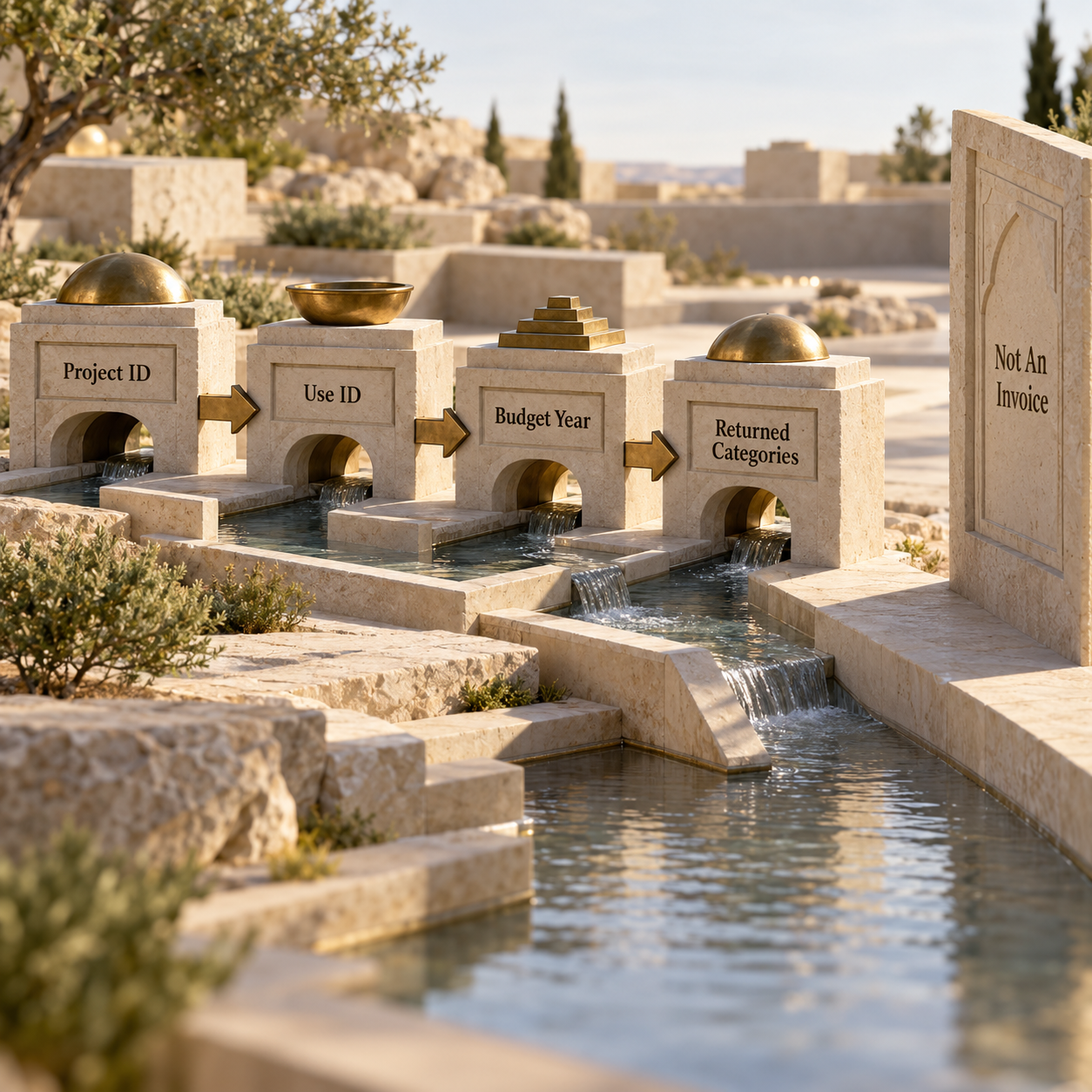
The record starts with project, use and year, not with an apartment cluster. DLD says the customer selects the project name, use and year before viewing the required RERA-approved service-fee information. RERA is the Real Estate Regulatory Agency. The service page exposes no page-specific publication or revision date, so the source date here is accessed 30 September 2026.
The live Service Charge Index maps a displayed project label to a project ID. Selecting that project returns its available uses, each with a use ID and available budget years. The selected detail response then returns charge-category rows. Its interface labels the rate column Rate (AED/Sq.Ft), accessed 30 September 2026.
That sequence is the record hierarchy. JVC is the place named inside each selected label, but the response remains attached to the project ID, use ID and budget year. It does not become a rate for the surrounding buildings.
Four JVC records, captured under one use and year
The four records below hold the use and year constant, but they remain four separate project records. Each official label and project ID comes from the DLD lookup, Residential and use ID 1 come from that project's use lookup, and the category values come from the linked detail response. The totals are editorial calculations that follow the current page logic: General Fund plus Reserved Fund, with Additional Charges kept separate.
Every selected response returned 10 category rows: eight General Fund rows, one Reserved Fund row and one Additional Charges row. That count is useful for auditing the arithmetic. It is not a quality score or a statement about amenities.
The sample is deliberately non-statistical. It was built to show reproducible record identity, including the difference between the similarly named Bloom Heights and Bloom Towers records. No mean, median or neighbourhood band is calculated.
Established and not established
The four-record table establishes only what the official lookup and responses expose. The stop line is as important as the returned rate.
This is why an official project record cannot stand in for a neighbouring building. Even two names that look related remain separate records when DLD exposes separate project IDs. A location label is not permission to merge them.
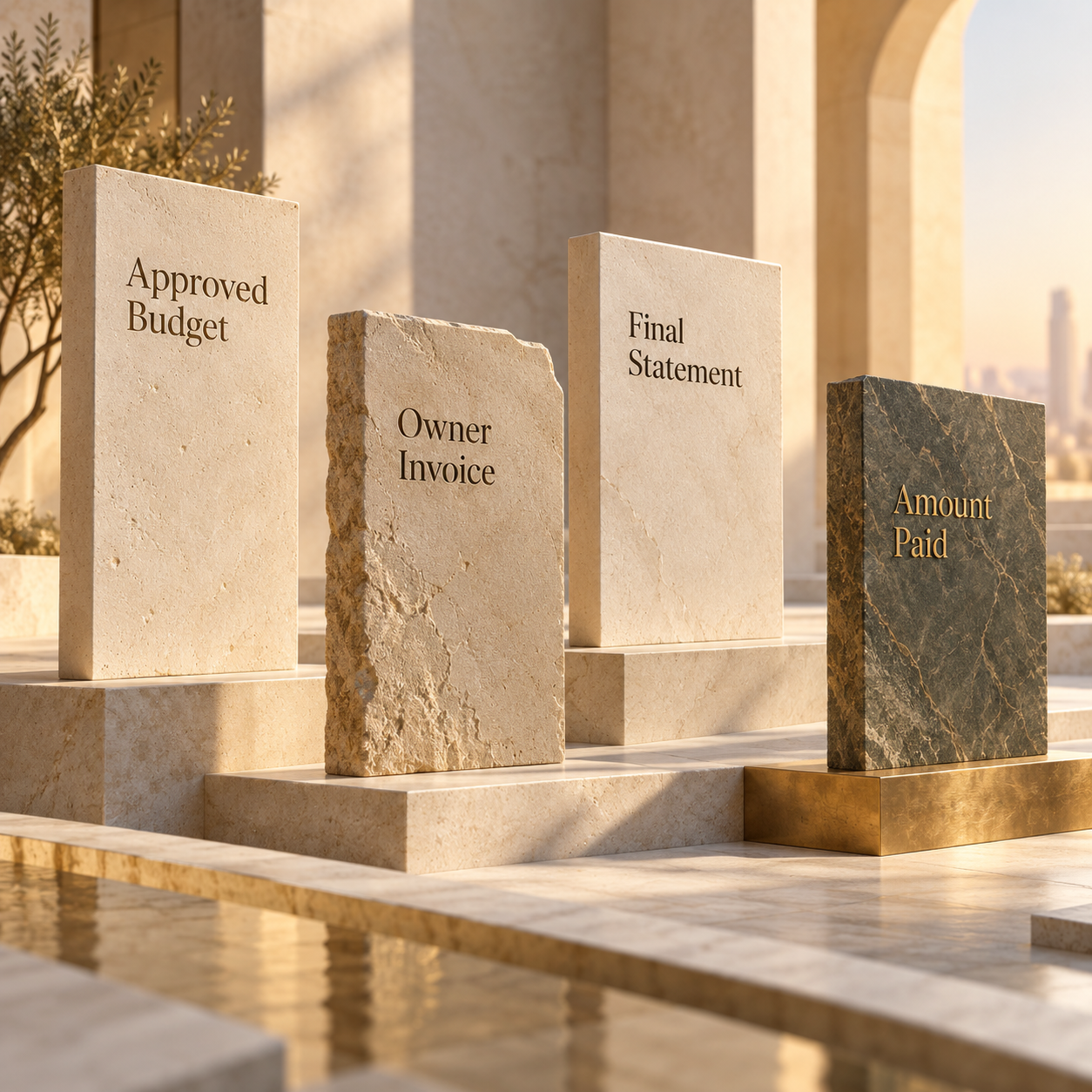
The approved annual budget is not the owner's final charge
The approved budget explains the project-level rate input. It does not prove the amount on one owner's final record.
DLD's approval of service fees and utilisation fees application requires a detailed annual budget, at least three tenders for each service provider, service and maintenance contracts, insurance and consumption records, and an external financial audit from a RERA-accredited auditor. The page exposes no page-specific publication or revision date, so it is cited as accessed 30 September 2026.
Mollak describes itself as the system that monitors service-charge payments and related accounts. Its Service Charge Index description says it displays the RERA-approved rate for community service charges, accessed 30 September 2026.
Those are related but distinct layers:
As document labels, an invoice, statement and payment record are separate owner artifacts. The public responses used here return none of those unit-level fields.
Read one record without importing another level
Belgravia shows the arithmetic and the stop condition. Its eight returned General Fund rows sum to AED 13.57 per sq ft, including the returned Income row of AED -0.23 per sq ft. Adding the returned Reserved Fund of AED 1.41 per sq ft gives the calculated AED 14.98 per sq ft total.
The same response returns a Parking row of AED 1,260.28 under Additional Charges. The current page logic keeps Additional Charges outside its service-charge total, and the public response does not return the unit title-deed area or a distinct unit-level billing basis. The AED 1,260.28 value is therefore recorded as returned and excluded from the calculated AED 14.98 total. It is not divided, converted or assigned to an owner.
This reading rule applies to the other three records. Use a returned number only with its category, charge type, project ID, use ID, year and area basis. If one of those fields is missing for the intended calculation, the missing field stays visible.
Put the record beside the wider JVC research
The service-charge record answers one building-level budget question. It does not answer the wider area-fit question.
Use the reviewed JVC road-access guide as the current Apartment hubs pillar for building pins, daily anchors and route checks. Then use the reviewed JVC versus Business Bay apartment-life comparison for the sibling area decision. Neither link turns a DLD project rate into a community rate.
FAQ, checked 30 September 2026
Can you compare service charges across JVC buildings?
You can compare exact project, use and year records when each identity is reproducible. This four-record teaching sample does not establish a JVC average, median, range or cluster rate.
What does the DLD Service Charge Index show?
DLD describes it as an inquiry into RERA-approved service fees for jointly owned properties. The customer selects the project, use and year before viewing the returned information, accessed 30 September 2026.
Is an approved service-charge rate the owner's final bill?
No. The approved project budget and returned rate are separate from the unit's title-deed area, owner invoice, final statement and payment record. Those unit-level fields were not returned in the four public responses used here.
Why are Additional Charges separate?
The current DLD page logic does not add charge type 4, Additional Charges, to its displayed service-charge total. This article preserves those returned values separately and does not infer a unit billing basis.
Is JVC a good area in Dubai?
The answer depends on the exact building and the household's repeated routine. The current JVC road-access guide provides a reviewed area-level starting point, while this article stays at the service-charge record level.