Mortgage valuation shortfall: a non-resident buyer's cash ledger
 Lida Moghaddam
Disclaimer: This article is for general informational purposes only. It is based on cited public data and published under Lida Moghaddam's RERA-licensed masthead. It is not financial, legal, or investment advice. Dubai's property market moves quickly, so figures, yields, and rules may change or become outdated by the time you read this. Verify current information with the relevant authority or a qualified professional before acting. Read the full disclaimer.
Table of contents
On an illustrative AED 2,000,000 purchase, a lender valuation of AED 1,800,000 cuts a 60% loan from AED 1,200,000 to AED 1,080,000. The purchase-price cash rises by AED 120,000, while the DLD mortgage-registration line falls by AED 300, so the defined core cash ledger rises by AED 119,700.
The shortfall changes the loan base, not the agreed price
The signed price and the lender's appraised value do different jobs. The price is the transaction input. The appraisal is the collateral input used in the LTV calculation. Under the CBUAE mortgage regulations, LTV is the outstanding loan divided by the appraised value of the residential property, and an independent on-site valuation must take place before an irrevocable lending commitment. Those rules were shown as in force when accessed on 26 September 2026.
That is why a lower valuation can create a cash gap even when the agreed price does not move. In this editorial illustration, the price stays at AED 2,000,000 and the valuation moves from AED 2,000,000 to AED 1,800,000. At the illustrative 60% LTV, the permitted loan base falls by AED 200,000 and the loan falls by AED 120,000.
The valuation figures are not a bank quote and no valuation report, sale and purchase agreement, offer letter or approval has been supplied for this example. They are inputs chosen to show the arithmetic. For the broader lending sequence, start with the non-resident mortgage pillar; the approval-file workflow explains how eligibility, property evidence and the final offer stay separate.
CBUAE ceilings and non-resident lender terms are different layers
The current CBUAE table sets regulatory maximums by borrower and property class, not a single maximum for everybody living outside the UAE. The rulebook also says providers may adopt more conservative ratios. A lender's non-resident product can therefore sit below the ceiling that may apply to an expatriate property class.
Source: CBUAE Regulations Regarding Mortgage Loans, current consolidated rule accessed 26 September 2026. The first-home bands reflect the in-force 2020 amendment.
For a real non-resident application, the bank must classify both the borrower and the property, then apply its own credit policy. Residency status, nationality class and property purpose should not be treated as interchangeable labels.
The worked ledger uses 60% because HSBC UAE's non-resident mortgage page said eligible customers could borrow up to 60% of the property's value when accessed on 26 September 2026. That is an issuer term with its own eligibility conditions. It is not presented as the market-wide rate or the outcome for this illustrative buyer.
Two valuations produce two cash ledgers
The lower valuation adds AED 119,700 to the defined core cash requirement. That total includes the cash needed to complete the AED 2,000,000 price, the DLD buyer sale-registration line of 2% of sale value, and the DLD mortgage-registration line of 0.25% of mortgage value. It excludes bank charges, service-partner charges, agency charges, insurance, conveyancing and any contractual reallocation of the seller's DLD line.
The DLD inputs come from two current, relevant service routes. The completed-property sale-registration route lists seller 2% and buyer 2% of sale value. The mortgage-registration route lists 0.25% of mortgage value. Both pages showed a last-updated date of 23 September 2026 when read for this article.
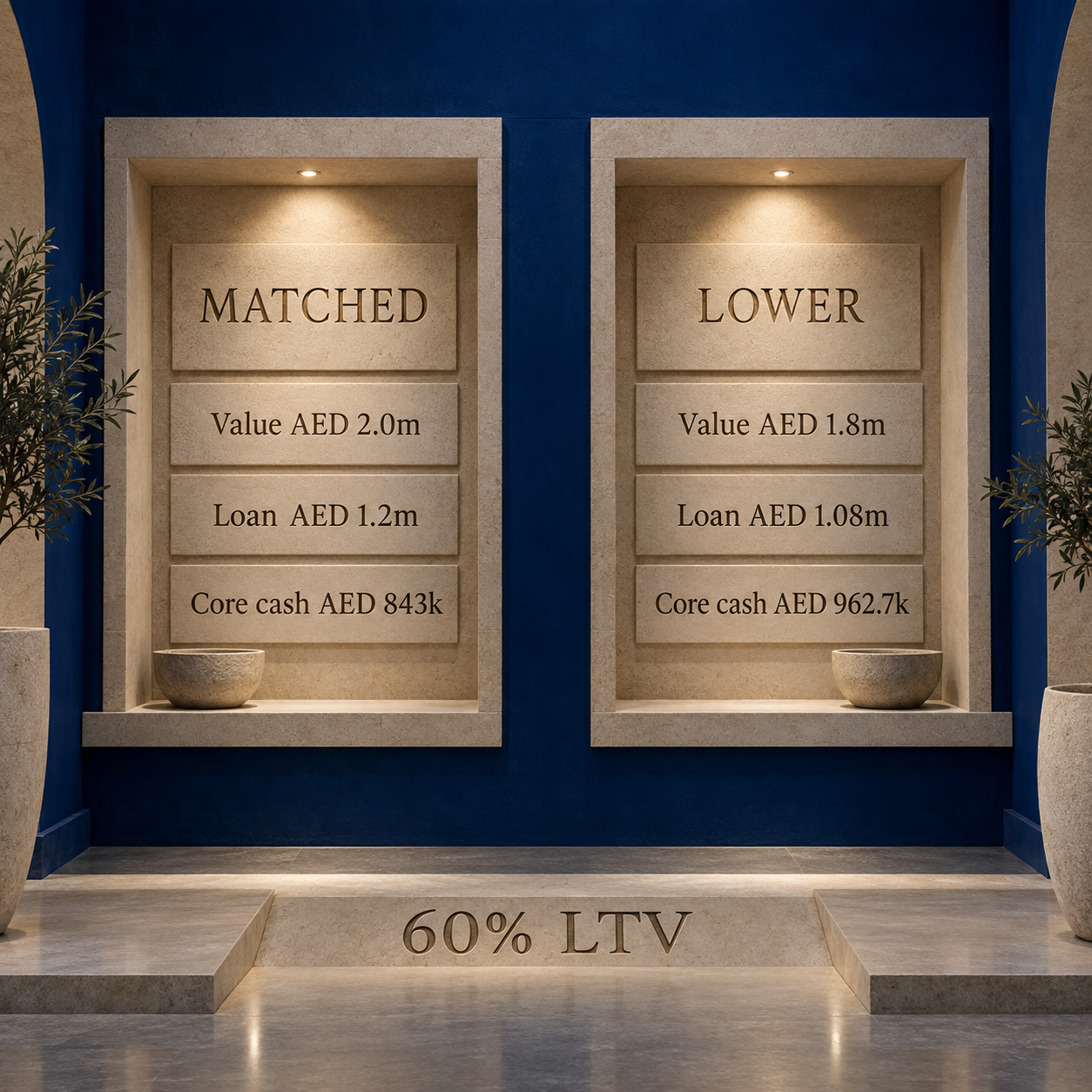
The sensitivity is linear inside this illustration. Each AED 100,000 valuation gap cuts the loan by AED 60,000, increases purchase-price cash by AED 60,000, and reduces the mortgage-registration line by AED 150. The defined core cash requirement therefore rises by AED 59,850 per AED 100,000 gap.
What changes and what does not
The valuation changes the appraised-value loan base and the amounts derived from the loan. It does not, by itself, rewrite the agreed price or the DLD buyer sale-registration line used here.
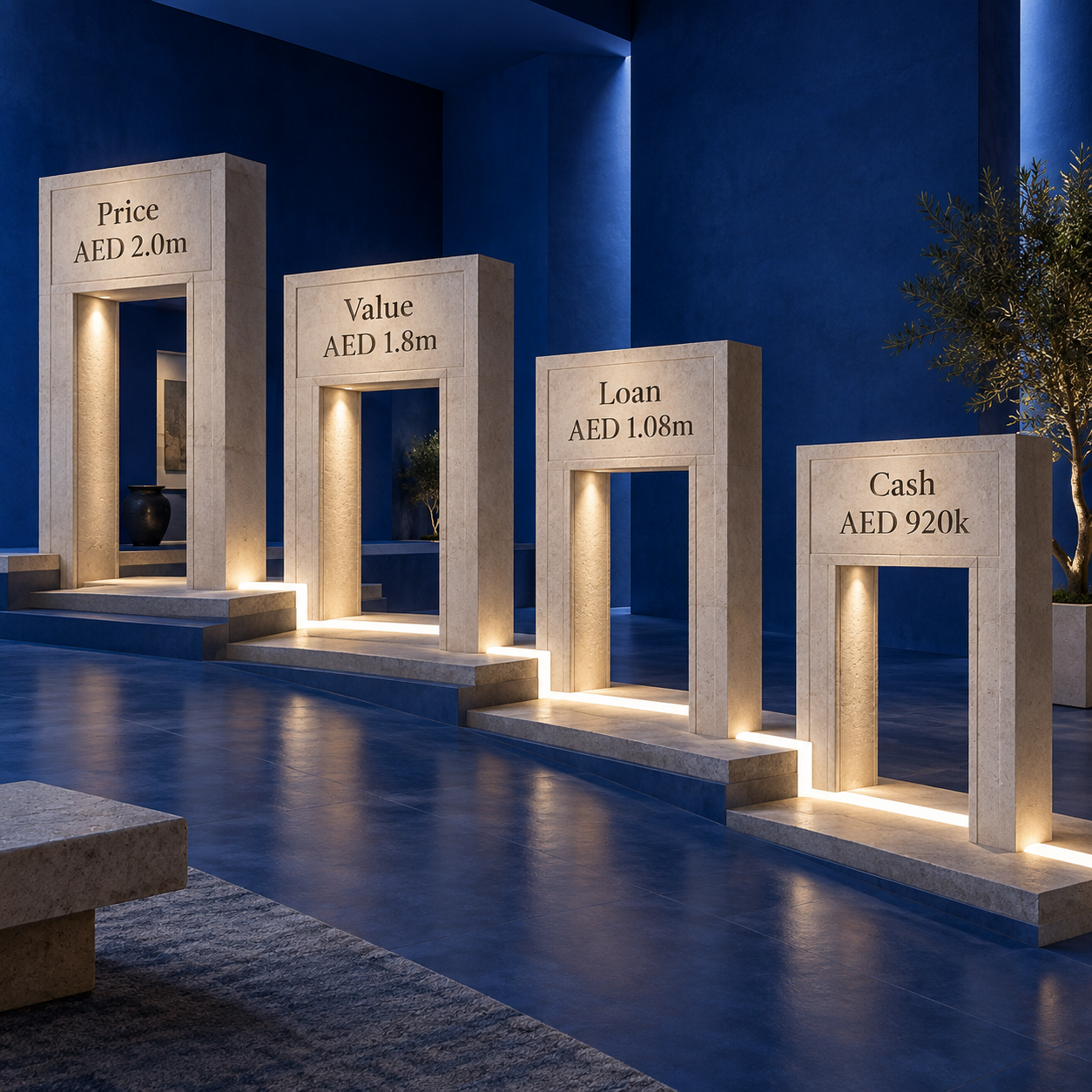
This distinction matters before a buyer treats an approval in principle as a completion number. FAB's published non-UAE-resident process, accessed 26 September 2026, places the property valuation after the MOU and before final approval. Its final-offer stage says the buyer may be asked to evidence the difference between the loan and purchase amounts. An approval stage and a final property-backed offer are therefore different records.
Build the completion file without assuming any record exists
The useful checklist is a list of records to obtain, match and verify, not a claim that the buyer already has them. The DLD routes and issuer process identify the following categories.
Confirm the lender's classification
Ask the lender to state the borrower class, property purpose, product LTV and the value used as the loan base. Compare those terms with the current CBUAE ceiling for that exact borrower and property class.
Obtain the valuation outcome
Record the lender-approved value, valuation date and any conditions only after the bank or its appointed valuer issues them. Do not substitute the illustrative AED 1,800,000 used in this article.
Match the final offer to the cash ledger
When issued, check the loan amount, buyer contribution, rate, fees, conditions and expiry in the final offer. Recompute the cash ledger from those actual terms.
Prepare the DLD identity and property records
For a completed-property sale, DLD lists Emirates ID or a valid passport for a non-resident foreigner, plus the applicable developer e-NOC. These are records to arrange for the actual route, not documents supplied to this article.
Prepare the mortgage-registration records
DLD's mortgage route lists a bank letter, three bank-certified mortgage contracts signed by both parties, and UAE ID or a passport copy for a non-resident foreigner. Confirm with the bank and registration channel which originals, electronic records and signatures are required at completion.
Reconcile receipts after payment
Keep the DLD receipt, bank disbursement evidence and the issued title or mortgage record when they exist. Reconcile them to the final ledger rather than treating a pre-completion estimate as proof of payment.
Keep contractual practice outside the authority total
DLD's completed-property page assigns 2% of sale value to the seller and 2% to the buyer. Market participants may negotiate a different contractual allocation, but that practice is not an official reassignment on the service page and is not assumed in this worked total.
The buyer line is therefore AED 40,000 in both scenarios. The separate seller line is also AED 40,000, but it stays outside the buyer authority total unless the actual signed documents allocate it to the buyer. No such contract has been supplied here.
FAQ, as of 26 September 2026
Does a lower bank valuation change the agreed purchase price?
No, not by itself. In this illustration, the price remains AED 2,000,000 while the appraised-value loan base falls, so purchase-price cash rises.
Is 60% the CBUAE maximum for every non-resident buyer?
No. The CBUAE table separates UAE nationals and expatriates, then property purpose and value bands. The 60% in the ledger is an issuer's published non-resident maximum used as an illustration, not a universal rule.
Can a non-UAE resident take a mortgage in Dubai?
Some lenders publish non-resident mortgage products. Eligibility, LTV, property acceptability and final terms remain issuer decisions within the applicable CBUAE limits.
Does the buyer always pay the full DLD sale-registration charge?
DLD's completed-property route lists seller 2% and buyer 2% of sale value. A different contractual allocation should be verified from the actual signed documents rather than assumed from general market practice.
Which number should be used after the bank issues its valuation?
Use the loan base and loan amount stated or confirmed by the lender, then rebuild every cash line from the actual offer and current DLD route. The AED 1,800,000 valuation here is only an editorial illustration.
Lida MoghaddamArchitect-turned-real-estate-specialist based in Dubai. She helps buyers, sellers, and investors read property with a designer's eye — structure, location, and long-term value.