
Dubai mortgage file refresh: approval, valuation and offer records (2026)
 Lida Moghaddam
Disclaimer: This article is for general informational purposes only. It is based on cited public data and published under Lida Moghaddam's RERA-licensed masthead. It is not financial, legal, or investment advice. Dubai's property market moves quickly, so figures, yields, and rules may change or become outdated by the time you read this. Verify current information with the relevant authority or a qualified professional before acting. Read the full disclaimer.
Table of contents
HSBC UAE publishes a 60-calendar-day Approval in Principle period, but its current public evidence does not give the valuation report or mortgage offer the same clock, accessed 30 September 2026. For a non-resident Dubai buyer, each issued record controls its own dates: AIP, valuation report, mortgage offer, Home Loan Agreement and transfer booking must be tracked separately.
One mortgage file contains several controlling records
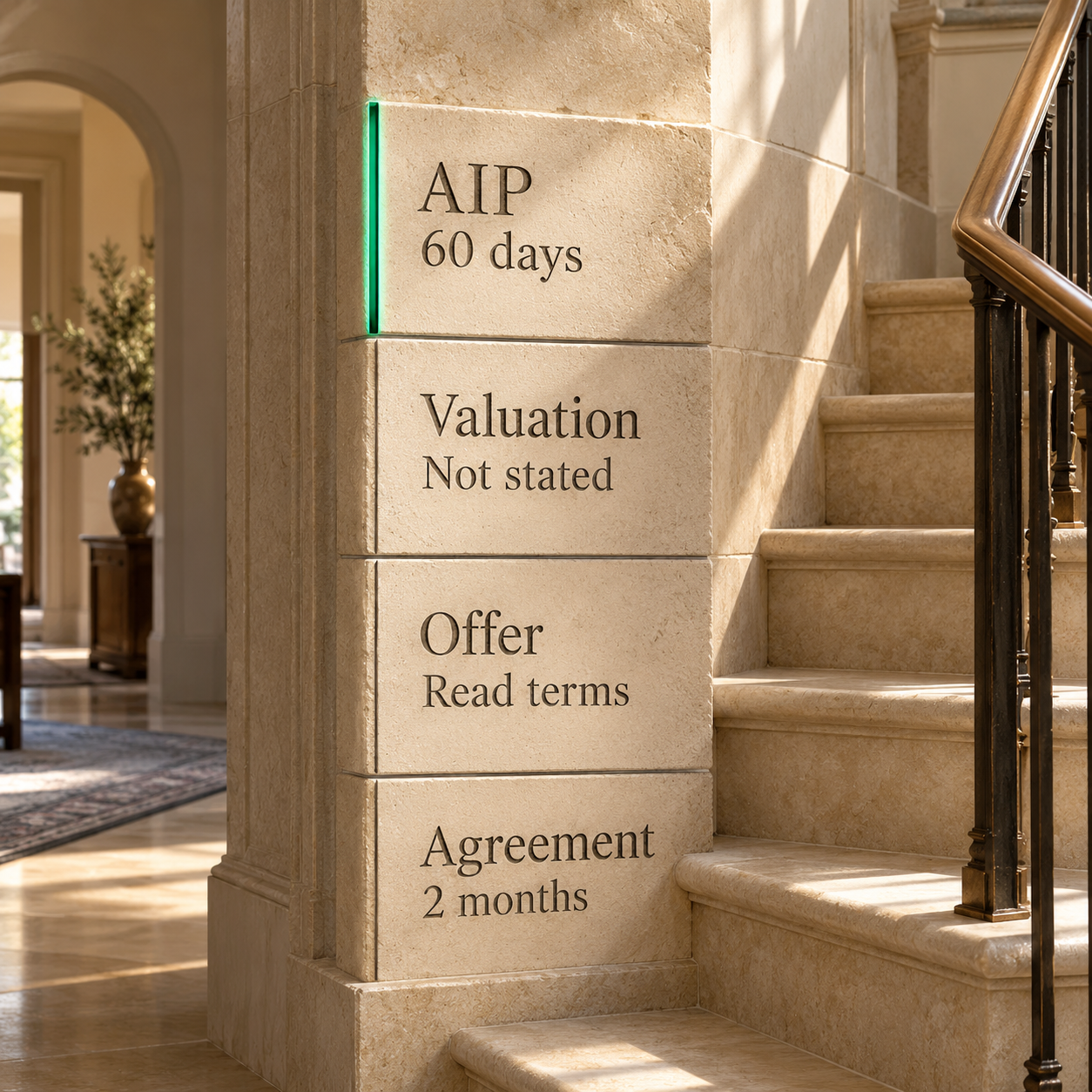
The file needs several clocks because each record answers a different question. An Approval in Principle assesses applicant information at an early stage. A valuation report records evidence about a named property. A mortgage offer states the lender's proposed terms, while the legal Agreement governs the contractual record. Dubai Land Department's Property Sale Registration service records the authority stage.
HSBC UAE's public AIP page states 60 calendar days, accessed 30 September 2026. The page does not transfer that period to a valuation or offer. Its non-resident mortgage page, accessed the same day, moves through valuation, mortgage-offer review and registration without publishing a shared expiry date.
That separation is the practical rule. The canonical non-resident mortgage guide covers the broader process. This tracker answers the narrower question: which dated record controls which stage?
The evidence tracker keeps each clock narrow
The public validity period returned for the early approval in the cited stage sample belongs to the AIP. The other rows tell the reader where to look and, just as importantly, what the current public source does not establish.
The HSBC KFS also prices a valuation at AED 2,625 including 5% VAT, accessed 30 September 2026. That fee and the possibility of a second valuation are returned lender facts. A reason or timetable for the second valuation is not returned, so the table leaves it open.
FAB provides a useful process cross-check without supplying a missing clock. Its non-UAE resident mortgage page, accessed 30 September 2026, places valuation after a property and MOU are identified, then separates final decision, offer-letter acceptance, registration and disbursal. The page does not publish a general valuation or offer validity period.
A declared timeline shows why one expiry date cannot govern the file
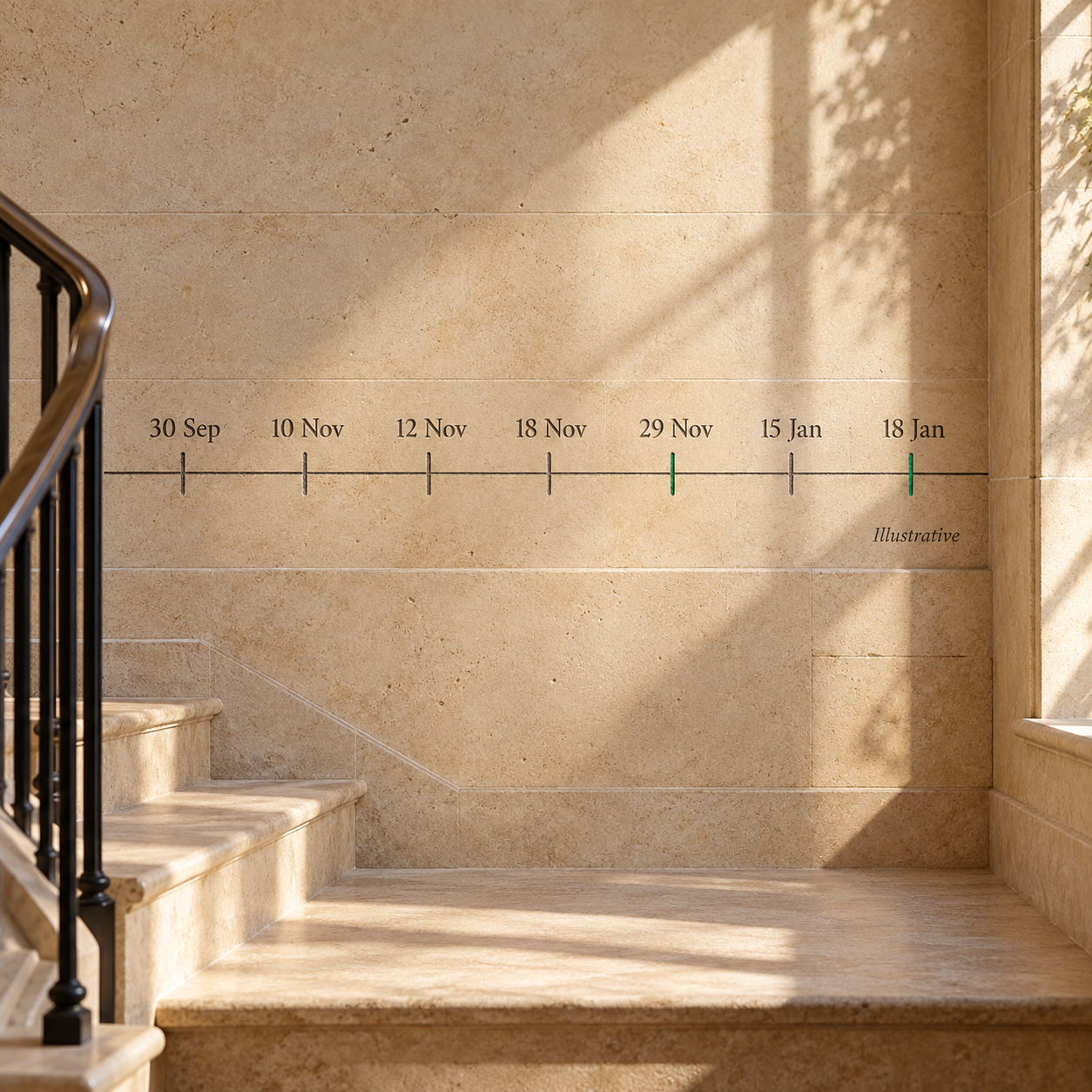
The illustrative timeline uses two returned periods and five declared dates. It does not invent a valuation or offer expiry. The separate AIP calendar explains the early approval in more detail.
With the AIP issue date labelled Day 0, adding HSBC's returned 60 calendar days produces a calculated marker of 29 November 2026. Adding the KFS's returned 2 calendar months to the illustrative Agreement issue produces a separate marker of 18 January 2027. The declared transfer appointment falls before that second marker, while the full illustrative path from AIP issue to appointment is 107 elapsed days.
Neither marker rewrites an issued document. The AIP letter controls how its end date is expressed. The Agreement controls its expiry, conditions, cooling-off treatment and drawdown requirements. The valuation report and mortgage offer remain without a public day-count rule in the cited evidence.
Refresh the record whose facts changed
Applicant evidence belongs to the applicant file, property evidence belongs to the selected property, and transfer evidence belongs to the authority service. A later request for a current document does not convert one record into another.
HSBC's mortgage application page, accessed 30 September 2026, says the full application may require identity records, a salary certificate, property documents, proof of down-payment funds and a personal bank statement dated within the past 6 months. Those are named evidence fields. The lender decides which current documents the live application requires.
The non-resident approval-file guide shows how applicant, LTV and valuation evidence fit together. For this tracker, the operating distinction is simpler:
Read the issued AIP
Record the issuer, issue date, stated end date, conditions and applicant facts assessed. Do not copy HSBC's public period onto another lender's letter.
Read the valuation report
Record the property identifier, inspection date, report date and the lender response. If the lender requests another valuation, record that request as a new event rather than backfilling a public expiry rule.
Read the offer and Agreement separately
Capture the name printed on each record, its issue and acceptance fields, and any expiry or drawdown language. Do not map the public phrase “mortgage offer” to the legal “Agreement” unless the issued file establishes that relationship.
Read the DLD service record
Use the booking or request record for the appointment date and the completed authority output for registration. DLD's Property Sale Registration service, accessed 30 September 2026, lists a valid passport for a non-resident foreign buyer and a developer e-NOC in freehold areas.
Public-facing and legal names stay separate
The public website uses “HSBC UAE.” The linked KFS and Home Loan Terms and Conditions identify the legal issuer as “HSBC Bank Middle East Limited.” The Home Loan Terms and Conditions show an effective date of 17 April 2026 and define the Agreement as the relevant Home Loan Agreement incorporating the stated terms.
That naming boundary matters. “Mortgage offer” is the public-facing stage label on HSBC's non-resident page. “Agreement” is the capitalised legal record in the KFS and terms. A buyer's own issued documents show whether and how those records connect in that file.
The same discipline applies to DLD. Dubai Land Department is the authority; Property Sale Registration is the service route; a transfer booking is a dated request record; and the electronic title deed is a service output. None is a substitute for the lender's approval, valuation or offer.
FAQ, checked 30 September 2026
How long does a Dubai mortgage Approval in Principle last?
HSBC UAE publishes 60 calendar days, accessed 30 September 2026. That is one named lender's public period; the issued letter controls its own dates and conditions.
Does a bank valuation expire after 60 days?
The cited HSBC evidence does not establish that. Its KFS, accessed 30 September 2026, says some loans may require a second valuation but publishes no day-count validity or trigger for it.
Is a mortgage offer the same as the Home Loan Agreement?
The cited HSBC artifacts use the names separately. The public non-resident page refers to a mortgage offer, while the KFS and terms refer to the Agreement; the issued records control the relationship in a buyer's file.
Lida MoghaddamArchitect-turned-real-estate-specialist based in Dubai. She helps buyers, sellers, and investors read property with a designer's eye — structure, location, and long-term value.