
DLD fee payment receipt: request routes and record scope (2026)
 Lida Moghaddam
Disclaimer: This article is for general informational purposes only. It is based on cited public data and published under Lida Moghaddam's RERA-licensed masthead. It is not financial, legal, or investment advice. Dubai's property market moves quickly, so figures, yields, and rules may change or become outdated by the time you read this. Verify current information with the relevant authority or a qualified professional before acting. Read the full disclaimer.
Table of contents
DLD's public Fees Payment Receipt screen offers separate certificate and receipt request modes for an emailed procedure receipt. Neither mode is the electronic title deed or a page-stated proof that the purchase price was settled (DLD Fees Payment Receipt, accessed 1 October 2026).
The two DLD routes do not issue the same record
The old-receipt service retrieves a procedure's fee receipt, while sale registration records a completed-property sale and names ownership documents separately. Treating them as one route hides which event the email belongs to.
The counts above reproduce the public screen state accessed 1 October 2026 (DLD Fees Payment Receipt form).
This is a narrow companion to the full Dubai purchase path. The pillar follows the buyer from budget to title deed; this workflow answers one later file question: which DLD receipt was requested or issued.
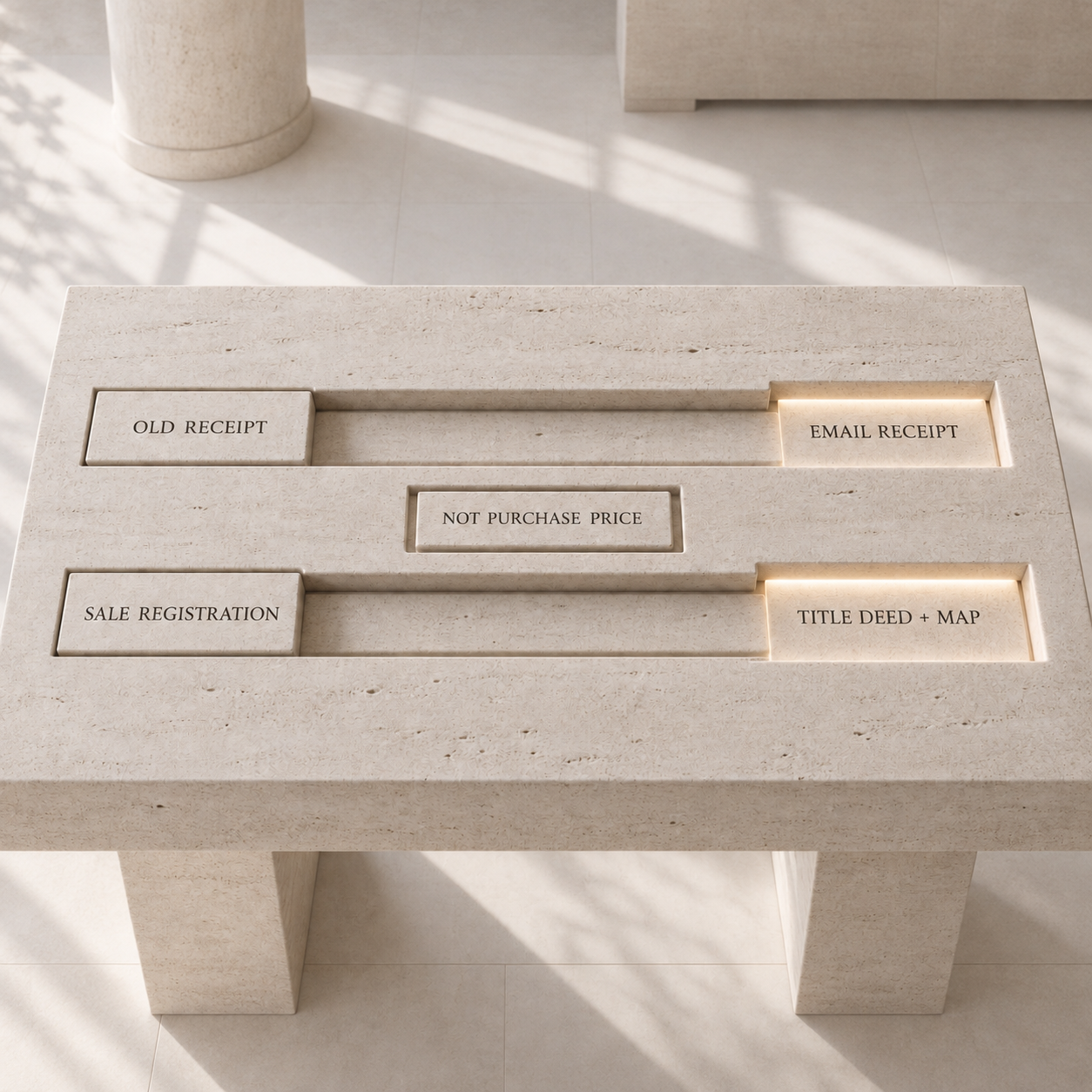
The old-procedure receipt service has three request paths
The available route depends on which identifier is already in the file: a certificate, a receipt, or an owned property visible in Dubai REST. DLD describes the service as a request for fees payment receipts from older procedures such as a sale, mortgage or map issue (DLD, accessed 1 October 2026).
Public search by certificate
The current public screen asks for Certificate Type, Certificate No., Certificate Year and Email Address. These are four required inputs. Selecting a certificate type identifies the procedure family; it does not turn the returned receipt into the certificate itself (DLD public form, accessed 1 October 2026).
Public search by receipt
The Receipt mode asks for Receipt Number, Receipt Year and Email Address. These are three required inputs in the 1 October 2026 screen state. The result still belongs to the Fees Payment Receipt service and is sent by email.
Request from an owned property
In Dubai REST, the owner selects the property, opens Property procedures, receipts and documents, then selects Fees Payment Receipt against the relevant procedure. DLD states that this path sends the receipt to the owner's verified profile email, so a verified email is a stated service term (DLD, accessed 1 October 2026).
The public path and owned-property path are alternatives inside one service. They should not be merged with sale registration merely because both can produce an emailed payment receipt.
The sale-registration receipt sits inside a 25-minute service
The payment receipt appears at step 3 of DLD's five-step service-centre sequence. It is an intermediate record inside the registration route, not the route's only issued document.
At a Real Estate Registration Trustee centre, DLD's current sequence is:
- The employee verifies the submitted documents, identifies deficiencies and uploads accepted documents to the digital vault.
- The employee enters the transaction data and performs an audit.
- The fees are paid, a receipt for payment is issued and the output is sent by email.
- The buyer's information is entered by Emirates ID or passport and the request is submitted.
- The request is created and its reference number can be used for follow-up under My Requests.
For an individual sale, the same page names seller and buyer Emirates IDs for identity verification, or a valid passport for a non-resident foreigner, plus a developer e-NOC in a freehold area. An e-NOC is the developer's electronic no-objection certificate for the transfer. DLD lists the service time as 25 minutes and the issued outputs as the Electronic Title Deed, Electronic Map and Fee Balances (DLD Property Sale Registration, accessed 1 October 2026).
The 25 minutes is DLD's stated service time for this route. It is not a statement about the full elapsed purchase, which can also depend on the contract file, e-NOC, funding and appointment readiness. The trustee-office transfer-day guide carries the wider document and handoff sequence.
The email-record checklist keeps four files separate
The strongest reading starts with the service route and ends with the record's own label. As a general record-keeping checklist, the points below are editorial comparison fields, not a DLD completeness standard.
- Route used: public Certificate search, public Receipt search, owned-property receipt path or Property Sale Registration.
- Destination: the email entered on the public form, or the owner's verified profile email for the owned-property route.
- Identifier: certificate type, number and year; receipt number and year; or the selected owned-property procedure.
- Record label: whether the attachment calls itself a procedure receipt, payment receipt, title deed, map or another record.
- Property and party details: compare only the fields actually returned with the transaction file. Do not infer a human name or property match from an identifier alone.
- Sale request reference: where sale registration applies, retain the request reference DLD says is needed for follow-up.
- Separate transaction records: keep any private-deposit receipt, bank payment confirmation, completion statement and electronic title deed under their own names. The DLD pages reviewed do not state that a fee receipt replaces them.
A document can be genuine and still answer a narrower question than the reader has. The receipt route answers whether a DLD procedure receipt was returned. The title deed answers the ownership-record question named by the sale-registration output. Neither service page supplies a universal private purchase-price settlement record.
The dated screen state is reproducible
The 1 October 2026 public screen offered 2 search modes. Certificate search had 4 required inputs; Receipt search had 3. The separate sale-registration page listed 5 service-centre steps, a 25-minute service time and 3 named outputs. These are returned and counted page fields, not estimates (DLD receipt form; DLD sale registration, both accessed 1 October 2026).
The pages do not supply page-specific publication or update dates. The access date therefore travels with each claim; the DLD site's footer date is not used as the date of either service page.
FAQ, checked 1 October 2026
How do I get an old DLD fee payment receipt?
Use DLD's Fees Payment Receipt service. The public screen can search by Certificate or Receipt, while the Dubai REST owned-property path starts from the property's Property procedures, receipts and documents menu (DLD, accessed 1 October 2026).
How long does the DLD fee payment receipt request take?
DLD lists the Fees Payment Receipt service time as Instantly. That is distinct from the separate Property Sale Registration service time of 25 minutes (DLD receipt service; DLD sale registration, both accessed 1 October 2026).
Is a DLD fee payment receipt the same as an electronic title deed?
No. The receipt service names a procedure receipt sent by email. The sale-registration service separately names the electronic title deed and electronic map as issued documents (DLD, accessed 1 October 2026).
Does a DLD fee receipt prove the seller received the purchase price?
Neither current DLD page used here identifies the fee receipt as proof that the private purchase price was settled. The record should retain the name and scope of the route that issued it.
What documents does DLD list for an individual property sale registration?
DLD lists seller and buyer Emirates IDs for identity verification, or a valid passport for a non-resident foreigner, and a developer e-NOC in freehold areas (DLD, accessed 1 October 2026).
Lida MoghaddamArchitect-turned-real-estate-specialist based in Dubai. She helps buyers, sellers, and investors read property with a designer's eye — structure, location, and long-term value.