
Property snagging Dubai: inspection and developer handover (2026)
 Lida Moghaddam
Disclaimer: This article is for general informational purposes only. It is based on cited public data and published under Lida Moghaddam's RERA-licensed masthead. It is not financial, legal, or investment advice. Dubai's property market moves quickly, so figures, yields, and rules may change or become outdated by the time you read this. Verify current information with the relevant authority or a qualified professional before acting. Read the full disclaimer.
Table of contents
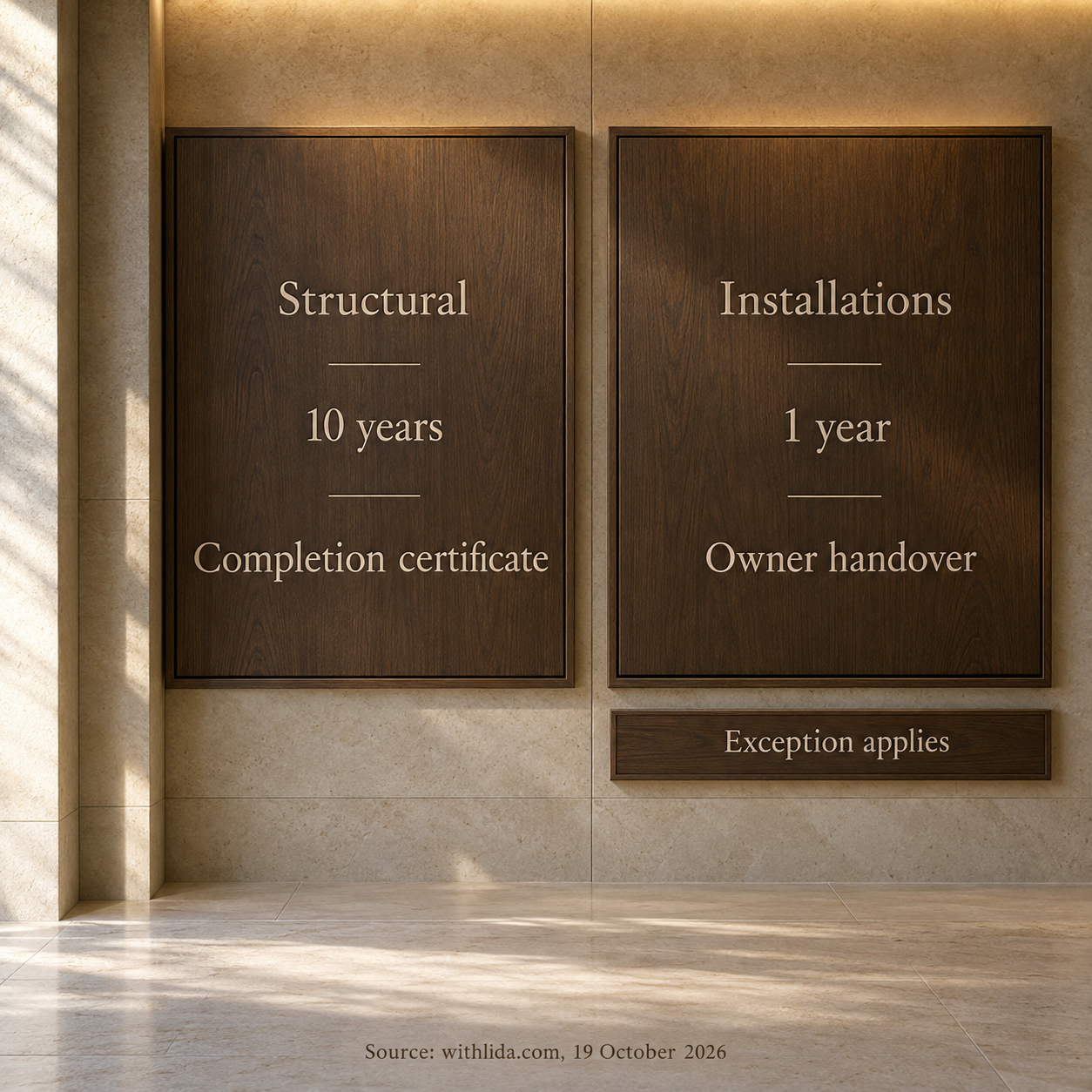
Property snagging in Dubai records defects and unfinished items around developer handover. For jointly owned property, Article 40 provides a 10-year structural period from the project completion certificate and a 1-year defective-installation period generally from owner handover. The dates differ. Dubai Law No. (6) of 2019, Article 40, verified 19 October 2026.
Owner handover: the verified distinctions
Source: withlida.com, 19 October 2026, from the official law, Article 40, Emaar FAQ and DLD complaints page, checked on that date.
Last verified: 19 October 2026. Checked by the publication's independent check, 19 October 2026.
This owner-handover guide sits alongside the Dubai buying guide in the Buy hub. The purchase contract, inspection record and handover documents each have a separate job.
What is property snagging in Dubai?
Snagging turns what is seen at a property inspection into an itemised record for assessment and follow-up. The useful output is a traceable observation, rather than a broad statement that a home needs attention.
A record might identify a chipped tile beside a doorway, an uneven paint finish behind a door or a cabinet front that appears misaligned. It gives another person enough information to locate the same item. Whether that observation represents a defect, a specification question or something requiring technical investigation is recorded separately.
The most useful file for an overseas owner is therefore one that survives a change of person: a representative can record an observation, a developer team can respond to that entry, and the owner can later understand exactly what was rechecked. For an owner attending personally, the same structure keeps the appointment from becoming a collection of unlabelled photographs.
What does a visible inspection establish?
A photograph of a ceiling mark establishes what the image shows at its recorded time and location. It does not establish the source of moisture, whether any condition remains active or which party is responsible. A photograph of a line in plaster similarly does not classify the building's structure.
Keep a specialist's diagnosis in its own report field, with the issuer, date, scope and reference. Where an executive demonstrates a fitting or control, the owner's note can record what was demonstrated and observed. Technical conclusions belong to the appropriately qualified professional's assessment. This guide's worksheet is for visible observations and records, not electrical, structural or concealed-system testing.
The distinction also separates owner handover from renting. The tenant move-in inspection record concerns condition evidence within a tenancy and possible Rental Dispute Center files. An owner's developer snag register instead follows the developer's handover process, the purchase agreement and the relevant property framework.
What happens during a home orientation?
Emaar describes Home Orientation as an accompanied walkthrough where observations go onto a checklist and its quality team coordinates follow-up. This is an example of a named developer's procedure, checked 19 October 2026, rather than a Dubai-wide inspection entitlement.
In the Emaar FAQ, a Property Handover Executive accompanies the visit. The Home Orientation Checklist records matters requiring attention. Emaar's Property Quality Assurance department, or PQA, liaises with the contractor on the recorded observations, subject to acceptance by PQA and the consultants.
That acceptance qualification matters to the record: an item appearing on a checklist and an item accepted for rectification describe different stages. The owner's register can preserve both without treating either as a technical or legal conclusion.
What belongs in the appointment file?
An editorial appointment file can bring together the unit identifier, appointment confirmation, current purchase specifications, the checklist and the owner's photograph index. These are suggested record categories, not an additional Emaar document requirement. A specification reference helps explain what is being compared; the photograph helps identify the observed item.
For example, a note reading "kitchen, cabinet beside oven, front appears out of line" allows the executive to locate the observation. Any relevant specification page can sit beside it. A preference about a different finish stays identifiable as a specification question rather than being recorded automatically as accepted rectification.
Is a second orientation part of this example?
Emaar's FAQ states that one Home Orientation is conducted per unit in accordance with the sale and purchase agreement, often shortened to SPA. It separately describes reporting pending snags to PQA after taking handover. Its listed reporting channels are the contact centre, PQA email and customer centre. These arrangements were checked on 19 October 2026 in the same FAQ.
A recheck field in a personal register therefore records what later happened when access was available. It does not create another appointment or establish a right to repeated pre-handover visits. The developer's current procedure and the relevant contract establish the access arrangements for that home.
Can a representative attend the snagging inspection?
Emaar's published orientation procedure allows a representative with an authorisation letter and the owner's passport copy for signature verification. Its separate handover requirements use different authority documents, so orientation permission and authority to complete handover need separate confirmation.
The orientation letter described in the Emaar FAQ, as of 19 October 2026, includes the representative's full name, contact number and the owner's consent to conduct the orientation. The FAQ separately lists power-of-attorney or notarised-authorisation requirements within its handover process. A power of attorney is a formal document authorising another person to act within its stated scope.
For the owner's file, it is useful to identify the task the representative is carrying out: attending, photographing, submitting observations, receiving replies or signing a specified document. These are different activities. An inspection appointment alone does not explain the scope of every later signature.
How does the owner retain continuity?
The representative can use the same room names and observation identifiers throughout the file. The owner then receives the checklist version used at the visit, its evidence index and the record of what was submitted. Any missing response remains visibly outstanding rather than being filled in from recollection.
This is an editorial way to organise representation, not a statement that every developer accepts the same letter or visitor arrangements. Another developer's current requirements, the unit's ownership structure and the particular documents being signed need their own confirmation. Identification copies belong in the relevant authorised submission, rather than in a broadly circulated photo folder.
How are observations recorded, reported and rechecked?
Each observation works best as a continuing entry: its original description stays linked to evidence, acknowledgement, the reported work and the recheck result. A fresh photograph can update the entry without erasing its history.
The following table is an editorial snag-register template, with illustrative descriptions and placeholders. It is not a completed inspection, an official DLD form or an Emaar checklist. Each row can be copied and expanded for an actual record.
Source: withlida.com, 19 October 2026. Original editorial template; descriptions and status options are illustrative, with no finding about a real unit or developer.
What makes an observation usable?
A room name, identifiable location and plain description let someone else find the item. "Bedroom wall" leaves a larger search area than "bedroom, wall beside window reveal". A room view establishes location; a detail image records the visible feature. Retaining both makes later comparison easier.
The evidence reference links the table to the original image or report. Keep an original file and an index identifying which entry it supports. An annotated copy can highlight the location while the original remains available. Record any uncertainty about the capture date rather than assigning a date from memory.
How does the record move through follow-up?
The sequence below is withlida's editorial workflow. The actual reporting channel and access arrangements come from the relevant developer process and contract.
Identify and preserve the observation
Assign the entry a stable reference. Record the room, item, observation date and evidence files. A later change in appearance becomes a dated update to the same entry.
Submit a recognisable version
Use the channel confirmed for that property. Keep the submitted checklist or report version, attachment list, recipient and submission date together. A report sent without its referenced images is a different record from the complete file.
Record the response precisely
Distinguish a delivery receipt from an acknowledgement, acceptance for work, a request for clarification or a referral for assessment. Record any stated work arrangement as the developer's communication, with its date and reference.
Recheck when access is arranged
Compare the identified item with the earlier entry. Record the recheck date, current visible condition and any new evidence. If access has not occurred, the status can say work reported complete, recheck pending.

What does each status mean?
"Acknowledged", "work reported complete" and "rechecked" answer different questions. The first records a response. The second records what the sender says about work. The third records a later observation. Keeping those statuses separate makes the file useful even when the people handling it change.
If the same feature remains visible, the recheck note can describe that appearance and link a new image. If the item cannot be inspected, the note can say so. Neither situation needs a guessed diagnosis or a new entry that breaks the connection to the original report.
Which statutory defect periods have different starting dates?
Article 40 of Dubai Law No. (6) of 2019 uses the project completion certificate for structural defects and, generally, owner handover for defective installations in jointly owned real property. The installation provision changes its start where an owner refrains from taking possession for any reason.
Jointly owned real property is a legal property category, including buildings with common-use parts and land subdivided for individual ownership. The property's actual classification matters when applying this framework. The following explanation reports Article 40's published text, verified 19 October 2026.
Source: withlida.com, 19 October 2026, from the official full PDF, Article 40, printed pages 25 and 26.
These are different categories and starting events. Calling Article 40(b) a universal one-year cosmetic warranty would lose its actual subject, defective installations, and its possession exception. A visible paint mark is not automatically classified by that provision merely because it appears in a snag report.
The reservation in Article 40(c) also matters: this article is not presented as an exhaustive account of every right an owner may have. Article 40(d) states that an agreement made after the law takes effect which contradicts the article is deemed null and void. These points come from the same official text, as of 19 October 2026; their application to a particular document belongs with a qualified legal professional.
The official English PDF states that the Arabic text prevails in case of conflict for interpretation and application. The table is a reading aid, with the original legislation linked for verification.
How do completion, handover and report dates fit together?
A useful date file retains each event separately, because the structural and installation provisions can point to different documents. The example below is entirely hypothetical and illustrates record fields, not a real project or a claim deadline.
Source: withlida.com, 19 October 2026. All dates are invented teaching inputs; the starting-event rules come from Article 40, checked on that date. The example is not a promised response or repair timetable.
The starting records in this example are 92 calendar days apart: 30 days in June + 31 days in July + 31 days in August = 92 days. The calculation compares the certificate date with the handover date. It does not calculate an expiry date or a deadline for starting proceedings.
Where Article 40(b)'s owner-refrains condition applies, its installation starting record would instead be the project's completion certificate. The example does not assume that condition applies simply because the owner lives overseas or sends a representative.
The report date serves another purpose: it connects the stated observation to a submission and its attachments. The developer-response and recheck dates then explain the follow-up history. None is substituted for the statutory starting records, and this illustration does not determine the legal effect of a handover form or a particular notice.
Where can an owner raise a complaint or contractual enquiry?
Dubai Land Department lists a complaint against a real estate company separately from enquiries concerning contractual disputes. Identifying the question and the supporting file comes before treating those routes as interchangeable.
As of 19 October 2026, the DLD Real Estate Complaints page lists:
- Complaint Against a Real Estate Company, a route for recording notes and complaints concerning a real estate company.
- Inquiries Concerning Contractual Disputes, described as automated responses to enquiries about contractual disputes or unwillingness to fulfil a contract.
- RVS Complaint Tracking, for checking a Real Estate Violation System complaint number's status.
The contractual-enquiry description is a service description, not a determination of a particular contract. Complaint tracking records a complaint's status, rather than the physical recheck status of a snag. Neither the landing page nor an acknowledgement establishes compensation, a judgment or when an individual matter will conclude.
For an owner organising the question, a concise file can identify the property, the relevant contract or handover document, the observation references, submission evidence and responses. This is an editorial way to present the history, not a claim that each named service requires an identical document pack.
A contractual interpretation or dispute-route question can then be put to DLD, RERA, the Real Estate Regulatory Agency, or a qualified legal professional using the actual documents. A technical classification can be put to an appropriately qualified property professional. The record keeps those questions visible without turning an owner's observation into either answer.
Change log: 2026-10-19 · first published · Emaar's orientation example, the full text of Article 40 and DLD's complaint-route descriptions verified; editorial snag register and hypothetical date worksheet added.
Property snagging Dubai FAQ, verified 19 October 2026
The recurring questions below distinguish the inspection record from developer access arrangements and the statutory starting events.
What is a snagging inspection?
A snagging inspection identifies and records observations about a property's condition for assessment and follow-up. A useful register links the item, location, evidence and response. It does not, by itself, establish the cause of a visible feature or legal responsibility.
Can someone attend home orientation on my behalf?
Emaar's FAQ, checked 19 October 2026, gives an orientation authorisation route using a letter and the owner's passport copy for signature verification. Its separate handover requirements differ. The relevant developer confirms the documents and scope for the actual task.
What does de-snagging mean?
De-snagging means rechecking previously recorded observations after work is reported. The editorial record keeps the original entry and adds the later visible result. Access depends on the relevant arrangements; Emaar's FAQ, as of 19 October 2026, specifies one Home Orientation and a separate route for reporting pending snags after handover.
Does every Dubai property have a one-year cosmetic warranty?
That is not what Article 40(b) says. It addresses defective installations in jointly owned real property, generally from owner handover, with a different start where the owner refrains from taking possession. Other rights are reserved by paragraph (c). Article 40, verified 19 October 2026.
Does submitting a snag report restart the structural period?
Article 40(a) names obtaining the project's completion certificate as the starting event. The report date identifies a different event, communication of observations. No restart from report submission is stated in that provision. Article 40, verified 19 October 2026.
Subscribe to withlida's newsletter for sourced Dubai property process updates.
Lida MoghaddamArchitect-turned-real-estate-specialist based in Dubai. She helps buyers, sellers, and investors read property with a designer's eye — structure, location, and long-term value.