Electronic title deed versus electronic map: the two post-transfer output records
 Lida Moghaddam
Disclaimer: This article is for general informational purposes only. It is based on cited public data and published under Lida Moghaddam's RERA-licensed masthead. It is not financial, legal, or investment advice. Dubai's property market moves quickly, so figures, yields, and rules may change or become outdated by the time you read this. Verify current information with the relevant authority or a qualified professional before acting. Read the full disclaimer.
Table of contents
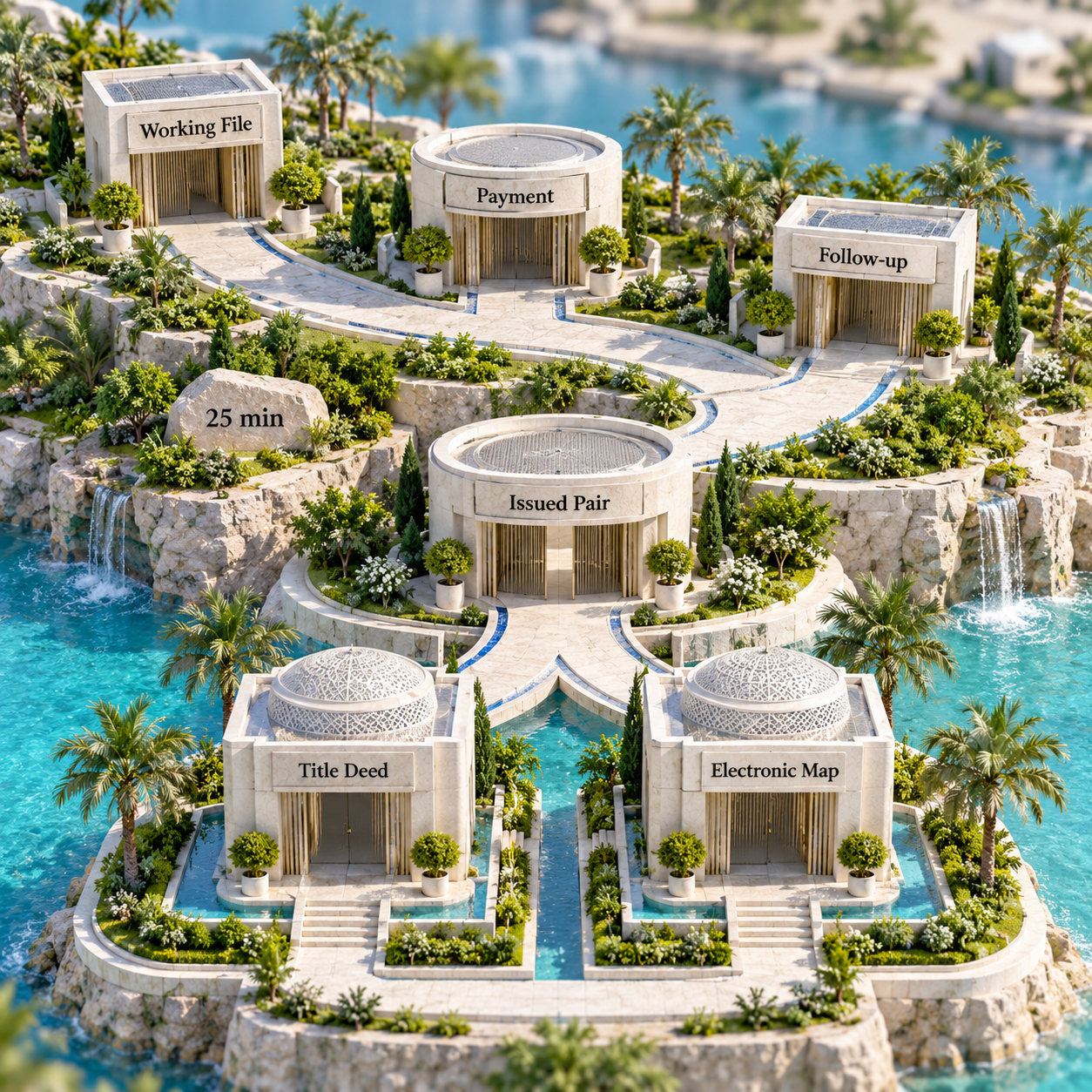
The Dubai Land Department's Property Sale Registration service names two issued documents, an electronic title deed and an electronic map, and gives the service a 25-minute time. They are separate outputs from the same completed-property registration route; the payment receipt, request reference and My Requests status sit in the workflow but are not listed as either issued document (DLD Property Sale Registration, accessed 2 October 2026).
The sale-registration route produces two final outputs
The electronic title deed and electronic map are separately named records, even though DLD lists them under one Issued Documents heading. On the current sale-registration page, both follow the service for registering a full or partial sale of land, property or a completed real estate unit through a Real Estate Registration Trustee centre, the service-centre channel DLD names for the transaction (DLD Property Sale Registration, accessed 2 October 2026).
This is a bounded distinction. The title deed has a separately published DLD validity-check route. The cited official pages do not give the electronic map an equivalent description, and its name alone is not evidence of what appears inside it.
The full Dubai buying process places these records after the wider contract, fee and transfer sequence. This guide stays with the final registration file.
Follow the evidence from request to issue
The clean file moves through four evidence levels: working documents, trustee-centre activity, tracking and payment records, then the two issued documents. That sequence describes what each record can establish for the buyer. It is not a reconstruction of DLD's internal timestamps.
Prepare the working file
DLD lists Emirates IDs for the seller and buyer, or a valid passport for a non-resident foreign buyer. In a freehold area, it also lists the developer's no-objection e-certificate, usually called an e-NOC, through Dubai REST. These are request inputs, not post-registration outputs.
Complete the trustee-centre activity
At the Real Estate Registration Trustee centre, DLD says the employee verifies the documents, uploads them through the digital vault, enters the transaction data and performs an audit. Those actions are the service activity. The page does not name a separate document called a trustee event.
Keep payment and follow-up records separate
DLD says the payer receives a receipt after paying the fees. It also tells the applicant to note the request reference for follow-up and says status can be checked under My Requests. A receipt answers the payment question; a reference locates the request; My Requests reports status.
Inspect the issued pair
The service's Issued Documents section names the electronic title deed and electronic map. DLD says the output is sent by email. Keep the delivered records under those exact names rather than treating the status screen as the end of the evidence trail.
The title deed has a separate official validity check
DLD gives the title deed an additional official test: its Verify Title Deed service checks the validity of a Certificate of Title or title deed issued by the Land Department. DLD lists that check as immediate and available through the Land Department website and Dubai REST App (DLD Verify Title Deed, accessed 2 October 2026).
That source establishes the check's purpose, channels and service time. It does not turn the sale-registration receipt into the deed, and it does not publish a complete list of the deed's visible fields on the overview page. The careful file therefore preserves the delivered title deed and uses the separate official route when validity is the question.
For an off-plan purchase, the record sequence starts earlier. The Oqood versus title deed guide separates the provisional registration certificate from the later completed-property outputs.
The electronic map remains a bounded official unknown
The current sale-registration page establishes only a narrow set of facts about the electronic map: DLD names it as an issued document, places it beside the electronic title deed and lists map-related fee labels. It does not state which fields appear on the map or what each field means.
That missing detail matters. A buyer can accurately say, "DLD lists an electronic map as one of this service's outputs." The same buyer cannot use this page alone to claim that the map shows a particular boundary, measurement, coordinate, planning status or legal right. Those propositions need the delivered record itself or another official source that expressly defines them.
The record name also does not say whether every property type receives an identical map layout. The page's fee labels vary by property context, while its Issued Documents section keeps the output name at the broader level of Electronic Map.
The fee labels are route-specific evidence
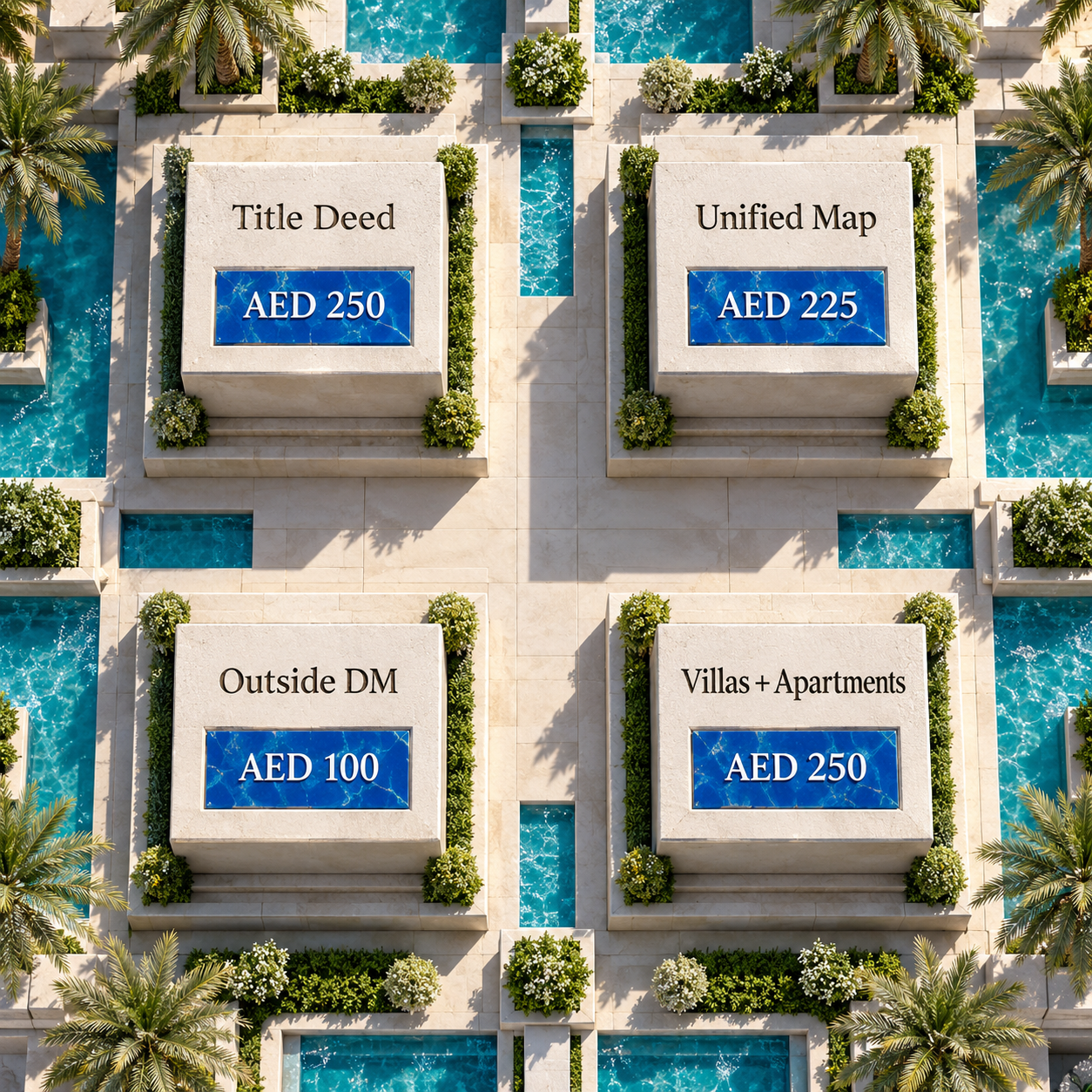
The sale-registration fee list distinguishes the certificate line from several map or property-type lines. These amounts belong to this trustee-centre registration page, accessed 2 October 2026. They are not a universal schedule for every other DLD service.
DLD does not say on this page that all four lines apply to one transaction, so they should not be added into one output total. The labels instead show why the property's type and map context must stay attached to any fee statement.
Keep one file with six separately named records
A complete working file can preserve six items without collapsing their roles: the payment receipt, request reference, My Requests status, a note of the trustee-centre activity, the electronic title deed and the electronic map. DLD formally names only the last two under Issued Documents on this service page.
The separation gives each later check a clear starting point:
- For payment, read the receipt.
- For follow-up, use the request reference.
- For current progress, read My Requests.
- For what happened at the centre, keep the appointment and transaction correspondence.
- For the issued title record, preserve the electronic title deed and use DLD's validity-check route when needed.
- For the second delivered output, preserve the electronic map without assigning fields the official page does not describe.
Electronic title deed and map FAQ, checked 2 October 2026
Is the payment receipt the same as the electronic title deed?
No. DLD lists the receipt in the payment step and separately lists the electronic title deed under Issued Documents. The receipt records the payment event; it is not the document named as the title output.
Is a My Requests status the same as receiving the two outputs?
No. DLD presents My Requests as the place to check request status and separately says the output is sent by email. Inspect the delivered electronic title deed and electronic map rather than substituting the status label for either record.
Can a buyer verify the title deed online?
Yes. DLD's Verify Title Deed service checks the validity of a Certificate of Title or title deed issued by the Land Department. DLD lists the check as immediate through its website or Dubai REST App, accessed 2 October 2026.
What if the electronic map is missing from the delivered file?
The sale-registration page names the electronic map as an issued document but does not publish a separate recovery procedure. Use the request reference and My Requests route to follow up with DLD on that specific registration file.
Subscribe to the withlida market brief for dated Dubai property process updates and source changes.
Lida MoghaddamArchitect-turned-real-estate-specialist based in Dubai. She helps buyers, sellers, and investors read property with a designer's eye — structure, location, and long-term value.