
Before a Dubai property transfer: the seller identity-record check (2026)
 Lida Moghaddam
Disclaimer: This article is for general informational purposes only. It is based on cited public data and published under Lida Moghaddam's RERA-licensed masthead. It is not financial, legal, or investment advice. Dubai's property market moves quickly, so figures, yields, and rules may change or become outdated by the time you read this. Verify current information with the relevant authority or a qualified professional before acting. Read the full disclaimer.
Table of contents
As accessed on 30 September 2026, Dubai Land Department's Title Deed Modification route names five ownership-data changes, but the three DLD service pages used here publish no general tolerance for transliteration, middle-name order, spacing or punctuation. A seller can therefore check which record differs, which exact service route addresses that record, and which question still needs an answer from DLD or the Real Estate Registration Trustee before the appointment.
Start with the record, not the spelling difference
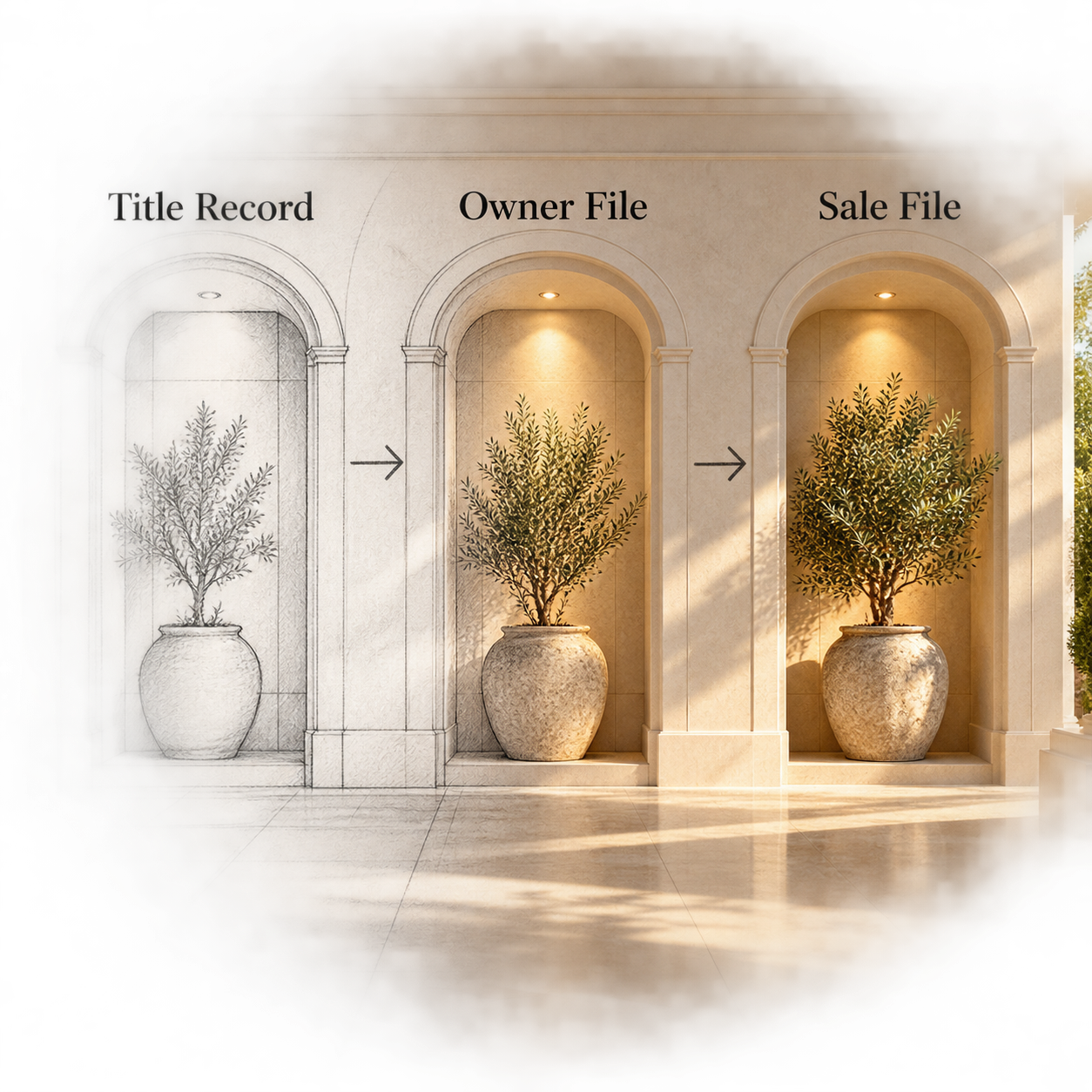
The same name can appear in several places, but those places do different jobs. The current title deed is a property ownership record. The owner file sits in DLD's system. A passport or Emirates ID is identity evidence. A Power of Attorney is authority evidence. Property Sale Registration is the transaction route for a completed property, land or completed real-estate unit.
The table keeps returned DLD statements separate from what the pages do not answer. Every route was reopened on 30 September 2026.
“Title record”, “owner file”, “identity evidence”, “authority evidence” and “translation evidence” are editorial classifications. DLD's exact service names remain visible in the route column. This prevents an output from one route being described as proof of a different update.
For the complete sale sequence around this check, use the Dubai property sale-path pillar. The narrower passport and title-deed mismatch worksheet provides a field-by-field comparison without turning any variation into an acceptance rule.
Build the comparison sheet before classifying the mismatch
The first pass is transcription, not interpretation. Copy the text exactly as each record displays it and keep blank fields blank.
The first five field types come from the Title Deed Modification description. The last row is an editorial observation field, because DLD's pages do not publish a tolerance for those differences (DLD, accessed 30 September 2026).
For an entity-owned property, copy the legal entity name from the actual company record. A developer brand, project name, community name, building name and unit identifier are different record levels. None can be used to infer the company's legal name without an official artifact that exposes both sides.
Run the checks in chronology
The chronology moves from current evidence to the relevant route, then to the sale appointment. It does not predict whether a particular difference will be accepted.
Capture the current records
Retain the current electronic title deed and copy the identity fields from the passport or Emirates ID that will be used. Where the owner is a company, retain the trade licence, Memorandum of Association and entity letter named on the person/entity page. Keep the property, company and individual records in separate rows (DLD person/entity route, accessed 30 September 2026).
Identify the record that carries the difference
If the differing value appears on the title deed, Title Deed Modification is the published ownership-data route. If it appears in the owner file in DLD's system, the person/entity route is the published system-file route. The pages do not say that one route automatically updates the other (DLD title-deed route; DLD person/entity route, both accessed 30 September 2026).
Separate identity from authority
A passport or Emirates ID identifies a person in the scopes stated on each page. A Power of Attorney addresses who can act. Title Deed Modification lists a legal Power of Attorney if the owner is absent, while Property Sale Registration says a legally authorized representative may be a contracting party. Neither statement supplies a universal checklist for an unseen authority document (DLD; DLD, both accessed 30 September 2026).
Keep translation as its own evidence question
Do not treat a translation as the source identity record or the authority instrument. The three service pages used here do not publish a general translation rule for this sale file. The UAE Ministry of Justice maintains an official translator directory, accessed 30 September 2026, but that directory does not establish that a translation is required or sufficient for a particular DLD transaction.
Ask about the exact unpublished point
State the observed difference without generalising it: transliteration, middle-name order, spacing, punctuation, a changed passport number, or another returned field. Ask which record needs action, which service route applies and what evidence will show completion. The public pages do not answer the acceptance question for an unseen file.
Retain the route output with the appointment file
Title Deed Modification names an Electronic Title Deed as its output. The person/entity page describes an updated DLD system file but lists no separate issued document. Keep any transaction reference or confirmation separately from the identity and authority documents, then compare the final appointment set with Property Sale Registration's current requirements.

The seller Power of Attorney transfer-file guide covers representation evidence in more depth. It does not turn the existence of a Power of Attorney into proof that the underlying title or owner record is consistent.
Fees and service times belong to their own routes
The current title-deed page lists AED 250 for title-deed certificate issuance, AED 10 as a knowledge fee and AED 10 as an innovation fee. The editorial sum is AED 270. DLD states a 25-minute service time and names an Electronic Title Deed as the output (DLD, accessed 30 September 2026).
The current person/entity page calls the service free. It also states that when an amendment is irrelevant to any procedure, an AED 20 plus VAT service-partner fee is added. DLD states a 20-minute service time and does not list an issued document on that page (DLD, accessed 30 September 2026).
These are route-level published times, not elapsed-time forecasts for resolving a mismatch or completing an appointment. No buffer, working-day interval or expiry period is inferred.
What the sale route uses on appointment day
Property Sale Registration is a later transaction route, not evidence that an earlier identity difference has been resolved. Its page says the service applies between seller and buyer, or their legally authorized representatives, for land, property or a completed real-estate unit (DLD, accessed 30 September 2026).
For individuals, the page lists Emirates IDs for both seller and buyer for identity verification only, with no copies taken, or a valid passport for non-resident foreigners. It also lists a no-objection e-certificate, or e-NOC, from the developer in freehold areas. An e-NOC is transaction evidence from the developer; it is not an identity document or an amendment output.
The trustee procedure is also specific. The employee verifies the submitted documents, identifies deficiencies, uploads required documents to the digital vault, enters transaction data and performs an audit. The page then names the Electronic Title Deed, Electronic Map and Fee Balances as issued documents. None of those statements publishes a general rule for how a name variation will be treated.
Source and method boundary
This article uses three DLD service pages and the Ministry of Justice translator directory, all accessed 30 September 2026. The DLD footer carries a site-wide update date, so it is not reported as a revision date for any individual service page.
Returned values are the exact service names, listed documents, fields, fees, times and outputs. Editorial calculations are the five named ownership-data purposes and the AED 270 fee sum. Editorial classifications are the record and evidence labels used to keep the comparison readable. Official unknowns are the matching tolerance, any file-specific translation rule, any document-expiry test and whether one amendment changes another record.
The saved audit reproduces every count and fee sum from the raw inputs. It also records each non-arithmetic statement in the bounded three-page sample. That local audit supports this article's checking process; it is not an official DLD decision surface.
FAQ, checked 30 September 2026
Will DLD accept a spelling difference between a passport and title deed?
The three DLD service pages used here do not publish a general tolerance for transliteration, middle-name order, spacing or punctuation. The answer for an actual file remains a question for DLD or the relevant Real Estate Registration Trustee before the appointment.
Which DLD service changes a name on a title deed?
Title Deed Modification expressly includes name correction among its ownership-data purposes and names an Electronic Title Deed as the output, accessed 30 September 2026.
Is amending the DLD person file the same as modifying the title deed?
Does DLD's sale-registration page publish a legal-translation rule?
No general legal-translation rule appears on the current Property Sale Registration page or the two amendment pages used here. A translation and its source document should remain separate evidence while the applicable official channel confirms what the actual file requires.
Lida MoghaddamArchitect-turned-real-estate-specialist based in Dubai. She helps buyers, sellers, and investors read property with a designer's eye — structure, location, and long-term value.