
After a Dubai Courts Resolution: What the DLD Contract Cancellation Record Shows
 Lida Moghaddam
Disclaimer: This article is for general informational purposes only. It is based on cited public data and published under Lida Moghaddam's RERA-licensed masthead. It is not financial, legal, or investment advice. Dubai's property market moves quickly, so figures, yields, and rules may change or become outdated by the time you read this. Verify current information with the relevant authority or a qualified professional before acting. Read the full disclaimer.
Table of contents
After a Dubai Courts resolution, the DLD Contract Cancellation Application starts with the court letter and moves through intake, audit, a fee event and electronic outputs; DLD currently lists AED 1,000 for cancellation, AED 250 for a title deed, two AED 10 per-drawing fees and a 15-minute service time (Dubai Land Department, accessed 1 October 2026). That record shows what entered and left the DLD service route, not the merits of the earlier dispute.
The DLD route begins after the court resolution
The operative starting point is an existing Dubai Courts resolution. DLD describes its Contract Cancellation Application as a service for cancelling contracts such as sale, mortgage and lease-to-own contracts on the basis of that resolution, and it lists a letter from Dubai Courts as the required document (DLD, accessed 1 October 2026).
That ordering matters. The DLD page describes what happens when the customer brings the court letter to the land registry service. It does not publish findings about an earlier breach, identify a defaulting party, state what notice was served, set a universal cure period or decide contractual forfeiture. Those questions cannot be reconstructed from the DLD service record alone.
For the wider ordinary-sale sequence, the cluster pillar explains how to sell property in Dubai. This companion begins only where a court resolution already exists and a cancellation record is being taken through DLD.
Five records have five different jobs
The cleanest reading keeps five records separate. A later e-receipt does not replace the court letter, and an electronic title output does not add reasons to the court's decision.
The creator and stage are important because provenance changes what a record can answer. DLD says an employee enters the transaction details, the transaction is audited and approved, the customer pays and receives an e-receipt, and service outputs arrive online. DLD names the approved e-Certificate of Title or title deed and approved e-receipt voucher as issued documents (DLD, accessed 1 October 2026).
The post-resolution workflow has five steps
The official path is a five-step service-center workflow at the Land Department main headquarters. DLD describes it in this order, as accessed 1 October 2026 (DLD Contract Cancellation Application):
Bring the court letter
The customer goes to the DLD Customer Happiness Center in the Land Department's main building. The listed required document is a letter from Dubai Courts.
Submit the file for completeness review
The customer gives the required document to a DLD employee, who checks whether anything is missing. This is an intake check in the published workflow, not a new determination of the earlier dispute.
Let DLD enter, audit and approve the transaction
A DLD employee enters the transaction details into the system. The service description then places audit and approval before payment.
Pay and keep the e-receipt
The customer pays the applicable fees and obtains a payment e-receipt. DLD lists cash, cheque, credit card and ePay as payment methods on the service page.
Receive the electronic outputs
DLD lists online delivery of the service outputs. The issued-document section names an approved e-Certificate of Title or title deed and an approved e-receipt voucher.
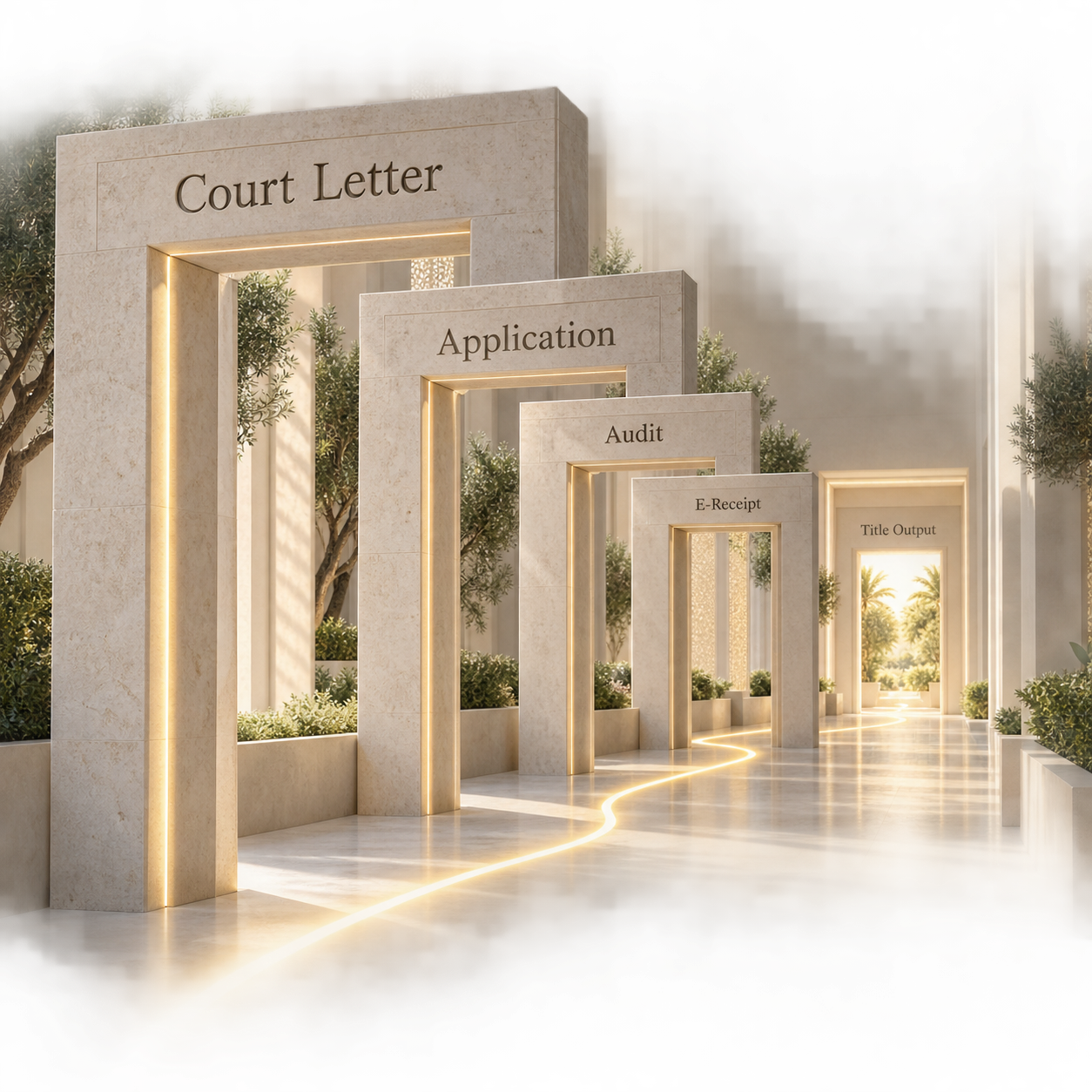
The page states a service time of 15 minutes (DLD, accessed 1 October 2026). That number belongs to the DLD service listing. The page does not say it includes obtaining the court resolution, preparing the letter, resolving missing documents or completing the earlier proceedings.
The fee record is a component schedule, not one quoted total
DLD publishes four separate charge lines, so the invoice should be read by component. As accessed 1 October 2026, the page lists the following amounts (DLD Contract Cancellation Application):
The dated editorial model is straightforward: AED 1,000 + AED 250 + AED 10 + AED 10 = AED 1,270. It assumes exactly one cancellation charge, one title-deed issuance charge and one drawing charged under both per-drawing lines. DLD does not label AED 1,270 as a package fee, and the page does not say every file carries exactly that combination.
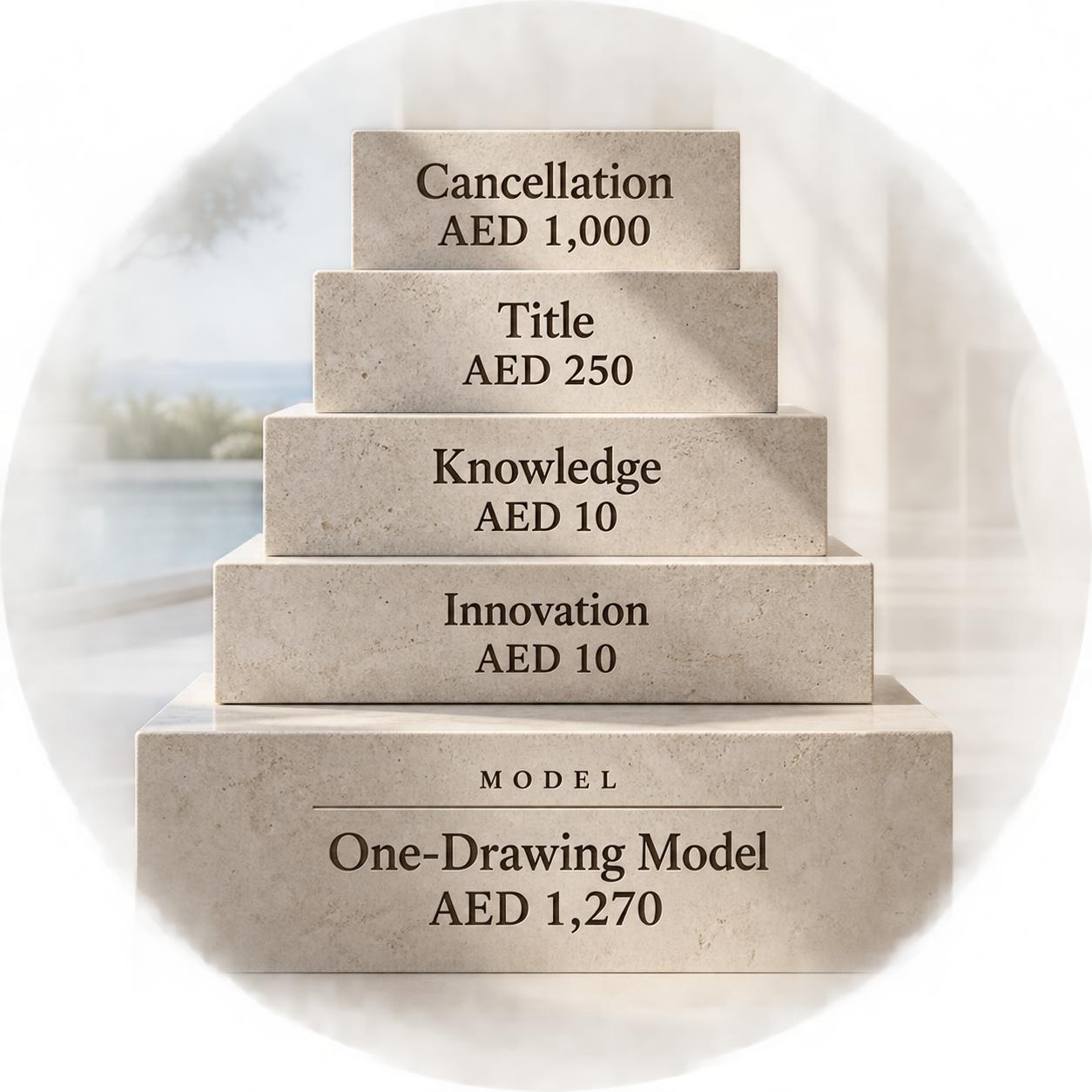
This distinction keeps quoted and calculated values visible. The four component amounts come from DLD. AED 1,270 is withlida's bounded arithmetic scenario using those inputs on 1 October 2026.
The DLD file cannot answer the earlier dispute by itself
The DLD service record can show the administrative sequence it owns. It can show that a court letter was submitted on this route, a transaction was entered and reviewed, a fee event occurred, and electronic outputs were issued as described by the service page.
It cannot, without the court material, show why the resolution was made. The DLD page does not identify the earlier contractual breach, the party said to have defaulted, the notice used, any cure period, the treatment of money already paid, a contractual forfeiture or the prevailing party. It also does not state a universal rule for those issues (DLD, accessed 1 October 2026).
That is why the records should not be merged into one conclusion. The court letter carries the court communication. The DLD application and audit carry the registry workflow. The e-receipt carries the fee event. The electronic title output carries the resulting registry document.
Keep this file connected to the wider sale path
An ordinary resale completion produces its own payment and registration evidence. The Dubai resale completion-day payment map separates those receipts and transfer-stage records. The post-resolution cancellation route here is different because its first listed input is a Dubai Courts letter.
The practical reading is narrow: match each statement to the record that can support it. Use the court document for the resolution's terms, the DLD transaction for the registry process, the e-receipt for payment and the electronic title output for the resulting title record.
Official source
- Dubai Land Department, Contract Cancellation Application, accessed 1 October 2026. The page supplies the description, required court letter, service-center procedure, fee lines, 15-minute service time, payment methods and issued documents. It shows no page-specific publication or update date.
FAQ, checked 1 October 2026
What document does DLD require for contract cancellation after a court resolution?
DLD lists one required document on this service page: a letter from Dubai Courts. The page says the cancellation application is based on a Dubai Courts resolution (DLD, accessed 1 October 2026).
How much does the DLD Contract Cancellation Application cost?
DLD lists AED 1,000 for contract cancellation, AED 250 for title-deed issuance, AED 10 knowledge per drawing and AED 10 innovation per drawing, as accessed 1 October 2026. The AED 1,270 figure in this guide is a calculated one-drawing model, not a DLD-quoted package total (DLD).
How long does DLD list for the contract cancellation service?
The DLD page states 15 minutes, as accessed 1 October 2026. It does not state that this figure includes the earlier court proceedings, preparation of the Dubai Courts letter or time needed to complete missing documents (DLD).
Does the DLD cancellation record prove who defaulted?
Not by itself. The DLD service page describes the post-resolution registry workflow and its outputs; it does not publish findings on breach, default, notice, forfeiture or which party prevailed. Those matters must be read from the relevant court and contract documents.
Lida MoghaddamArchitect-turned-real-estate-specialist based in Dubai. She helps buyers, sellers, and investors read property with a designer's eye — structure, location, and long-term value.