
Service-charge clearance in a Dubai resale: records from offer to transfer (2026)
 Lida Moghaddam
Disclaimer: This article is for general informational purposes only. It is based on cited public data and published under Lida Moghaddam's RERA-licensed masthead. It is not financial, legal, or investment advice. Dubai's property market moves quickly, so figures, yields, and rules may change or become outdated by the time you read this. Verify current information with the relevant authority or a qualified professional before acting. Read the full disclaimer.
Table of contents
For an ordinary ready-property resale in a freehold area, the service-charge file is not one certificate: it is an owner balance or statement, a developer clearance event, the e-NOC DLD requires, and a separate transfer receipt. On wasl's current Dubai REST route, account-settlement verification is listed as 2 working days inside a 3 to 5 working day overall NOC service time (wasl, accessed 2 October 2026).
The service-charge file has several records, not one certificate
The useful question at each stage is not simply whether the account is “clear”. It is who issued the record, when its information took effect and which later event has not happened yet.
DLD describes its Service Charge Index as an inquiry into approved service fees for jointly owned properties. The user selects the project, use and year, and DLD lists the service time as immediate (DLD Service Charge Index, accessed 2 October 2026). That makes it a rate record, not an owner ledger.

This workflow sits beneath the full Dubai property sale path. The separate developer NOC guide compares request routes, fee evidence and expiry. Here, the narrower job is to keep the service-charge records in chronological order.
At offer stage, the owner account record answers the balance question
An offer-stage figure is only as current as the owner-specific record behind it. The official index can establish an approved project rate for a year, but it cannot establish whether this owner has paid, owes an amount or has a credit.
Nakheel's current owner material gives a bounded example of the distinction. Its website or app shows the outstanding amount but not the service-charge payment history. An owner can request payment history from Nakheel Community Management by email. The same page says the Property and Customer Reference numbers appear on the Service Charge Statement of Accounts and the Service Charge Invoice (Nakheel, accessed 2 October 2026).
Those are separate evidence fields:
- The portal balance shows the amount currently exposed by that portal.
- The statement or invoice identifies the property and customer references printed on the record.
- The payment history records earlier account movements that the portal balance does not display.
None of those records, by itself, proves that the later resale NOC review has passed. A record supplied with an offer also needs its own date or billing period. If the document exposes neither, its effective date remains unresolved rather than becoming the date on which someone forwarded it.
Clearance timing belongs to the named developer route
Current developer routes establish that service-charge review can sit before NOC approval, but they do not create one Dubai-wide timetable.
Nakheel's title-deed resale checklist includes service-charge payment, including provisional service charges. Its current FAQ lists an expected resale NOC issuance time of 2 to 3 working days and a 30-day validity period for the issued NOC. Those terms belong to Nakheel's published route (Nakheel, accessed 2 October 2026).
wasl says service charges and its other named account issues must be resolved before the NOC application. On the Dubai REST route, it lists 2 working days to verify account settlement, 3 working days to verify documents and an overall service time of 3 to 5 working days. Its email exception route is listed at 7 to 10 working days after payment (wasl, accessed 2 October 2026).
The wasl page also lists 3 working days for document verification. It does not say that the 2-day account check and 3-day document check must be added into a fixed 5-day sequence. The published 3 to 5 working day overall period remains the controlling statement.
The e-NOC bridges clearance and DLD registration
The e-NOC is the handoff record, not a substitute for every account document behind it. DLD's current Property Sale Registration page requires a no-objection e-certificate from the developer through Dubai REST when an individual registers a sale in a freehold area (DLD, accessed 2 October 2026).
That DLD requirement establishes three things: the record is electronic, the developer issues it, and it belongs in the freehold registration file. The DLD page does not publish one universal NOC fee, clearance format, service-charge cut-off or validity period.
The issued certificate therefore controls its own date and conditions. A preceding balance screenshot does not prove that the certificate was issued. A developer's request approval does not prove that DLD has registered the transfer. Each event needs its own record.
The transfer receipt proves a different payment
DLD's receipt belongs to the registration procedure, not the service-charge ledger. In the service-centre sequence, the trustee verifies the documents, uploads them to the digital vault, enters and audits the transaction, then takes the fees and issues a payment receipt. DLD separately names the Electronic Title Deed and Electronic Map as the issued documents (DLD Property Sale Registration, accessed 2 October 2026).
The page lists a 25-minute service time. That is the stated time for the DLD sale-registration service once the file is in that route. It is not a promise for offer preparation, service-charge reconciliation or developer NOC issuance.
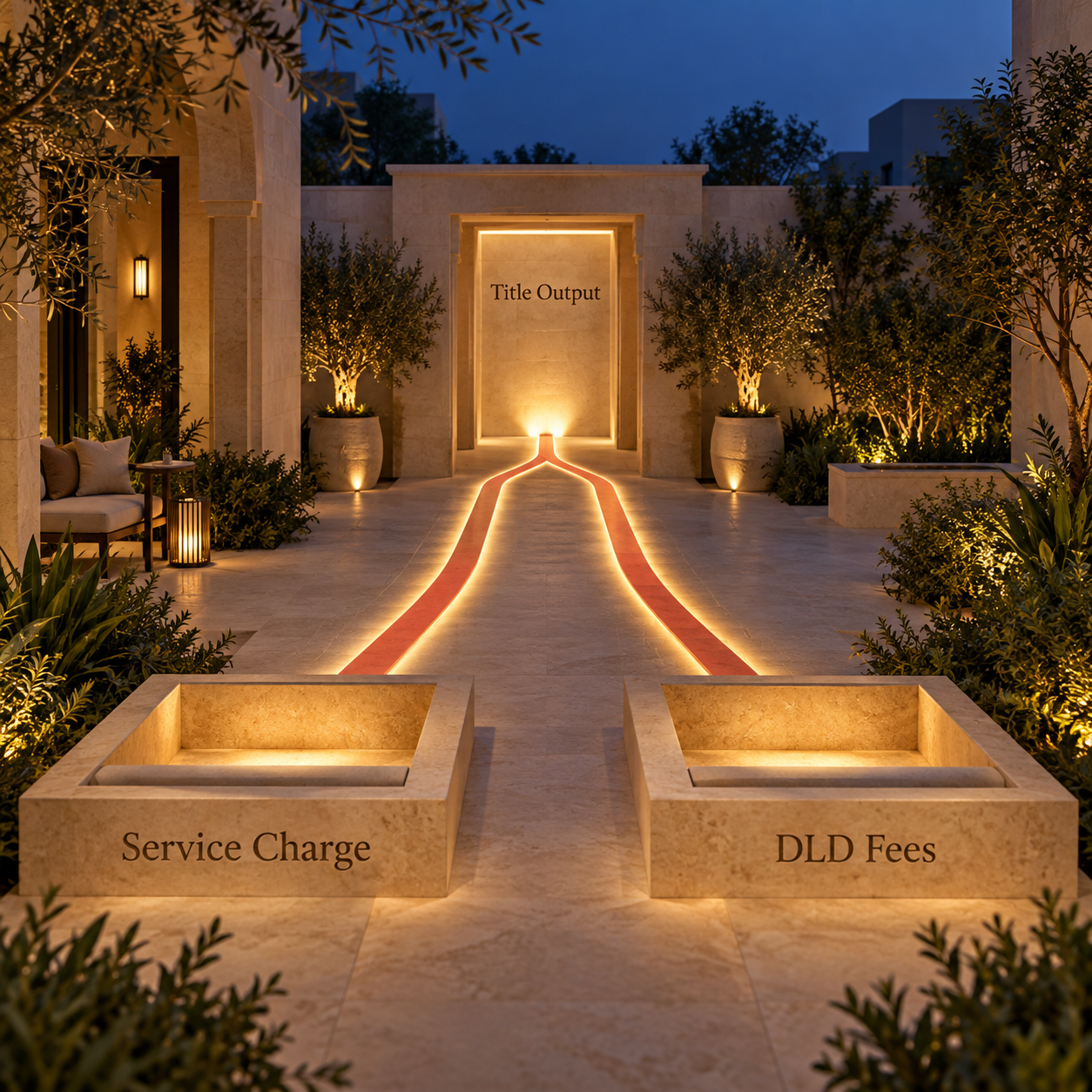
This boundary matters at completion. A DLD receipt can prove that the recorded DLD amount was paid in that procedure. It does not prove an owner-account balance at the developer or community manager. Conversely, a service-charge receipt can prove a payment event on that account, but not the later title transfer.
Build the file in chronological order
The chronology is strongest when every record retains its issuer, property reference, effective date and next dependency.
Capture the offer-stage account position
Retain the owner-specific balance, statement or invoice with its property reference and visible date or billing period. Keep the DLD index result separate as the approved-rate record.
Refresh the account record before the NOC request
Use the named developer or manager's current route. A changed balance is a new account event, not a correction to the earlier offer-stage record.
Retain the clearance response
Record the route, request reference, reviewed account status and any transaction-specific amount. A public page may explain the route, while the actual response controls that property's result.
Read the issued e-NOC
Keep the issue date, property identity, stated validity and conditions exactly as printed. DLD requires the developer e-NOC for the freehold sale-registration file.
Keep the DLD receipt separate
Match the fee receipt to the DLD procedure and booking reference. Do not relabel it as a service-charge clearance receipt.
Retain the title output
The Electronic Title Deed and Electronic Map are separate DLD outputs on the current service page. Their issue completes a different evidentiary step from the developer's account review.
The current public sources do not establish a universal private apportionment between seller and buyer, a citywide final service-charge certificate or one rule for later account adjustments. Those questions remain transaction-specific until the signed contract and the named manager's records establish them.
FAQ, checked 2 October 2026
How do I know the service charge on a Dubai property?
Is service-charge clearance the same as the developer e-NOC?
No. Nakheel's current title-deed resale checklist includes service-charge payment, while wasl says its named account issues must be resolved before the NOC application (Nakheel; wasl, both accessed 2 October 2026). DLD separately requires the issued developer e-NOC for an individual's freehold sale-registration file (DLD, accessed 2 October 2026).
How long does service-charge clearance take in a Dubai resale?
Does the DLD transfer receipt prove that service charges are clear?
No. On the current DLD route, the receipt follows payment of DLD procedure fees. The owner account, clearance response and developer e-NOC remain separate records (DLD, accessed 2 October 2026).
Lida MoghaddamArchitect-turned-real-estate-specialist based in Dubai. She helps buyers, sellers, and investors read property with a designer's eye — structure, location, and long-term value.