Dubai Municipality housing fee: calculation and amendment (2026)
 Lida Moghaddam
Disclaimer: This article is for general informational purposes only. It is based on cited public data and published under Lida Moghaddam's RERA-licensed masthead. It is not financial, legal, or investment advice. Dubai's property market moves quickly, so figures, yields, and rules may change or become outdated by the time you read this. Verify current information with the relevant authority or a qualified professional before acting. Read the full disclaimer.
Table of contents
Dubai's published tenant housing fee is 5% of yearly rental charges, collected through monthly electricity and water bills, as of 18 October 2026. An assessment query has a named Municipality route: Adjust Housing Fees. Sources: UAE Government portal and Dubai Municipality's service directory, checked 18 October 2026.
Source: withlida.com, 18 October 2026. Rate: UAE Government portal, Dubai paragraph, checked 18 October 2026. R is a variable, not a quoted market rent. The monthly column divides the calculated annual fee evenly across 12 months for comparison and budgeting; it is not an official bill adjustment or proration calculation.
Last verified: 18 October 2026.
For the surrounding household budget, the cost-of-living guide leaves housing fees as a household-specific addition. The Dubai tenancy-contract guide explains the lease record. This guide connects that annual rent to the municipal bill line.
What is the Dubai Municipality housing fee?
The housing fee is a Municipality charge linked to rent, collected on the electricity and water bill. The UAE Government portal states that Dubai tenants pay it at 5% of yearly rental charges, with housing fees added to monthly electricity and water bills, checked 18 October 2026.
DEWA, the Dubai Electricity and Water Authority, is the bill issuer through which this charge is collected. Its VAT FAQ explicitly describes the housing fee as collected on behalf of Dubai Municipality, checked 18 October 2026. That collection arrangement explains why a housing assessment appears alongside utility charges.
For reconciliation, an assessment means the rental value and fee basis applied to the home. The bill is the record of the amount charged for a stated period. Keeping those records together makes the question precise: which rental value underlies this housing-fee amount, and which period does it cover?
The entire bill total cannot answer that question. It combines the housing line with other account charges. A change in the total might relate to electricity, water, the housing line, or another separately described item. The useful comparison isolates the line being queried before doing any arithmetic.
For a tenant, the annual-rent figure comes from the lease covering the period under review. The percentage supplies a calculation rule, while the amount on the bill records what the account was charged. The reconciliation connects those inputs through a common period.
A tenant with a straightforward annual lease has a clear contractual input for the comparison below. An owner seeking the basis of a rental-value assessment has a different starting record: the Municipality's assessment for the owned unit. Both situations fit the Municipality's published amendment-service scope, but the tenant calculation alone cannot resolve an owner's assessment.
How is a tenant's housing fee calculated?
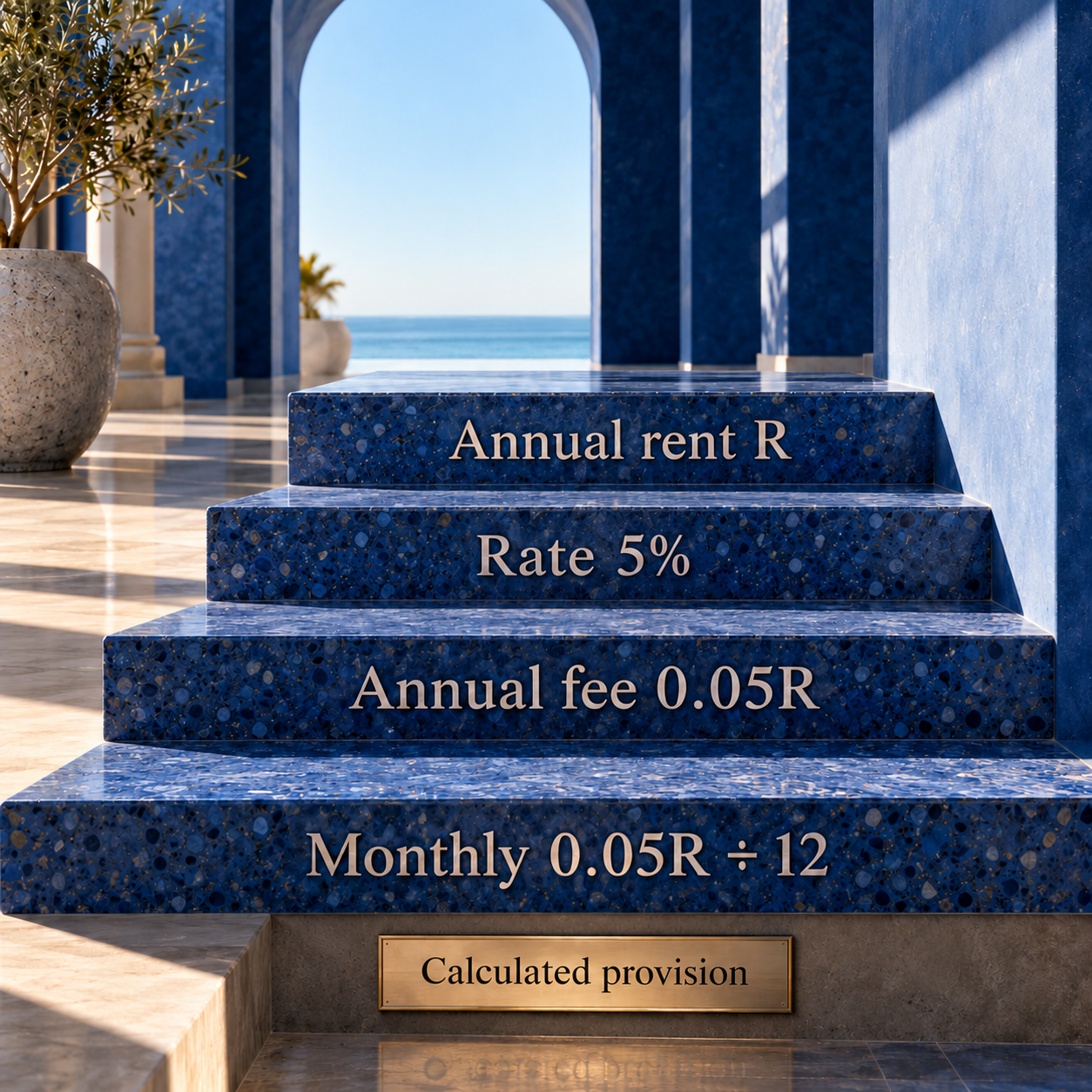
The annual calculation is annual contractual rent × the published tenant percentage. The UAE Government portal's Dubai paragraph publishes 5% of yearly rental charges, checked 18 October 2026. Use the annual rent relevant to the bill period when building a contractual-rent comparison.
An annual rent is the amount for the year recorded in the lease. It is different from the amount of an individual rent payment. A cheque, transfer or other instalment may cover part of that annual commitment. The annual figure is the input to this calculation, regardless of how the lease schedules those payments.
Worked example using the rent in your contract
Let R be your annual contractual rent in AED. Let F be the calculated annual fee and P the calculated monthly provision. The only policy input is the official tenant rate; the other input comes from the lease.
Source: withlida.com, 18 October 2026. Calculated from the UAE Government portal's published Dubai tenant rate, checked 18 October 2026, and the reader-supplied inputs R and H. The monthly provision assumes an even allocation across 12 months. No current rent, official rounding method or entitlement to a credit is assumed.
The arithmetic is reproducible: 5% = 0.05 = 1/20, so dividing the annual result by 12 gives R/240, calculated from the same official rate and the stated monthly-allocation assumption. Enter the rent from the relevant annual lease in place of R; leave the source document beside the calculation.
Why the monthly provision is only a comparison
The monthly provision is useful for recognising the scale of the housing line and making a budget. It does not establish the assessment dates or treatment of a particular account. A bill covering a different period needs the authority's explanation before it can be compared on the same basis.
In the table, H means the housing-line amount from the bill being examined. It does not mean the total DEWA bill, the VAT total or the amount paid toward the account. D, the difference between H and the provision, is an amount to explain. Its existence alone does not establish an overpayment.
If the rent changed at renewal, keep the earlier and later annual rents with their own contract dates. Applying the current rent to every earlier bill would mix periods. The calculation can show what each contractual input produces, while the Municipality confirms the value and dates actually applied to the assessment.
Is the housing fee electricity usage or VAT?
The housing fee uses a rent basis, while VAT has a separate treatment on taxable utility charges. DEWA's VAT page states that VAT is charged at 5% on consumption bills and other taxable supplies, and that VAT is not applicable to the housing fee collected for Dubai Municipality, checked 18 October 2026.
Source: withlida.com, 18 October 2026. UAE Government portal and DEWA VAT information, checked 18 October 2026. Utility tariffs and a complete account-bill calculation are outside this table.
The matching percentages can cause confusion because they describe different calculations. The tenant housing percentage is applied to yearly rent. Utility VAT is applied to the relevant taxable supplies. It is not an instruction to add VAT to the housing-fee provision.
For the same reason, a change in electricity use does not explain a housing assessment calculated from rent. If the query concerns the housing line, a calculation based on utility consumption is testing a different charge. The bill can be read in separate parts even though the amounts are collected together.
What can an owner check?
An owner can query the rental-value assessment through a service whose published scope includes owned units. The Dubai Municipality directory's Adjust Housing Fees card describes amendments on leased or owned units based on rental value, checked 18 October 2026.
For an owned home, the important input is the rental value and basis used by the Municipality. A purchase price, mortgage payment or building service-charge invoice does not supply that assessment within the verified directory description. The directory establishes that the amendment service covers owned units; it does not publish the detailed owner calculation on that card.
The owner comparison therefore starts with the assessment behind the bill. It can identify the home concerned, the rental value being applied, the period in question and the billed housing amount. Any explanation already supplied by the authority belongs alongside those records.
This page does not assign an owner percentage or an exemption category. The published tenant rule and the directory's reference to owned units are separate pieces of information. Reading them together confirms a route for an owner query, without filling in a valuation method the directory does not state.
An owner with an assessment query can ask which recorded property details and rental value were used, which period they apply to, and what the current amendment service requires for that case. Those are questions for the authority, rather than a substitute valuation produced from the tenant formula.
The same distinction helps a tenant reading general housing-fee information intended for owners. The tenant's annual contractual rent provides the published-rule comparison above. An owner-specific assessment needs its own confirmed basis. Keeping the occupancy situation explicit prevents the inputs from being mixed.
How is a housing-fee assessment amended?
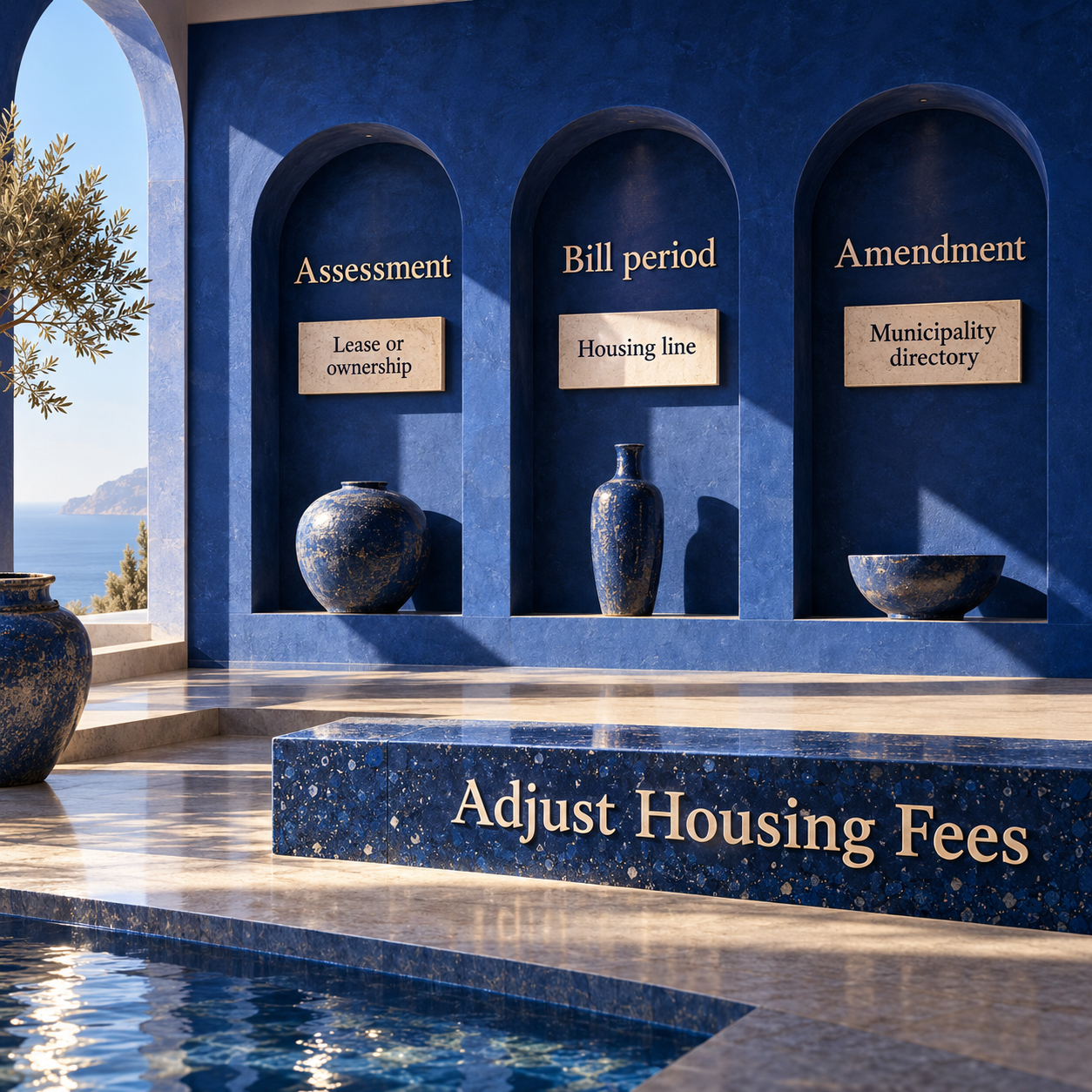
The verified starting route is the Dubai Municipality Services directory, where the service is called Adjust Housing Fees, with the description Amend Dubai Municipality Housing Fees. Its scope covers leased and owned units based on rental value, according to the directory, checked 18 October 2026.
The route below describes that public directory. The supporting-record suggestions are editorial preparation, not a claim about mandatory application fields or attachments.
Open the Municipality service directory
Go to the Dubai Municipality Services directory and find Adjust Housing Fees. The directory has a Search control and lists that exact service name, checked 18 October 2026.
Use the named housing-fee service
The card describes amendments to housing fees for leased or owned units based on rental value. Its View More link leads toward the detailed service. Follow the current official requirements presented there; the directory description alone does not establish an attachment list, login method or sequence of application screens.
Present the assessment question clearly
For a tenant, the editorial comparison uses the annual lease rent, relevant dates, housing-line amount and calculated provision. For an owner, it uses the authority's rental-value assessment and the bill period. The current official service determines what must be submitted.
Keep the authority's reference and response
Record the reference issued for the enquiry or application and the authority's explanation. Any confirmed assessment value, applicable period or subsequent billing treatment can then be matched to the bill. This record-keeping step is the publication's reconciliation method.
The service card posts 3 working days. That is the posted service target, as shown in the Municipality directory, checked 18 October 2026. It is not a commitment that every requested amendment will be accepted or that an account entry will change within that period.
The directory remains the useful public entry point if a direct service-detail link does not open. This guide does not reproduce unverified portal screens or turn the directory card into a detailed application manual. The official service supplies the current requirements for the particular request.
An amendment enquiry also does not establish when a credit might appear or whether any amount is refundable. The authority's response needs to identify the outcome, its applicable period and any billing follow-through. Keep those questions distinct from the posted service target.
How do you reconcile the housing-fee line on a DEWA bill?
A useful reconciliation connects the assessment input, the bill period and the amount being queried. The checklist below is the publication's way of organising that comparison. It is not Dubai Municipality's mandatory document list and does not establish what a particular application will require.
Source: withlida.com, 18 October 2026. Editorial reconciliation checklist. The official amendment route and service scope are published in the Dubai Municipality directory, checked 18 October 2026; that directory card does not provide a mandatory document list.
Match dates before comparing amounts
The lease period and bill period need to be visible together. A renewed lease may supply a different annual rent from the previous agreement. That creates a question about the assessment's applicable dates, which a single monthly provision cannot settle.
Where the reader has several bills, recording each housing-line amount beside its own period makes the pattern legible. A separate note can identify a contract renewal or an authority response. This is a chronology of the reader's records, not an assumption that a particular event automatically updates the assessment.
Keep the calculation attached to its input. If a comparison uses the current annual rent, label it that way. If it concerns an earlier lease period, use the corresponding annual-rent record. An amount without its period can be mathematically correct and still answer the wrong question.
State the amount queried without assuming the outcome
A concise enquiry can read: “The housing-fee line for [bill period] is [billed amount]. The annual contractual rent for [lease dates] is [annual rent]. The published-rate monthly provision produces [calculated amount]. Please confirm the rental value and period used for this assessment, and the amendment requirements if the record needs updating.”
Those brackets are reader-supplied fields, not official form labels. For an owner, the enquiry can instead identify the recorded ownership assessment and ask the authority to confirm the rental value and applicable period. Neither version assumes the request will produce a reduction.
After a response, compare what was confirmed with the original question. A complete reconciliation distinguishes the assessment value, its dates, the billed amount and any separately confirmed account treatment. If something remains unclear, the reference and written response preserve the exact point that still needs explanation.
Other tenancy processes sit in the Rent desk's operating guides. The housing-fee calculation here remains a comparison of the municipal line, rather than a new calculation of the household's entire living cost.
Dubai housing-fee FAQ, verified 18 October 2026
The answers below use the published tenant rule, DEWA's VAT treatment and the Municipality directory's service description, checked on 18 October 2026.
How much is the municipality housing fee in Dubai for a tenant?
The UAE Government portal's Dubai paragraph states 5% of yearly rental charges, collected through monthly electricity and water bills, checked 18 October 2026. This is the published tenant rule; an individual assessment's rental value and period can be queried with the Municipality.
How do I calculate the monthly housing-fee provision?
Multiply annual contractual rent by 0.05, then divide by 12, calculated from the official tenant rate, checked 18 October 2026. This is an even monthly provision for comparison, not a determination of proration or the amount on a particular bill.
Is VAT charged on the housing fee?
No. DEWA's VAT FAQ says VAT is not applicable to the housing fee collected on behalf of Dubai Municipality, checked 18 October 2026. VAT on taxable utility consumption is a separate calculation.
Can using less electricity reduce the housing fee?
The published tenant housing rule is based on yearly rental charges, according to the UAE Government portal, checked 18 October 2026. Electricity use is a different input. A housing-line query therefore concerns the assessment and its period.
How can I reduce or correct the housing fee on my DEWA bill?
The verified assessment-amendment route is Adjust Housing Fees in the Dubai Municipality Services directory, checked 18 October 2026. The authority determines the request's outcome; a difference from a reader's calculation does not by itself establish a reduction.
Does the amendment service cover an owner living in an owned unit?
The Municipality directory includes owned units, alongside leased units, in the service's rental-value scope, checked 18 October 2026. Its card does not state an owner percentage or detailed valuation method. The authority can confirm the basis applicable to the unit.
How long does an amendment take, and when would a refund appear?
The Municipality directory posts 3 working days as the service target, checked 18 October 2026. That does not establish approval, refund entitlement, a credit date or the bill on which a change might appear. Those details require the authority's response.
Change log: 18 October 2026 · first published · tenant rate checked against the UAE Government portal, VAT treatment against DEWA, and amendment scope and posted target against Dubai Municipality.
Checked by the publication's independent check, 18 October 2026.
Subscribe to the withlida newsletter for dated Dubai tenant explainers.
Lida MoghaddamArchitect-turned-real-estate-specialist based in Dubai. She helps buyers, sellers, and investors read property with a designer's eye — structure, location, and long-term value.