Home insurance Dubai: buildings, contents and liability (2026)
 Lida Moghaddam
Disclaimer: This article is for general informational purposes only. It is based on cited public data and published under Lida Moghaddam's RERA-licensed masthead. It is not financial, legal, or investment advice. Dubai's property market moves quickly, so figures, yields, and rules may change or become outdated by the time you read this. Verify current information with the relevant authority or a qualified professional before acting. Read the full disclaimer.
Table of contents
Home insurance in Dubai separates buildings, contents, portable belongings and legal liability. Sukoon's Home Umbrella wording gives a default contents excess of AED 350, subject to specific covers and the schedule. A landlord's buildings cover does not itself insure a tenant's possessions. This guide reads one insurer's wording, accessed 21 October 2026, including General Conditions C.II(d).
Source: withlida.com, 21 October 2026, classification from Sukoon's Definitions and Sections 1 to 5. These are sections to examine, not confirmations that an event qualifies. Evidence examples combine the wording's claims requirements with the ownership records needed to distinguish the items.
What does home insurance cover?
Home insurance covers the benefits selected for the insured person and premises, subject to the wording, schedule and endorsements read together. The schedule records the insured address, people, period, selected sections, limits and deductibles. An endorsement changes or adds to those terms. A product name alone does not establish those details (Sukoon, Introduction and Definitions, accessed 21 October 2026).
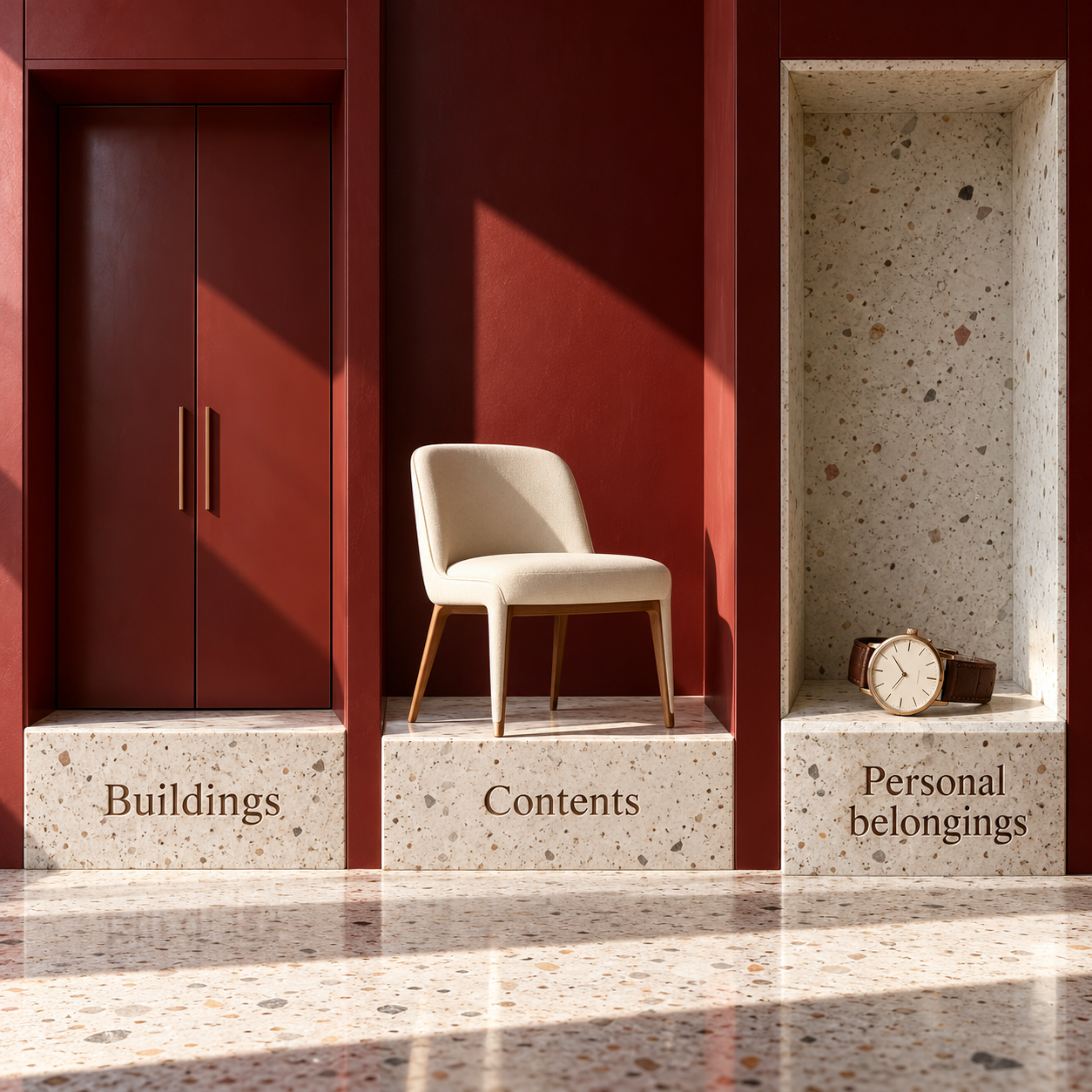
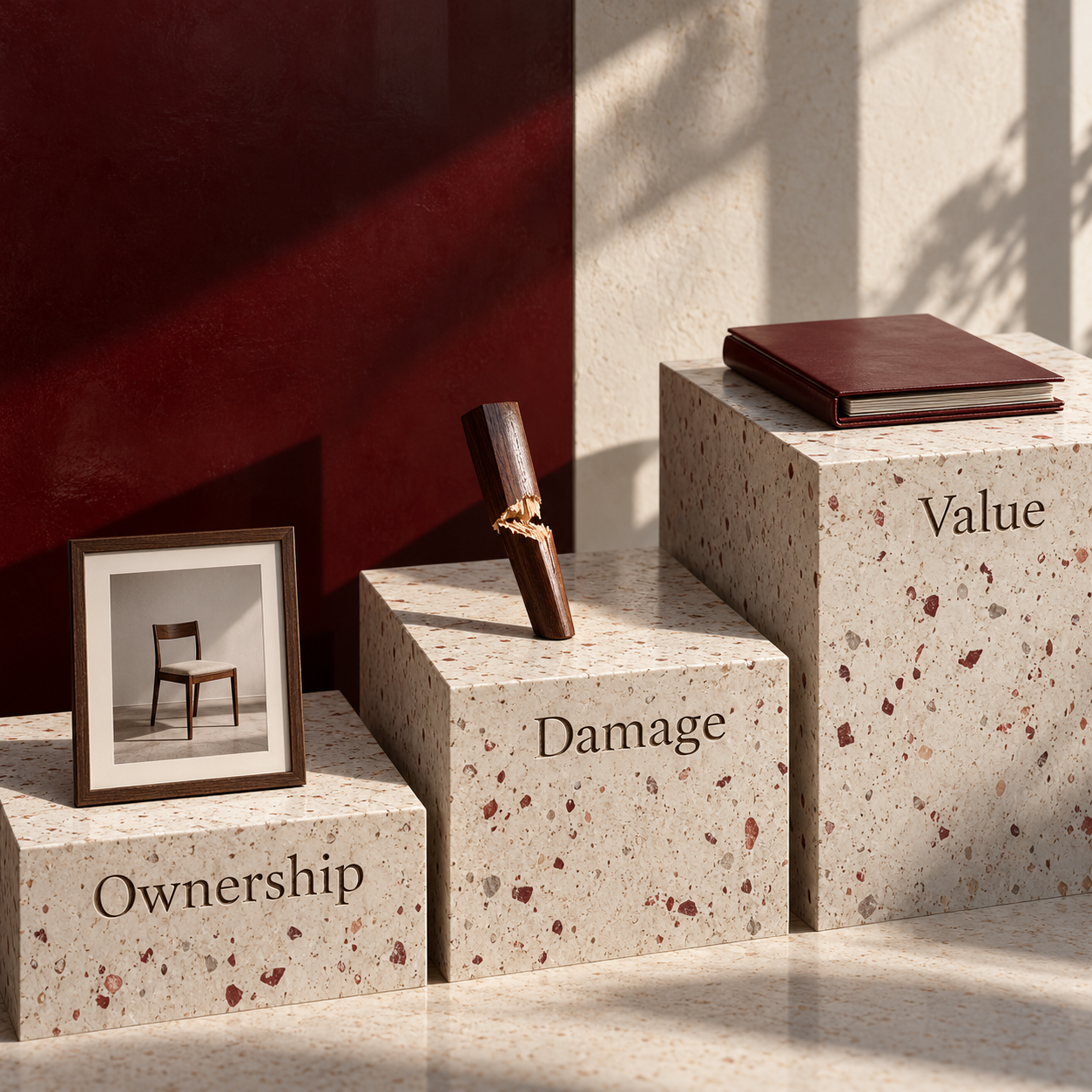
Buildings and contents answer the ownership question first. Sukoon's buildings definition includes the home and the landlord's permanent fixtures and fittings. Its examples of fittings include built-in furniture, kitchen units, fixed pipes, wiring and sanitary fittings. Contents include qualifying household goods and white goods belonging to the insured, family or resident domestic helper, and qualifying tenant fittings, excluding the landlord's fixtures.
The next question is the cause. Named-peril cover responds to listed causes, subject to their conditions. Sukoon's buildings and contents sections list causes including fire, specified water escape, storm and flood, and theft meeting the relevant entry conditions. A list of causes is not confirmation of cover for every event involving water, weather or missing property (Sukoon, Definitions and Sections 1 and 3 Part A, accessed 21 October 2026).
Accidental damage widens the question beyond the named causes, but remains conditional. In this wording, buildings accidental damage is Section 2 and contents accidental damage is Section 4; each applies only when shown in the schedule. Their exclusions still matter.
Portable possessions need another reading. Section 5 deals with personal belongings, valuables and portable equipment in and away from home if selected. Its temporary overseas extension is limited to 90 days in a policy period, with a police-report condition and other restrictions. It is not unrestricted worldwide cover (Sukoon, Sections 2, 4 and 5 Part A, accessed 21 October 2026).
Does a landlord's policy cover a tenant's belongings?
A landlord's buildings policy does not, by itself, make the tenant's furniture, clothing or electronics insured property. The insured-person definition, ownership wording and selected sections determine whose possessions fall within a policy (Sukoon, Definitions and Introduction, accessed 21 October 2026).
In a furnished home, the landlord's loose sofa and dining table are different from the fitted kitchen. They also remain different from furniture the tenant buys. A signed inventory can establish who supplied an item; it cannot expand the insurance definition. A clause making the tenant responsible for landlord furniture does not automatically establish that the furniture is insured under the tenant's contents section.
Tenant liability is a separate route. Sukoon's Section 3 Part J concerns specified legal responsibilities under the tenancy for damage to the home and landlord's fixtures, certain fixed glass and sanitary breakage, and specified pipe and cable damage. It is not a general reimbursement promise for every landlord-owned object. Its schedule limit, event conditions and exclusions must all be considered (Sukoon, Section 3 Part J, accessed 21 October 2026).
For an owner living in the home, buildings and personal contents remain distinct interests. For an owner letting it, the policy also needs to reflect the occupancy and use. A building-wide certificate, an owner's individual policy and a tenant's policy may describe different insured property; their existence alone says nothing conclusive about the tenant's belongings.
Liability roles differ too. Owner's public liability under Section 1 Part E concerns the owner in that capacity. Occupier's personal and employers liability under Section 3 Part K has different conditions, including exclusions relating to property in the insured's custody or control. Neither can simply be substituted for Tenant's Liability (Sukoon, Sections 1 Part E and 3 Part K, accessed 21 October 2026).
What is excluded from home insurance?
Exclusions depend on the section, cause and use of the home, so a listed peril must be read with its exclusions rather than in isolation. The distinctions below refer to Sukoon's wording accessed 21 October 2026, not every Dubai policy.
For escape of water under Section 3 Part A, damage to insured contents and repair of the failed component are separate matters. The clause excludes the component or appliance from which the water escaped and the cost of locating and rectifying the source. A damaged rug and a failed water connection therefore raise different coverage questions.
Theft has event requirements. Section 3 Part A refers to forcible and violent entry or exit and excludes, among other things, unexplained missing items and losses not reported to police. A possession that cannot be found is not automatically a qualifying theft (Sukoon, Section 3 Part A, accessed 21 October 2026).
Contents accidental damage under Section 4 excludes categories including jewellery, valuables and fine art, gradual deterioration, damp and rust, certain cleaning or repair damage, domestic-animal damage, and glass oven doors or ceramic cooker hobs. Mechanical or electrical failure without the required accidental cause is also excluded. The notes applying to Sections 3 and 4 exclude business or professional goods and contents in a furniture depository or storage. A laptop used for work therefore needs a use-based check as well as a value-based one (Sukoon, Section 4 and following notes, accessed 21 October 2026).
Unoccupancy means more than simply owning a furnished home. The definition refers to a home not lived in or substantially empty beyond the stated period. General Conditions Part E requires notification if it will be unoccupied for more than 60 consecutive days; several coverage sections also contain unoccupancy exclusions. General Information discusses a possible extension by agreement. Notification alone does not establish that an extension has been accepted (Sukoon, Definitions, General Conditions E and General Information B, accessed 21 October 2026).
Use restrictions also deserve separate attention: Section 4 excludes damage while the home is lent, let or sublet, and the General Exclusions address short-term rental or holiday-home use. General exclusions also cover matters such as war, terrorism, specified cyber risks and gradual wear. The relevant schedule and any amendment need to be read against the home's actual use (Sukoon, Section 4 and General Exclusions, accessed 21 October 2026).
How are contents valued, and what do the limits mean?
The sum insured is the amount attached to a benefit; it is not a promise that every loss will be paid at that amount. Sukoon's General Conditions Part A bases contents values on replacement cost with stated exceptions and says inadequate insurance may reduce settlement. Replacement cost means the cost of replacing an item at current prices (Sukoon, Definitions and General Conditions A, accessed 21 October 2026).
A sublimit restricts a particular item or category within broader cover. An excess, also called a deductible, is the portion the insured bears under the applicable claim terms. These operate differently from depreciation, which adjusts the assessed value of specified goods.
Source: withlida.com, 21 October 2026, Sukoon Home Umbrella Definitions and General Conditions C, accessed that date. These are this wording's figures, not market-wide limits. Other special deductibles and schedule terms can apply.
The differing undeclared-item clauses are a specific point for written clarification from the insurer against the issued schedule and endorsements. The larger figure in Definitions cannot safely be treated as an entitlement while the separate General Conditions cap remains unresolved. Listing an item also involves its description, acceptance and applicable terms, not merely noting it in a private spreadsheet.
The wording states that only one deductible applies to multiple items arising from the same occurrence at the same time. The displayed excesses are therefore not added together here. Nor does this guide turn the underinsurance warning into a proportional payout formula that the cited clause does not provide.
Settlement value can differ from a replacement shopping list. General Conditions C specifies depreciation for clothing, linen, electrical and electronic goods, bicycles and white goods, with further provisions for specified accidental damage and third-party property. It also limits replacement of undamaged matching items. General Information's broader valuation explanation does not remove those detailed settlement conditions (Sukoon, General Conditions C.II and General Information A, accessed 21 October 2026).
For buildings, General Information A refers to rebuilding to the same specification rather than treating the sale price as the reconstruction cost. That is another reason to keep buildings valuation separate from the household inventory (Sukoon, General Information A, accessed 21 October 2026).
How does a furnished-tenancy inventory separate contents and fixtures?
A furnished inventory works best as an ownership and classification record before it becomes a valuation total. The following amounts are wholly illustrative editorial inputs, not market prices, insurer valuations, premiums or expected claim payments. No particular home or policy is represented.
Source: withlida.com, 21 October 2026. All amounts are invented inputs solely for this exercise; classification follows Sukoon's Definitions and Sections 3 to 5, accessed that date.
The tenant's ordinary non-portable bucket is AED 4,000 + AED 3,000 + AED 2,000 = AED 9,000. The laptop and jewellery bucket is AED 4,000 + AED 6,000 = AED 10,000. Together the tenant's listed possessions total AED 19,000, counted once. A laptop appearing in both an in-home and portable-cover discussion does not become two possessions.
The landlord's moveable furniture and white goods total AED 12,000 + AED 5,000 = AED 17,000. This stays separate from the tenant's property. No value has been assigned to structural fixtures, so the exercise cannot produce a buildings sum insured or a complete furnished-home valuation.
The classification buckets do not dictate how an insurer requires items to be declared across its schedules. A portable item may still need to be included in a full contents declaration as well as separately described for portable cover. That is a schedule-reconciliation question, not permission to omit it or duplicate a loss.
If an incident affected both the supplied bath and the tenant's television, the records would identify different owners and possible sections. The cause, liability, selected benefits, exclusions, depreciation and excess would still require assessment. None of these inventory totals predicts that assessment's outcome.
What documents support a home insurance claim?
A claim file needs evidence of the incident, ownership and value, linked to the selected cover. Sukoon's indicative document list includes relevant police, fire or meteorological reports, invoices and receipts, valuations, official documents, repair or replacement quotations and salvage estimates where applicable. The list is not exhaustive (Sukoon, How to Make a Claim, accessed 21 October 2026).
Record the incident and preserve evidence
The wording's accident guidance puts personal safety and preventing further damage first. It asks for evidence to be kept and says repairs or replacement should not be authorised except where preventing further loss, damage or liability. Dated photographs, damaged-item details and relevant professional reports help describe what happened.
Connect each item to its owner and value
An invoice, valuation, serial number, photograph or instruction manual can support an item's identity and value. In a furnished tenancy, the signed inventory and condition record also help separate landlord property from tenant property. A quotation establishes a proposed repair or replacement cost; it does not establish the cause of damage.
Notify the insurer and follow the claim instructions
The policy number identifies the relevant schedule. Sukoon's process asks for incident details and a completed, signed claim form with supporting documents. Different notification and submission conditions apply, as set out below.
Forward liability correspondence
For a claim made against the insured, the wording requires full written details as soon as possible and correspondence forwarded unanswered without delay. A landlord's demand, neighbour's letter or repair invoice is evidence for assessment, rather than proof that liability or cover has already been established.
Source for the process: Sukoon, General Information, How to Make a Claim and What to Do in Case of an Accident, accessed 21 October 2026.
The wording contains separate clocks, not one universal claims deadline:
Source: withlida.com, 21 October 2026, Sukoon General Conditions S and claims/accident guidance, accessed that date. These periods belong to this wording. An outer time limit is not a suggested waiting period; other policy duties remain.
The Dubai move-in inspection guide explains the condition evidence that can sit beside this file. A handover photograph records visible condition; a receipt records a transaction; a technical report may address cause. Each supports a different part of the account.
How does insurance differ from the deposit, maintenance and repairs?
Insurance assesses a claim under a policy; the lease and applicable law govern the parties' separate tenancy obligations. Paying a deposit does not establish contents insurance, and having insurance does not settle who must maintain an installation.
Dubai's Law No. 26 of 2007 provides the relevant distinctions. Article 16 places maintenance and repairs affecting intended use with the landlord unless otherwise agreed. Article 20 allows a security deposit for maintenance at expiry and provides for return of the deposit or remainder. Article 21 addresses return of the property in its received condition, except ordinary wear or damage for reasons beyond the tenant's control (official law, Articles 16, 20 and 21, accessed 21 October 2026).
Those provisions do not supply a universal repair-cost threshold or a fixed deposit percentage for this guide. The signed lease and addendum need to be read with the applicable law. The Dubai tenancy-contract guide explains that document structure.
An excess is payable under the relevant insurance terms; a deposit deduction concerns the tenancy account. They are different amounts with different bases. A maintenance invoice can also relate to the failed source of a leak while the insurance assessment concerns resulting damage to other property. An invoice alone does not merge those questions.
For a furnished tenant, the most useful document match is the ownership inventory beside the condition record, lease responsibilities and insurance schedule. For an owner, the match also includes the insured building scope and any separate building-wide policy. Confirm the allocation in the contract and the insured scope with the insurer. The rent hub connects the wider registration, renewal and moving processes.
Home insurance Dubai FAQ, checked 21 October 2026
The answers below use Sukoon's wording accessed on the stated date; each issued schedule can differ.
Is there home insurance in the UAE?
Yes. Sukoon's published wording is one example offering selected buildings, contents and personal-belongings sections. Its existence does not establish that every Dubai household must buy a policy. Any lease, lender or building requirement needs its own document check.
How much does home insurance cost in Dubai?
The wording does not provide a universal premium. A quote needs the insured property and values, selected benefits and relevant risk information. The illustrative inventory above is not a premium estimate.
Which is the best home insurance?
For this coverage question, the relevant fit is whether the issued terms match the ownership, occupancy, belongings, activities and liabilities being described. Limits, excesses and exclusions can be compared without ranking insurers.
Does home insurance cover accidental damage?
In this wording, buildings and contents accidental damage apply only when the relevant sections appear in the schedule. Sections 2 and 4 have exclusions, so selecting the option does not mean every mishap qualifies.
Are personal belongings covered outside the UAE?
Sukoon's selected Section 5 Part A provides a temporary overseas extension up to 90 days in a policy period, subject to the schedule, police-report requirement and exclusions. Ordinary in-home contents wording is a different starting point.
Can a claim be supported without an original receipt?
The wording requests several kinds of evidence, including receipts, valuations, photographs and official documents, and allows further requests. Whether available records establish ownership and value is for the insurer to assess; no outcome follows automatically from this guide.
Last verified: 21 October 2026. Checked by the publication's independent check, 21 October 2026.
Change log: 2026-10-21, first published, Sukoon's supplied English wording and the cited tenancy-law provisions checked; individual schedules and endorsements are outside this reading.
For dated explanations of Dubai tenancy processes, subscribe to withlida's newsletter.
Lida MoghaddamArchitect-turned-real-estate-specialist based in Dubai. She helps buyers, sellers, and investors read property with a designer's eye — structure, location, and long-term value.