RERA rent calculator worked example: index result, notice and renewal
 Lida Moghaddam
Disclaimer: This article is for general informational purposes only. It is based on cited public data and published under Lida Moghaddam's RERA-licensed masthead. It is not financial, legal, or investment advice. Dubai's property market moves quickly, so figures, yields, and rules may change or become outdated by the time you read this. Verify current information with the relevant authority or a qualified professional before acting. Read the full disclaimer.
Table of contents
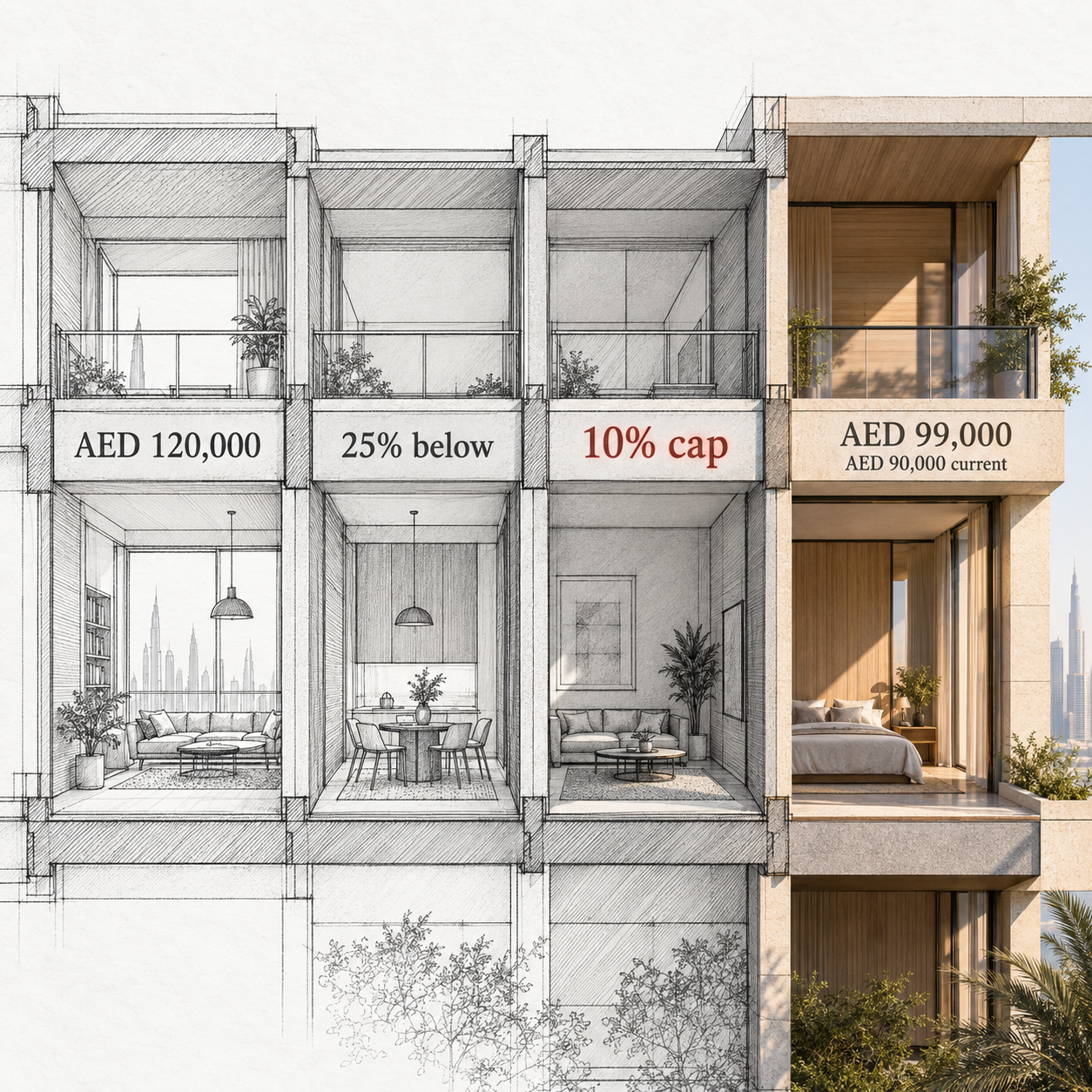
Dubai's renewal scale has five statutory maximum bands, 0%, 5%, 10%, 15% and 20%. In this transparent hypothetical, AED 90,000 against an assumed AED 120,000 index average is 25% below the average, which maps to a 10% cap and a maximum revised rent of AED 99,000, while the 90-day notice test remains separate (Decree No. 43 of 2013 and Law No. 33 of 2008, checked 25 September 2026).
Read the renewal as three separate tests
The clean answer is not one percentage. A renewal file has an index result, a statutory cap and a notice timeline. Each answers a different question.
The first two rows come from different official instruments. Dubai Land Department, or DLD, runs the Rental Index service. Decree No. 43 of 2013 supplies the maximum bands and says the average market rental rate is set according to the Rent Index approved by RERA, DLD's Real Estate Regulatory Agency. The notice rule comes from Article 14 of Law No. 33 of 2008. All were checked on 25 September 2026.
For the broad rule set, use the Dubai rent increase rules guide. This companion stays with the worked calculation.
What the live DLD calculator asks for
The current service asks for the contract end date, property type and current annual rent, plus a way to identify the relevant property. DLD's service procedure also names the area and room count. The live residential interface exposes an Ejari Contract Number or Municipality Number, with area-based fields elsewhere. Ejari is DLD's tenancy-registration system.
The live form was extracted at 2026-09-25T06:14:15Z. DLD's service page displayed “Site was last updated on 23 September 2026 - 07:09 AM” when checked on 25 September 2026. The live interface also required a CAPTCHA.
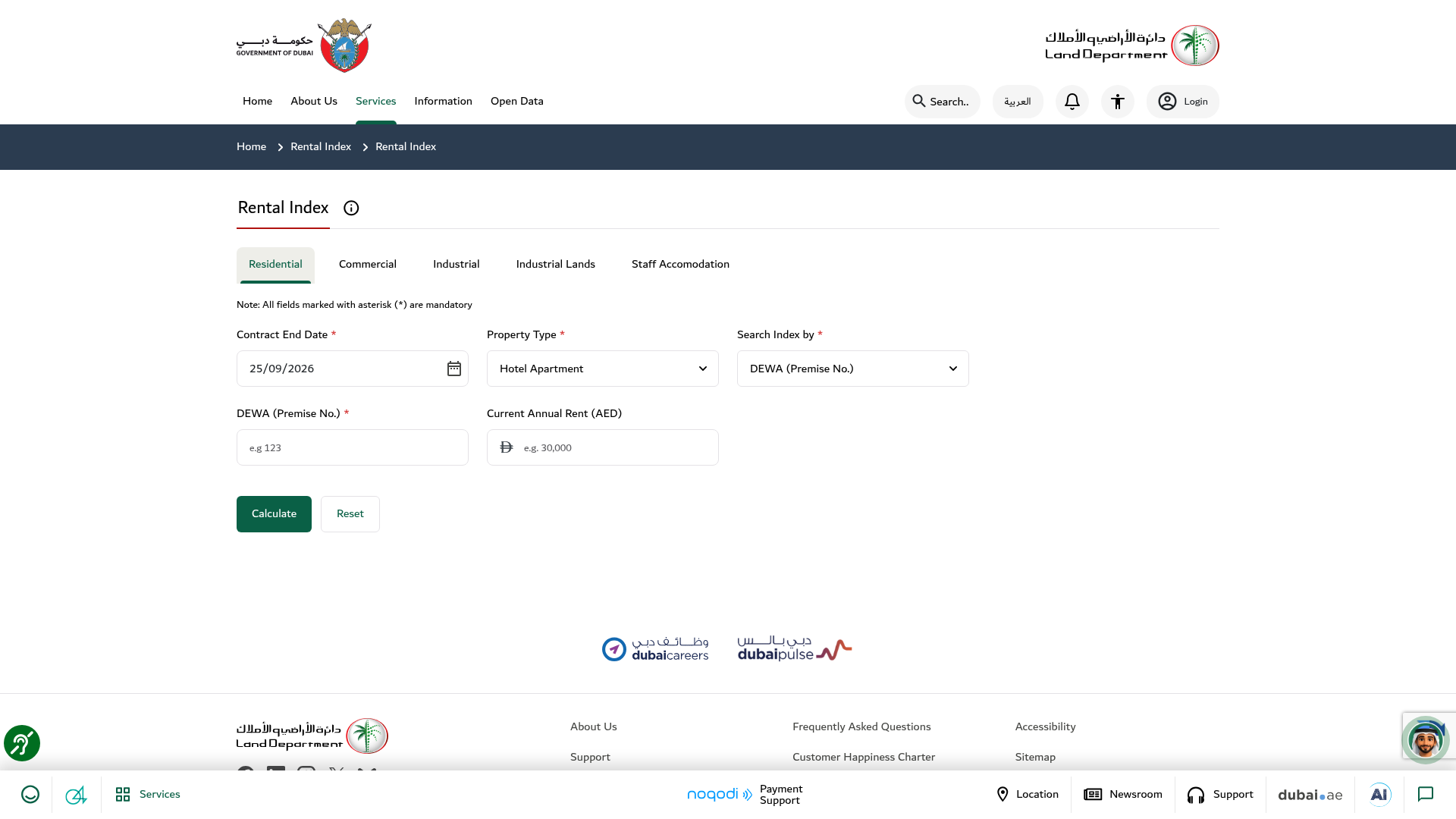
No valid Municipality Number, Ejari Contract Number or complete area record was used in this run, so the calculator did not return a result for a real tenancy. The worked example therefore assumes an index average of AED 120,000. It does not invent a property address, contract number, calculator certificate or transaction document.
The worked calculation reaches AED 99,000
The calculation has four stages, and each stage can be checked independently. DLD's own Decree 43 calculation sheet, fetched 25 September 2026, uses the same sequence: calculate the gap against the official average, identify the band, apply that band to current rent, then add the increase.
1. Calculate how far the current rent sits below the assumed average
The assumed index average is AED 120,000. The current annual rent is AED 90,000.
AED 120,000 minus AED 90,000 = AED 30,000.
Divide the AED 30,000 difference by the AED 120,000 average:
AED 30,000 ÷ AED 120,000 × 100 = 25%.
The denominator matters. DLD's published worked method divides the difference by the index average, not by the current rent, as checked 25 September 2026.
2. Map the 25% gap to the decree band
Decree No. 43 of 2013 sets five maximum bands. The table below reproduces the official thresholds checked on 25 September 2026.
Source: Decree No. 43 of 2013, Articles 1 and 3, checked 25 September 2026.
A 25% gap sits in the 21% to 30% row, so the maximum band in this hypothetical is 10%.
3. Apply 10% to the current rent
The band applies to the current AED 90,000 rent:
AED 90,000 × 10% = AED 9,000.
Add that increase to the current rent:
AED 90,000 + AED 9,000 = AED 99,000.
That is the worked maximum revised annual rent. It is not the assumed AED 120,000 index average, and it is not a direction to use that amount in an actual contract.
4. Compare the proposal with the worked maximum
The hypothetical proposal is AED 105,000. Against the current AED 90,000 rent, that is an AED 15,000 increase, or 16.67% rounded to two decimal places. The proposal is AED 6,000 above the worked AED 99,000 maximum.
The stage checks are therefore consistent: AED 30,000 gap, 25% below the average, 10% band, AED 9,000 maximum increase, AED 99,000 maximum revised rent. The full arithmetic was recomputed in code for this article on 25 September 2026.
Notice changes the contract process, not the arithmetic
The 90-day rule does not alter 25%, 10% or AED 99,000. It asks whether the proposed contract change was notified in time.
Article 14 of Law No. 33 of 2008 says that, unless the parties agreed otherwise, a party wishing to amend a lease term must notify the other party no less than 90 days before the lease expires. The law defines Notice as written notification sent through a notary public, registered mail, by hand or another technological means approved by law. This official text was checked 25 September 2026.
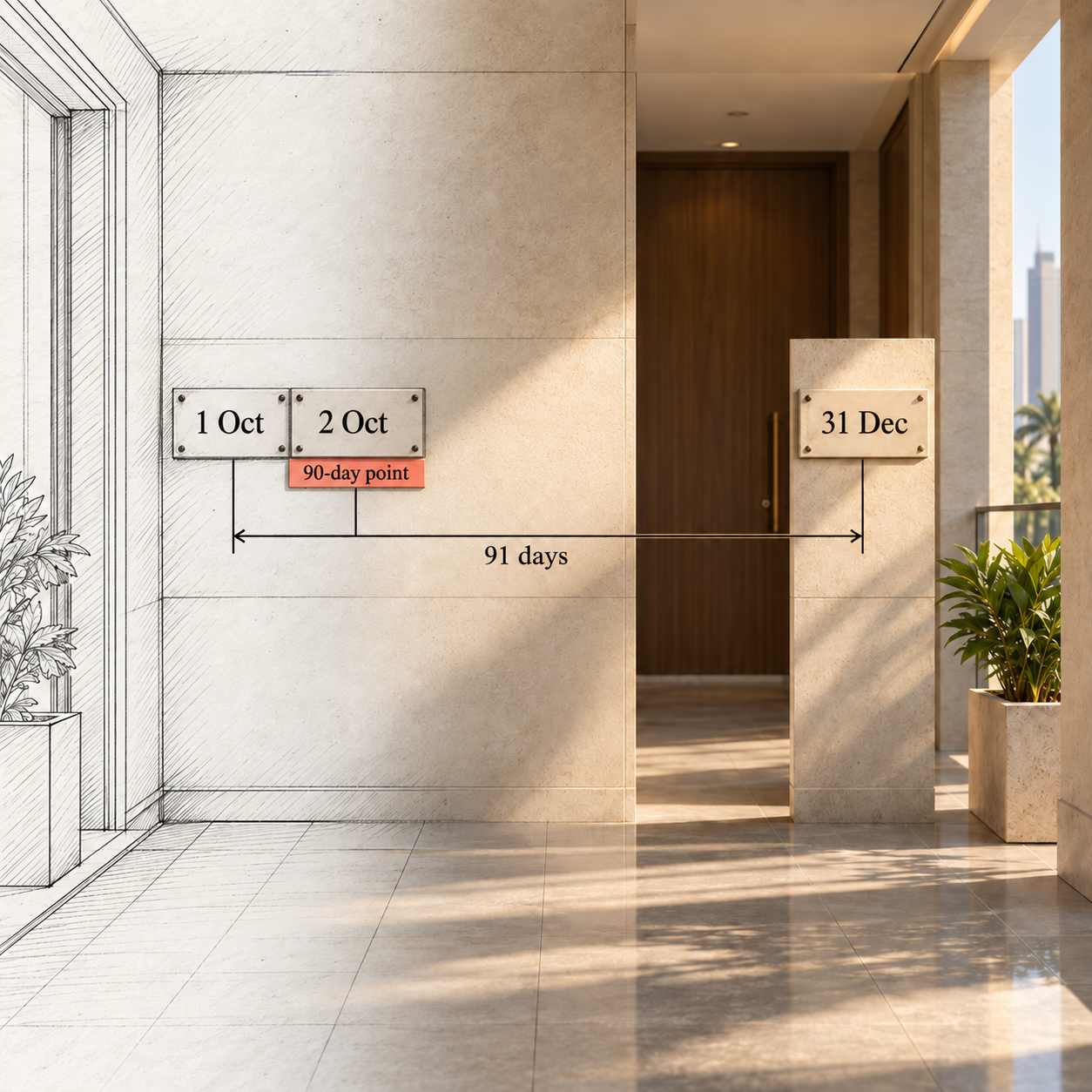
For the hypothetical 31 December 2026 expiry, the point 90 days before expiry is 2 October 2026. A notice dated 1 October is 91 days before expiry. A notice dated 3 October is 89 days before expiry. Those calculations establish timing only.
DLD's Smart Rent Index explanation, published 16 February 2025 and fetched 25 September 2026, also treats index eligibility and 90-day notice as separate conditions. It says an increase is not applied where the index shows eligibility but the landlord did not give the tenant at least 90 days' notice.
The index-date versus notice-date companion covers what each timestamp proves when calculator evidence changes between notice and renewal.
Keep one renewal file with all three tests
A readable renewal file preserves the calculator inputs, the band calculation and the notice evidence without treating one as a substitute for another. The steps below are an editorial record-keeping method, not an official statutory checklist.
Save the registered contract
Keep the Ejari-registered contract showing the current annual rent and exact expiry date. Do not infer either input from an informal message.
Capture every calculator input
Record the run date, contract end date, property type, search method, property identifier or area details, bedroom count where requested, and current annual rent. Save the full result rather than only its percentage.
Recompute the band
Subtract current rent from the displayed comparable average, divide by that average, and map the percentage to the Decree 43 table. Then apply the permitted band to current rent.
Keep the notice and delivery evidence
Retain the complete written notice and the evidence showing when and how it reached the other party. The legal definition of Notice and the 90-day timing rule are separate from the index calculation.
Compare like with like
If the parties hold different results, compare the contract end date, search method and property inputs first. A cropped output or a run for a different unit cannot explain the difference on its own.
RERA rent calculator FAQs, checked 25 September 2026
How much can rent increase under RERA rules?
Decree No. 43 of 2013 sets maximum bands of 0%, 5%, 10%, 15% and 20%, according to how far current rent sits below the RERA-approved index average. The applicable amount also depends on the actual index result and the separate contract and notice facts.
How do I check rent on the RERA calculator?
Open DLD's Rental Index service and enter the contract end date, property type, supported property lookup and current annual rent. The live residential surface checked 25 September 2026 exposed an Ejari Contract Number or Municipality Number, with area-based fields elsewhere.
Can a landlord increase rent after one year in Dubai?
One year by itself does not set the amount. The index result, the Decree 43 maximum band, the tenancy terms and Article 14's default 90-day notice test answer different parts of the renewal question.
What is the RERA rent calculator?
DLD describes its Rental Index as a service that calculates the rental increase and the average rent in the real-estate market for the required area. The service was checked 25 September 2026.
Lida MoghaddamArchitect-turned-real-estate-specialist based in Dubai. She helps buyers, sellers, and investors read property with a designer's eye — structure, location, and long-term value.