
Dubai tenancy deposit evidence checklist
 Lida Moghaddam
Disclaimer: This article is for general informational purposes only. It is based on cited public data and published under Lida Moghaddam's RERA-licensed masthead. It is not financial, legal, or investment advice. Dubai's property market moves quickly, so figures, yields, and rules may change or become outdated by the time you read this. Verify current information with the relevant authority or a qualified professional before acting. Read the full disclaimer.
Table of contents
Article 20 in Dubai Land Department's tenancy legislation guide says a landlord may take a security deposit for property maintenance and must refund the deposit or its remainder when the lease expires. As checked on 19 September 2026, the cited law sets no universal deposit percentage, so the useful record is the one that connects the agreed amount, the unit's condition and every handover step.
What the law establishes and what the contract supplies
The law gives the deposit file its basic questions: what condition was handed over, what changed, and what part of the deposit is in issue. In the DLD Tenancy Guide, accessed 19 September 2026, Article 15 says the landlord must hand over the property in good condition for the use stated in the lease. Article 20 permits a security deposit for maintenance at lease expiry and provides for refund of the deposit or its remainder. Article 21 says the property is surrendered in the condition in which it was received, except for ordinary wear and tear or damage beyond the tenant's control, and sends a dispute on that point to the Tribunal.
Those provisions do not state a universal deposit percentage or a fixed refund period. The signed tenancy contract and any signed addendum therefore matter for the facts the parties agreed: the deposit amount, payment recipient, inventory, cleaning or reinstatement language, maintenance allocation, inspection steps and any stated refund timing. The Dubai tenancy contract guide explains the wider contract structure.
This distinction keeps the file neutral. A receipt proves payment. A condition schedule records an observed condition. An invoice records work and price. None of those records decides by itself who is responsible. Together, they let the parties compare the contract, the statutory baseline and the history of the unit without relying on memory.
The seven-phase deposit evidence checklist
The practical file starts before money changes hands and ends only when the refund or claimed deduction is documented. Each item needs a clear link to the unit and lease, plus a copy held by the person who may need to rely on it later.
The table separates evidence type from conclusion. For example, a move-out photograph may show a mark, while the move-in schedule may show the same mark already existed. An invoice may show that work occurred, while the contract and the matched condition record help frame why the cost is being raised. That separation is useful to both tenant and landlord.
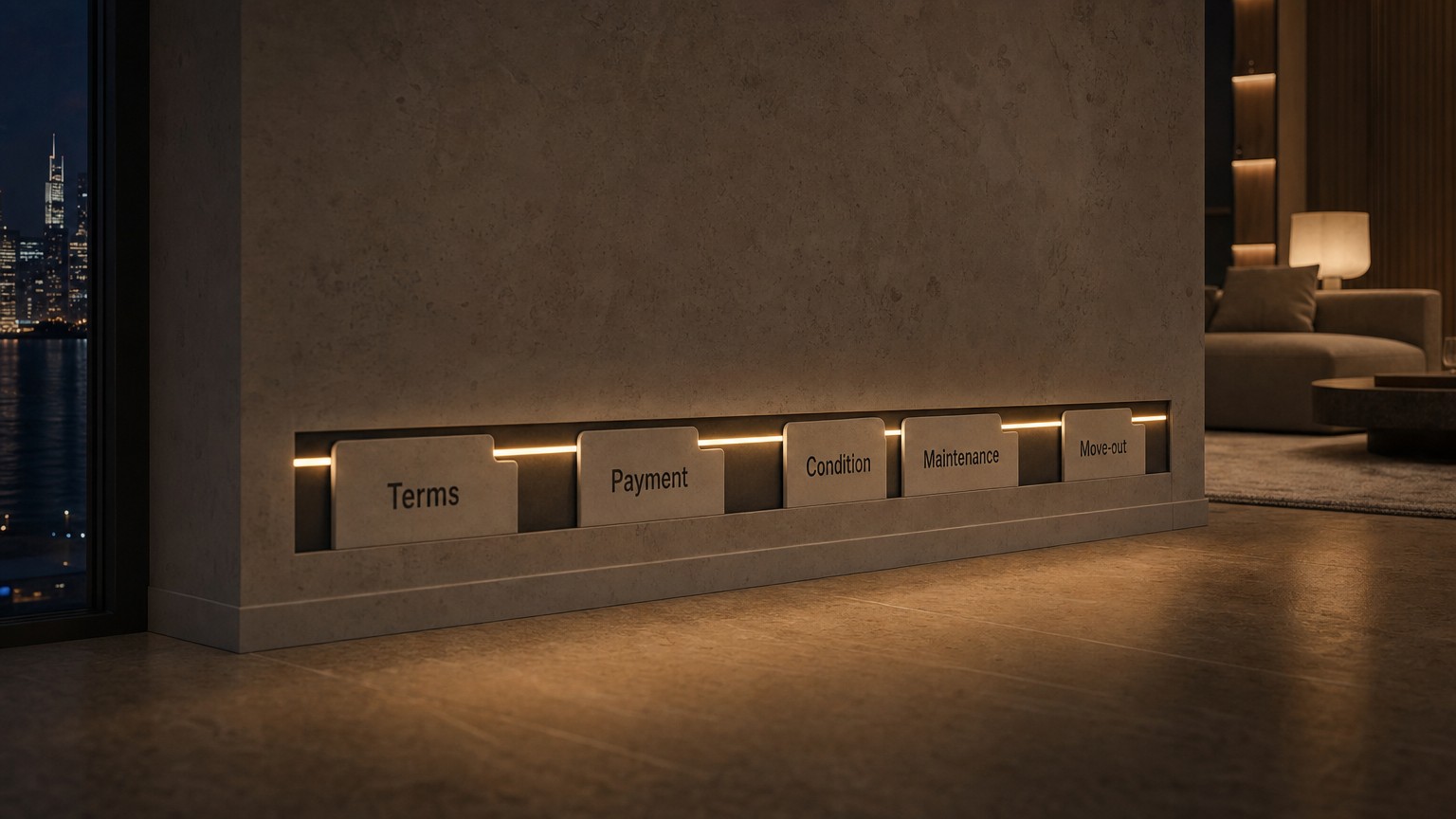
The contract and Ejari have different jobs
Ejari identifies the registered tenancy relationship, but it is not a substitute for a condition schedule. DLD describes its Register / Renew Tenancy Contract service as the registration or renewal of a tenancy contract and lists the issued document as an e-Contract Registration Certificate. Through the app, the required record includes a copy of the Unified Tenancy Contract; the trustee-centre route asks for the original contract and the applicant's identity evidence (DLD, accessed 19 September 2026).
The official Ejari templates page provides the Unified Ejari Tenancy Contract. In the evidence file, that contract and the Ejari certificate anchor the property, parties and lease period. A separate condition schedule can then carry details that the registration record is not designed to capture, such as a chipped tile, an appliance serial number, a wall mark or the number of access cards handed over.
A simple naming system keeps the connection visible. A folder can use the Ejari contract number or the unit and lease dates as its reference. Every receipt, inspection page and maintenance thread can repeat that reference. If an addendum changes a deposit-related term, retain the signed version with the contract rather than leaving the change only in a message thread.
At the end of the tenancy, the Ejari record has its own closure sequence. The companion guide to Ejari cancellation and the next tenancy record explains that official step. Cancellation evidence and deposit-condition evidence belong in the same move-out folder, but they prove different things.
Handover records work best as matched records
A matched inspection makes the comparison visible because move-in and move-out use the same room order, labels and viewpoints. A practical schedule starts with the entrance, then follows a fixed route through living areas, bedrooms, bathrooms, kitchen, balcony or terrace, storage and parking where applicable. Each line can record the item, observed condition, photo filename and whether the parties agree on the note.
The photographs become easier to interpret when they include one wide view for location and one close view for detail. The file index can identify the room and surface in plain language. Video can add context, but a long unindexed recording is harder to match to a later claim than named still images and a written schedule.
Both sides benefit from a clear handover acknowledgement. A signed page is one form. An email sharing the final schedule and image link, followed by a reply confirming receipt, is another factual record. The RDC FAQ, accessed 19 September 2026, says exchanged WhatsApp messages and email may be relied upon as evidence when the parties are questioned about and acknowledge the exchanged messages in the case record (RDC FAQ). That does not make every message decisive. It explains why a complete, reciprocal thread is more informative than an isolated screenshot.
Where the parties view an item differently, the schedule can record both positions. “Tenant notes existing wall mark; landlord response pending” preserves the factual gap. Rewriting the document as if agreement existed would remove exactly the point a later reviewer may need to see.
A worked hypothetical evidence timeline
The following example is illustrative. Its day markers are sequence labels, not statutory deadlines.
Day -7: terms and payment
The signed contract identifies the unit and deposit. The transfer reference repeats the unit and states “security deposit”. The recipient issues a matching receipt. Both records go into the same lease folder.
Day 0: keys and starting condition
The parties record the keys and access cards handed over, meter readings and a room-by-room schedule. A living-room wall mark and an appliance serial number receive matching photo filenames. Both parties receive the schedule.
Day +1: receipt of the file
The tenant sends the final inspection PDF and photo link in one message. The landlord or manager confirms receipt. If a point is disputed, the reply identifies the exact schedule line rather than rejecting the file generally.
Month 4: maintenance event
A maintenance request identifies the affected room, attaches a dated image and refers to the relevant contract clause. The reply, access record, completion note and any invoice remain in one thread. The deposit file now shows the condition before and after the work.
Notice stage: book the comparison
The notice and delivery record are stored with the contract end date. The parties exchange an inspection appointment and reuse the original room order and filenames for the move-out comparison.
Move-out day: record agreement and open points
The handover sheet records returned keys, final meter readings and the condition schedule. Agreed items are marked as agreed. Any open item carries both positions and the supporting filename.
Final account: refund or itemised claim
The refund transfer closes the file, or a written itemisation links each claimed amount to a contract term, condition comparison and supporting document. The response addresses those same items. If the records do not reconcile, the complete file is ready for the official process.
If the records do not reconcile
The neutral official route is the Rental Disputes Center, and its current services begin with documents rather than a general allegation. The RDC offers an amicable-settlement service within a legal framework, as well as a first-instance rental lawsuit service. The suitable route depends on the claim and facts; the official portal supplies the current classification and filing steps.
Before that stage, an itemised written exchange can show exactly what remains open: the amount sought, the contract term relied on, the relevant move-in and move-out entries, and the response. This is not a substitute for the RDC process. It creates a readable record of what the parties agree on and what they do not.
For amicable settlement, the RDC currently lists the latest lease or Ejari, identity evidence, the plaintiff's IBAN and supporting documents such as correspondence, notices, utility bills, cheques and letters. It requires documents to be in Arabic or legally translated into Arabic and uploaded through the RDC site (RDC amicable-settlement service, accessed 19 September 2026). Its first-instance rental service publishes the same core evidence categories (RDC first-instance service, accessed 19 September 2026).
As of 19 September 2026, the RDC publishes the filing fee for a monetary claim as 3.5% of the claimed amount, with a minimum of AED 500 and a maximum of AED 15,000. The amicable-settlement page also lists AED 100 for process service, AED 10 knowledge fee, AED 10 innovation fee, AED 25 to register a power of attorney when applicable, and an additional AED 130 plus VAT partner fee when filing through a Real Estate Services Trustee Centre. The same page says half of the court fee paid for basic claims is refunded if conciliation reaches a settlement. These are current service mechanics, not an estimate of a case result.
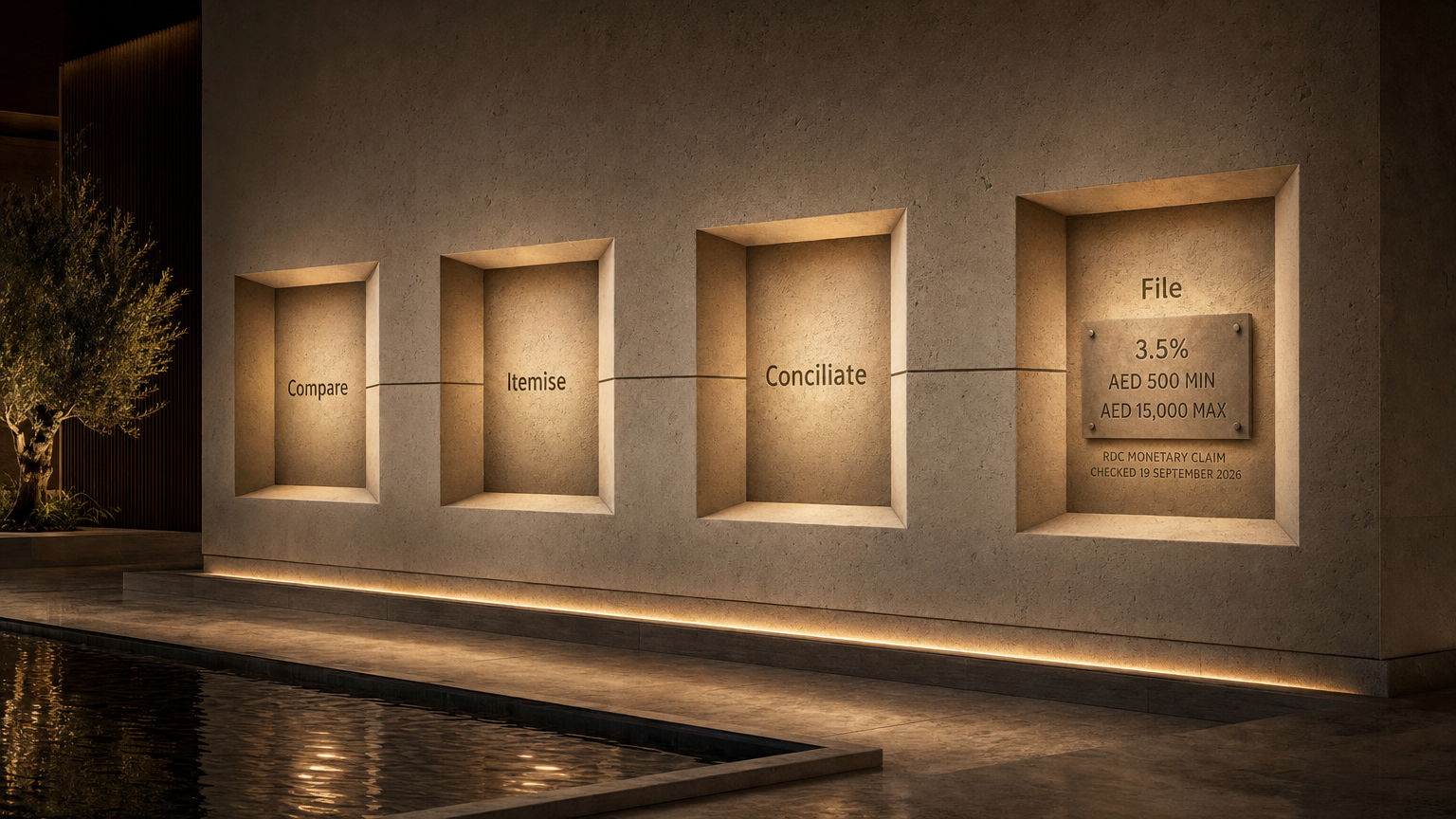
The point of the evidence checklist is not to predetermine the decision. It is to give each party, a conciliator or a tribunal the same traceable sequence: agreement, payment, starting condition, events during occupancy, ending condition and the final amount in issue.
FAQs, checked 19 September 2026
Is a security deposit refundable in Dubai property renting?
Article 20 in DLD's tenancy legislation guide provides for refund of the security deposit or its remainder when the lease expires. The contract, condition records and any supporting costs explain why the final amount may be disputed (DLD Tenancy Guide, accessed 19 September 2026).
How can I get my tenancy deposit back?
The factual route is to document payment, match move-in and move-out condition, record key return, and ask for a written refund or itemisation. If the parties cannot agree, the RDC publishes amicable-settlement and first-instance services with current filing requirements (RDC, accessed 19 September 2026).
How long does a landlord have to pay back a deposit?
Articles 20 and 21 in the cited DLD guide do not state a fixed number of days. Check any timing written into the signed contract and verify the current official process if the amount remains disputed (DLD Tenancy Guide, accessed 19 September 2026).
What are my rights when paying a deposit?
The official legal baseline addresses the deposit's maintenance purpose, refund of the deposit or remainder at lease expiry, and the property's return condition. The signed contract supplies the agreed amount and detailed terms, while the receipt proves the payment made for that tenancy (DLD Tenancy Guide, accessed 19 September 2026).
Lida MoghaddamArchitect-turned-real-estate-specialist based in Dubai. She helps buyers, sellers, and investors read property with a designer's eye — structure, location, and long-term value.